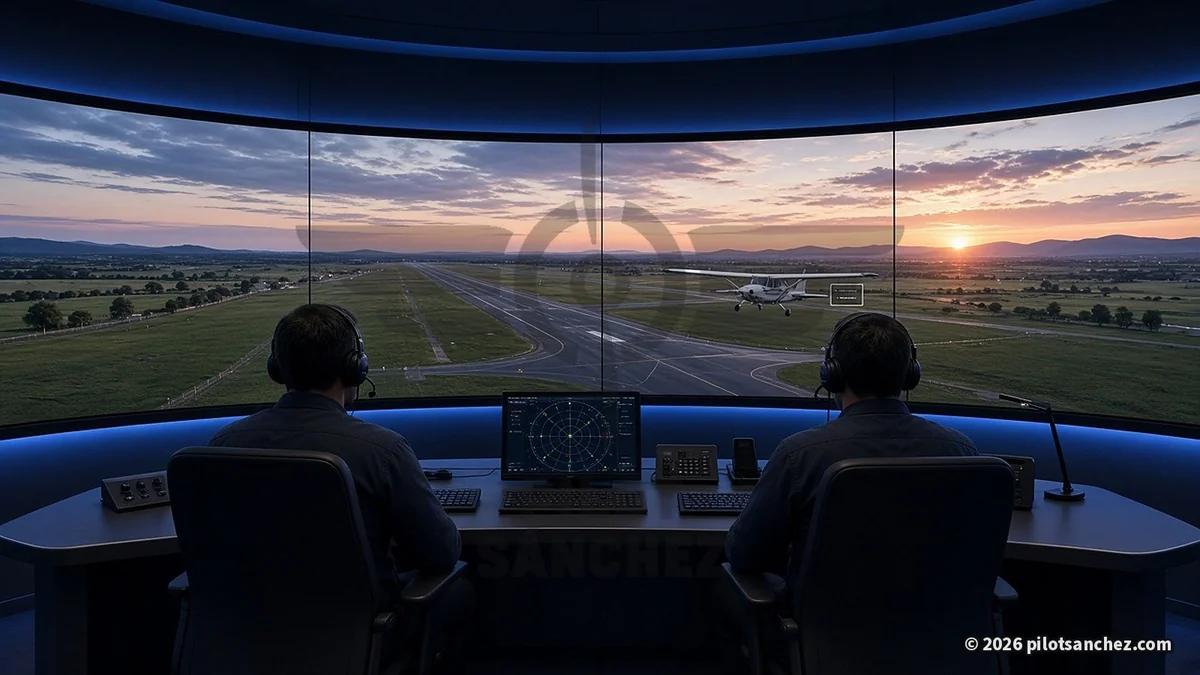
For a century, airport control towers have worked the same way: controllers in a glass room high above the field, looking out of the windows. On 6 November 2026 the US Federal Aviation Administration (FAA) announced that the country's first digital towers are operational at Bartow Executive Airport (KBOW) in Florida and Kenai Municipal Airport (PAEN) in Alaska. Controllers there watch the airfield on screens fed by cameras and sensors instead of through a window.
Europe has been doing this for more than a decade, and Spain has had its own trial running in Vigo since 2025. Here is what a digital tower is, where the technology stands on both sides of the Atlantic and what, if anything, changes when you call one on the radio.
What a Digital Tower Is
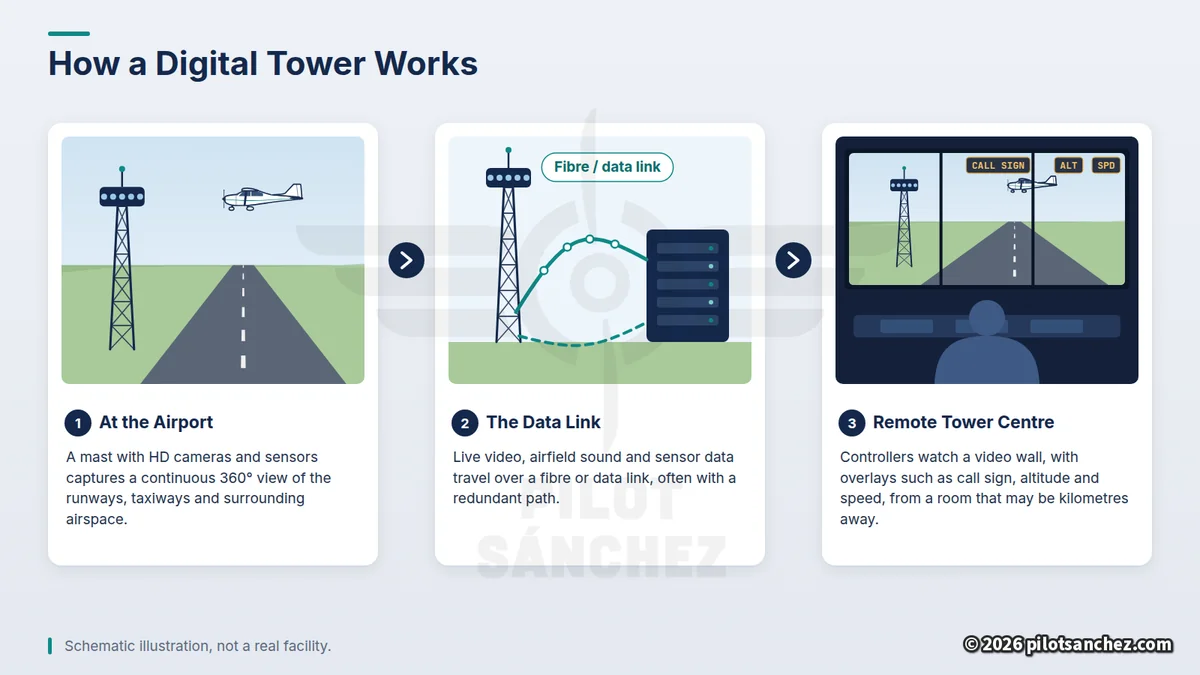
The FAA describes a digital tower as a "technology-enabled alternative to a traditional air traffic control tower". High-definition cameras, displays and sensors give controllers a continuous 360-degree view of the runways, taxiways and surrounding airspace, displayed on a video wall, and microphones pick up airfield sounds, which are played back in the control room. The systems can add tools a window cannot offer, such as automatic target detection, data tags on aircraft, infrared cameras and better low-light visibility.
The control room does not have to be at the airport. In Europe the same idea is usually called a remote tower, because the controllers can sit tens or hundreds of kilometres away and, in some cases, control more than one airport from a single remote tower centre.
The US Programme
- Approval. In September 2026 the FAA issued its first System Design Approval to the Frequentis smartVISION digital tower system, approved for what the FAA calls single-runway environments in Class D airspace. Bartow started using it that month.
- Who Pays and Who Controls. The approval covers sponsor-owned towers (the FAA calls Bartow a Non-Federal Control Tower), where the airport sponsor procures the system. The FAA says controllers "are still managing the airspace" and that the cameras give them more information for the job they already do.
- What Comes Next. Five more airports are due to get the technology: Winter Haven Regional and Venice Municipal in Florida, Montgomery County Airpark in Maryland, Johnston Regional in North Carolina and Durango-La Plata County in Colorado. AVweb reports that $50 million has been set aside for digital towers, which the FAA presents as a lower-cost way to bring tower services to smaller airports.
- An Earlier Attempt. AVweb also notes that a camera-based tower at Leesburg Executive Airport in Virginia began providing air traffic services in 2018. The FAA found it operationally viable in 2021, but ended the programme in June 2023 after the developer, Saab, withdrew from the approval process.
Europe Got There First
The world's first remotely controlled airport was Örnsköldsvik in Sweden. On 21 April 2015 the Swedish air navigation service provider LFV started controlling its traffic from a remote tower centre in Sundsvall, about 150 km away, with a system developed with Saab. Others followed:
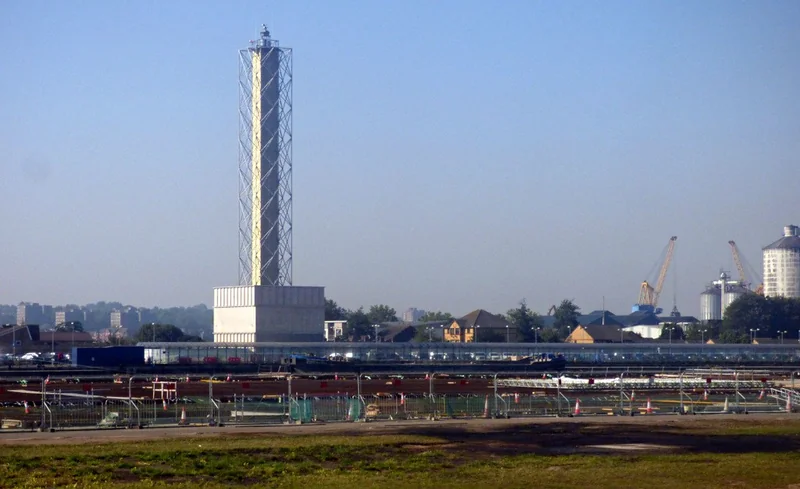
- United Kingdom. On 30 April 2021 London City became, in the words of NATS, "the first major international airport in the world to be fully controlled by a remote digital air traffic control tower". Sixteen cameras and sensors on a 50 m mast feed a control room at Swanwick, 115 km away, with call signs, altitude and speed overlaid on the live image.
- Norway. Avinor introduced its first digital tower at Røst in October 2019. Its centre in Bodø now handles 14 airports, which Avinor calls the world's largest digital tower centre, and in 2026 it trialled single controllers handling two airports at once, on four airport pairs.
- EASA Guidance. EASA publishes guidance material on remote aerodrome air traffic services. The current version, Issue 3, has applied since 1 April 2023 and covers single and multiple mode of operation, contingency planning and how airspace users should be informed.
And in Spain: Vigo
Spain's first digital tower started operating at Vigo airport on 17 June 2025, with AESA's approval. It is run by Saerco with Skyway-Searidge technology. According to Aena, the first flight it controlled was an Iberia departure to Madrid, followed by a private flight from Madrid-Cuatro Vientos.
The roll-out is gradual. In October 2026, La Voz de Galicia reported that the remote tower was still in a trial phase: two hours in the early morning and two in the afternoon, when traffic is light, only in visual meteorological conditions and with a second controller in the conventional tower ready to take over. The controllers' union USCA has repeatedly complained that, on the monitors, an aircraft a mile and a half out is just a dot, and that it is hard to tell an A320 from a light aircraft until it is very close. Aena is preparing to add automatic tracking to the two movable cameras so that they follow approaching aircraft on their own.
What Changes for You as a Pilot
Where a tower already existed, very little, and that is the point. EASA's guidance says that remote aerodrome air traffic services "should not negatively impact airspace users", and the FAA stresses that controllers still provide the same service. You fly the same circuit, call on the same frequency and follow the same clearances as in any controlled airspace. At the five airports due to get a digital tower, which have no tower today, the change is bigger: check the Chart Supplement for tower hours, airspace class and frequencies before you go. A few details are still worth knowing:
- Check the AIP. In Europe, EASA guidance says section AD 2.23 of each aerodrome's AIP entry should state that air traffic services are provided remotely and where the signalling lamp is, so light signals may come from a mast rather than from a tower building. Approach charts should also note that the service is remote, and the aerodrome chart should show the lamp. Make it part of your VFR preflight briefing.
- Say the Airport's Name. Where one controller handles several aerodromes at once, the AIP can require you to include the airport name or tower call sign in every transmission, not only the first one.
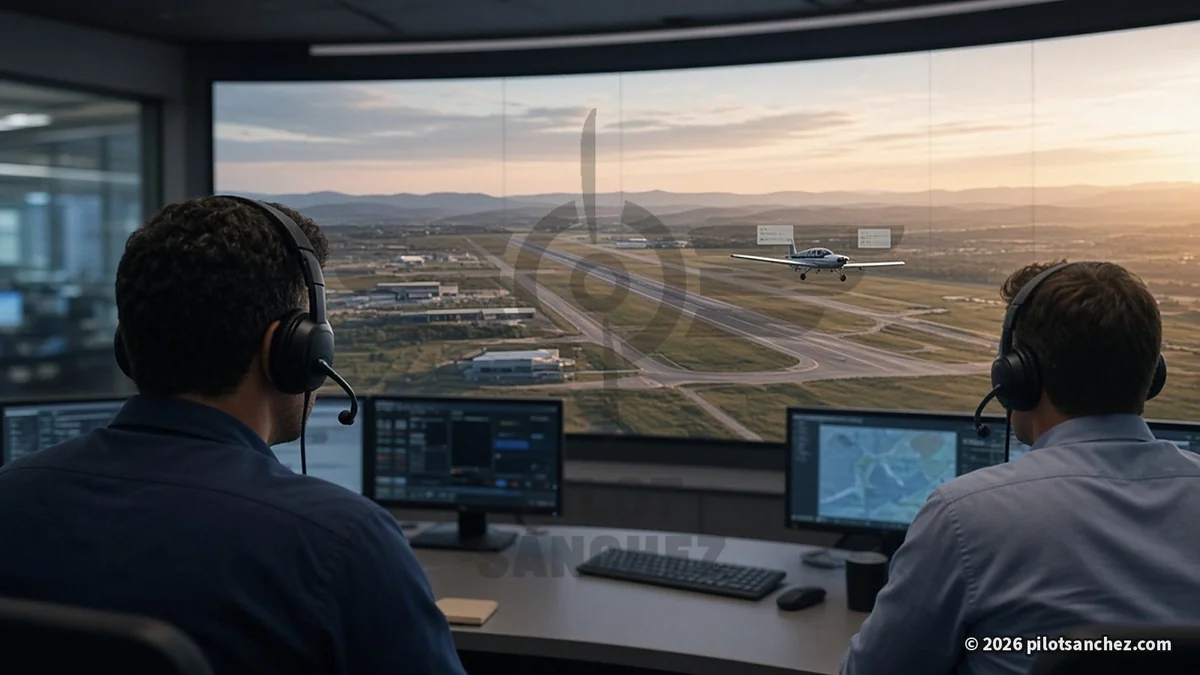
- Make Yourself Easy to Find. On a screen, a small aircraft far away can be hard to pick out, as the Vigo controllers point out. Accurate position reports and your lights on help the controller find you on the video wall; where the system shows data tags, a correctly set transponder helps too, whether the controller is looking through glass or at a screen. And as our post on the McMinnville midair collision shows, see-and-avoid remains your responsibility either way.
- Have a Plan B. EASA asks providers to publish contingency procedures and any interdependencies between airports served from the same centre, and it reminds pilots that choosing an alternate is still their responsibility. If you are planning a flight into a remotely controlled aerodrome, read what the AIP says about disruptions and keep an alternate in mind.
For a refresher on what Class D airspace around a towered airport means for a VFR flight, see our guide to airspace classes A to G.
Why It Matters
For many smaller airports a conventional tower is expensive to build and staff, and some never get one. Digital towers could bring air traffic services to places that would otherwise have none, and give controllers tools a conventional cab lacks, such as infrared and data overlaid on the live image. The open questions are image quality, which the Vigo controllers have raised, and reliability, including what happens when the link fails, which is why EASA asks for published contingency procedures. Leesburg shows that approval can stall even when the system works. The FAA's first two sites, and the five that follow, will add to the decade of experience Europe already has.
Sources
- FAA, "FAA Deploys First Digital Air Traffic Control Towers in Florida and Alaska", 6 November 2026
- FAA, Digital Towers (programme page and milestones)
- AVweb, "Digital Towers Operational at Two Airports", 6 November 2026
- Saab, "Sweden First in the World with Remotely Operated Air Traffic Management", 21 April 2015
- NATS, "London City is first major airport controlled by remote digital tower", 30 April 2021
- Avinor, Digital towers
- EASA, Easy Access Rules for Guidance Material on Remote Aerodrome Air Traffic Services (ED Decision 2023/005/R, Issue 3)
- Aena, "La primera torre de control digital de España comienza a operar en el Aeropuerto de Vigo", 17 June 2025
- La Voz de Galicia, "Aena afina la fiabilidad de las cámaras de la torre remota del aeropuerto de Vigo", 24 October 2026
Cover: AI-generated illustration of a digital tower room, not a real facility. Image: Pilot Sanchez.
