Ask a room full of student pilots what Class D means and you will get a confident answer. Ask what Class E means and the room goes quiet. That silence is worth fixing, because the airspace letter is not decoration on the chart: it tells you, in one character, whether you need a clearance, whether you need the radio, who ATC will keep you apart from, and how far you must stay from cloud.
This guide uses the European rulebook, the Standardised European Rules of the Air (SERA, Regulation (EU) No 923/2012), as the reference, and then points out where the US rules in 14 CFR Part 91 differ. The letters are the same on both sides of the Atlantic. Some of the details are not.
Shape versus class: CTR, TMA and ATZ are not classes
The first source of confusion is mixing up the structure of a piece of airspace with its class. SERA defines a control zone (CTR) as controlled airspace extending upwards from the surface, and a control area as controlled airspace extending upwards from a specified limit above the earth. A TMA is a type of control area, and an aerodrome traffic zone (ATZ) is simply "an airspace of defined dimensions established around an aerodrome for the protection of aerodrome traffic".
Those words describe the box. The letter describes the rules inside it. A CTR can carry any controlled class except E, which SERA rules out for control zones, and a TMA, which is a kind of control area, can carry any controlled class. When you read the chart, read both: the name tells you who to call, the class tells you what you need before you go in.
Under SERA, Classes A to E are controlled airspace and Classes F and G are uncontrolled. The Spanish AIP, for example, spells this out in ENR 1.4: controlled airspace (control areas, airways and control zones) is classified A, B, C, D or E, and the rest is F or G.
The seven classes at a glance
All of this comes from SERA.6001, seen from the VFR seat:
| Class | VFR allowed? | ATC clearance for VFR | What ATC gives a VFR flight | Two-way radio for VFR |
|---|---|---|---|---|
| A | No | — | — | — |
| B | Yes | Required | Separation from all other flights | Required |
| C | Yes | Required | Separation from IFR; traffic information on other VFR, avoidance advice on request | Required |
| D | Yes | Required | Traffic information on all other flights; avoidance advice on request (no separation) | Required |
| E | Yes | Not required | Traffic information as far as practical | Not required by the class |
| F | Yes | Not required | Flight information service if requested | Not required by the class |
| G | Yes | Not required | Flight information service if requested | Not required by the class |
Two more rules sit on top. In Classes C to G a speed limit of 250 kt IAS applies to VFR flights below 10,000 ft AMSL, unless the authority approves an exception for a type that cannot fly that slowly. And SERA.6001(b) makes all airspace above FL195 Class C, while SERA.5005(d) keeps VFR below FL195 except in specially established cases.
Class A and B
Class A is IFR only. The VMC minima table lists it "for guidance" only, and SERA says explicitly that this does not imply VFR flights are accepted there. Class B is the most protective class a VFR pilot can fly in: everyone needs a clearance and everyone is separated from everyone else.
Class C: separated from the airliners, not from each other
ATC separates you from IFR traffic. Other VFR aircraft are your problem: you get traffic information and, if you ask, avoidance advice. Clearance and continuous two-way radio are mandatory.
Class D: clearance yes, separation no
This is the class that catches people out. You need a clearance and continuous two-way communication, yet ATC does not separate VFR from anybody. You receive traffic information on all other flights and avoidance advice on request. In practice, that means you are still the one doing see-and-avoid while flying exactly where the controller told you to.
Class E: controlled, but not for you
Class E is controlled airspace, but the control is for IFR: IFR flights need a clearance and are separated from other IFR flights. A VFR flight needs no clearance and, under the class rules, no radio, and gets traffic information only "as far as is practical". You can be flying VFR at 1,500 m from a cloud while an IFR aircraft is cleared out of it. SERA also says Class E may not be used for control zones.
Class F and G: uncontrolled
No clearance, no separation, flight information service if you ask for it. SERA treats Class F as a temporary measure, to be replaced by another classification. Class G is what is left over: in Spain, for instance, the AIP classifies all the airspace of the Madrid, Barcelona and Canarias FIRs that is not otherwise designated as Class G.
RMZ and TMZ: the fine print on top of the letter
A class can be tightened locally. SERA.6005 lets an authority designate parts of E, F or G as a radio mandatory zone (RMZ). There, VFR flights must keep a continuous listening watch and talk as necessary, and before entering you make an initial call with the station name, call sign, aircraft type, position, level and intentions. A transponder mandatory zone (TMZ) requires every aircraft to carry and operate a Mode A/C or Mode S transponder. Both must be published in the AIP, so they show up on your chart and in your planning. You do not get to discover them in flight.
VMC minima: how far from cloud in each class
SERA.5001 sets the minima in Table S5-1. It is simpler than it looks:
| Altitude band | Classes | Flight visibility | Distance from cloud |
|---|---|---|---|
| At and above 10,000 ft AMSL | B–G | 8 km | 1,500 m horizontal, 1,000 ft vertical |
| Below 10,000 ft AMSL and above 3,000 ft AMSL or 1,000 ft above terrain (whichever is higher) | B–G | 5 km | 1,500 m horizontal, 1,000 ft vertical |
| At and below 3,000 ft AMSL or 1,000 ft above terrain (whichever is higher) | B–E | 5 km | 1,500 m horizontal, 1,000 ft vertical |
| Same low band | F, G | 5 km | Clear of cloud and with the surface in sight |
A few footnotes matter in real life:
- Where the transition altitude is below 10,000 ft, FL100 replaces 10,000 ft in the table.
- In the low band of F and G, the authority may allow flight visibility down to 1,500 m, for example for flights at 140 kt IAS or less. That is a national option, so check the AIP before you count on it.
- Taking off, landing or joining the circuit at an aerodrome inside a control zone needs a reported ceiling of at least 1,500 ft and ground visibility of at least 5 km, unless ATC clears you (SERA.5005(b)). Below that you are into special VFR territory.
- At night, SERA.5005(c) adds a 1,500 ft ceiling, removes the reduced-visibility options and requires continuous sight of the surface in the low band in every class from B to G.
If the numbers in a METAR or TAF are sitting right on these values, take that as a warning. The minima are the floor, not the target, and losing the horizon on a legal VFR day is a well-documented way to die.
Getting in: clearances and the radio call
For Classes B, C and D the clearance is the whole game. SERA.4001 says a flight plan must be submitted for any flight, or portion of a flight, that receives an ATC service. The same article explains that "flight plan" can mean limited information, for example to obtain a clearance for a minor portion of a flight or to take off from or land at a controlled aerodrome. If you pass it in flight, SERA.4001(d) says it should reach the ATS unit at least 10 minutes before you reach the entry point into a control area, unless the authority has set a shorter time for domestic VFR. Whatever the local practice, the habit is the same: call early, well before the boundary, with call sign, type, position, level and intentions.
Then listen to what comes back. The Norwegian CAA's VFR guide, published on EASA's site, puts it in one line: "STAND BY is not a clearance to enter controlled airspace." If you are not sure whether you have been cleared, ask. Remember too that a clearance from one unit does not automatically take you into the next unit's airspace.
Where airspace blocks meet, SERA's acceptable means of compliance say that flights at a common level between vertically adjoining classes follow the less restrictive class. The Spanish AIP adds a rule for one block sitting inside another: there the more restrictive class applies, except in VFR sectors and corridors. That is a good reminder that the national AIP fills in the gaps SERA leaves.
Flying in the US? Same letters, different details
The FAA uses the same letters (the US has no Class F), but the rules a VFR pilot meets are not identical:
- Class A starts at 18,000 ft MSL and goes up to FL600 (AIM 3-2), and VFR is not permitted.
- Class B needs an explicit clearance (14 CFR 91.131) and at least a private pilot certificate, unless a student, sport or recreational pilot has the required training and endorsements. The VFR cloud rule is just "clear of clouds" with 3 statute miles visibility.
- Class C and D do not require a clearance as such: you need two-way radio communication established before entry (91.130, 91.129). The AIM is precise about what counts. If the controller answers "(your call sign), standby", communication is established and you may enter. "Aircraft calling, standby" or "remain outside" means you may not.
- Cloud distances in 14 CFR 91.155 for Classes C, D and E below 10,000 ft MSL are 3 statute miles visibility, 500 ft below, 1,000 ft above and 2,000 ft horizontally. In Class G at 1,200 ft above the surface or less, by day, it is 1 statute mile and clear of clouds.
- Class E can reach the surface around airports in the US, and 91.155(c) and (d) then require a 1,000 ft ceiling and 3 miles of visibility to operate VFR there. SERA does not allow Class E for control zones.
- Equipment and speed: Classes A, B and C, and the 30 NM "Mode C veil" around the major Class B airports, require an altitude-reporting transponder (91.215) and ADS-B Out. Below 10,000 ft MSL the limit is 250 kt everywhere. It drops to 200 kt within 4 NM of the primary airport of Class C or D at or below 2,500 ft above the surface, and under a Class B shelf (91.117).
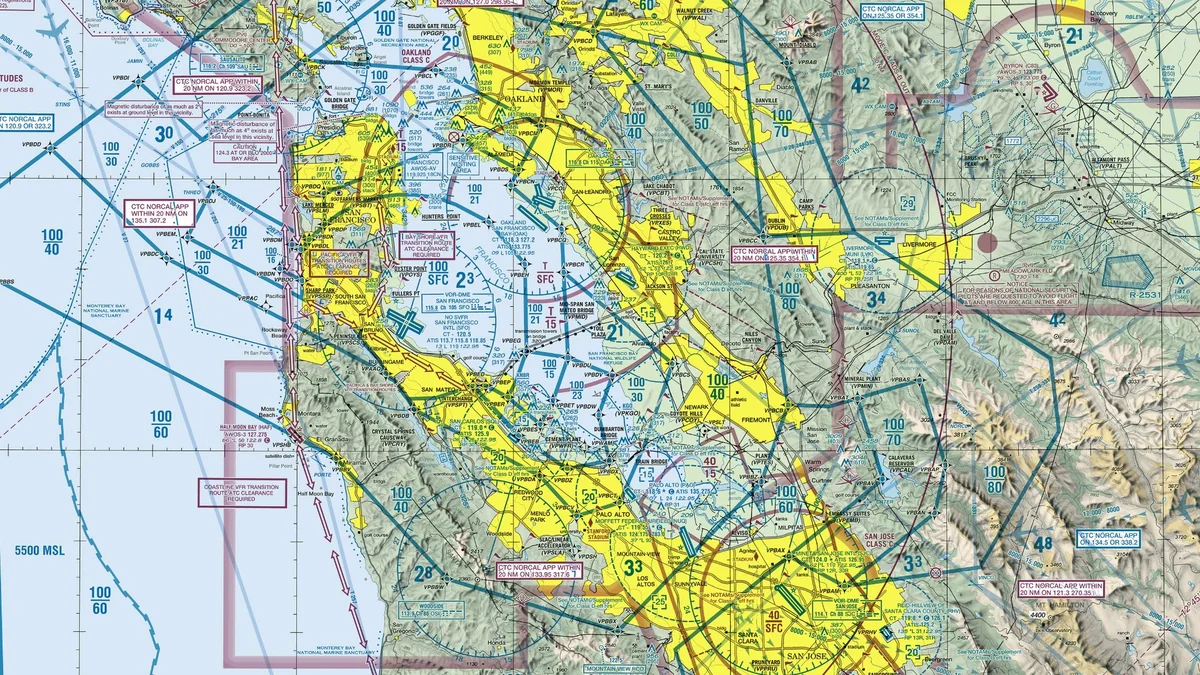
The cover image shows how this looks on a US chart. According to the FAA's Aeronautical Chart Users' Guide, Class B ceilings and floors appear in solid blue figures in hundreds of feet MSL, so "100 over SFC" is surface to 10,000 ft. Class C figures are magenta, and a "T" ceiling means "up to the floor of the Class B above". Class D is a blue dashed line.
Why it matters: airspace infringements
EASA says airspace infringements have "increased significantly over recent years", and its safety campaign is blunt about the consequence: unauthorised entry into controlled airspace increases the risk of an airprox or a mid-air collision with commercial traffic, and navigation errors are a major cause. The advice that comes out of it is practical:
- Plan every flight, even a local one. Check NOTAMs, weather and which restricted or danger areas will be active, and save the ATC and FIS frequencies you will need.
- Do not plan a track that grazes a boundary. A small navigation error is all it takes.
- Keep the transponder on, with your assigned code or 7000.
- If you realise you have infringed, keep squawking and call FIS or ATC straight away. Silence is the worst option.
- Debrief afterwards, report it and share what happened. That is how the rest of us learn why it happens.
A five-minute airspace check before you go
- Draw the route, whether in the Planner, a moving-map app or on paper, and list every airspace block the line passes through, with its class, base and top.
- For every B, C or D block, note the unit and frequency, the entry points and what you will say. Plan to call well before the boundary.
- Check for RMZs and TMZs along the way, and make sure the transponder works.
- Run the weather and NOTAMs in the Briefing, and compare the forecast visibility and cloud base with the VMC minima for each class you will fly through, not just the departure and destination.
- Decide your plan B now: the route that avoids controlled airspace if the clearance does not come.
Our guide to planning a flight with your aircraft on Pilot Sanchez covers how the rest of the preparation fits together.
FAQ
Is Class E controlled airspace?
Yes. Under SERA, Classes A to E are controlled. In Class E the control is provided to IFR flights only: VFR flights need no clearance and, unless the area is an RMZ or TMZ, the class itself does not require a radio or transponder. National rules in the AIP can still add equipment requirements.
Can I enter Class D in Europe once ATC has answered my call?
Not on that basis alone. SERA makes all flights in Class D subject to an ATC clearance. The US rule, where two-way communication is enough for Class C and D, does not carry over. Wait for the words "cleared" or "cleared to enter", and if in doubt, ask.
Cover: crop of the FAA San Francisco VFR Terminal Area Chart (edition effective 3 September 2026), U.S. Federal Aviation Administration. Public domain (work of the U.S. Government). Not for navigation.
Sources
- EASA, Easy Access Rules for Standardised European Rules of the Air (SERA), revision August 2025: SERA.4001, SERA.5001 (Table S5-1), SERA.5005, SERA.6001 with AMC1/GM1, SERA.6005 and the definitions in Article 2
- ENAIRE, AIP España ENR 1.4, ATS airspace classification and description (PDF)
- EASA, Airspace Infringement: safety promotion page and leaflet
- CAA Norway, VFR Guide for Norway (2016), hosted by EASA (PDF)
- 14 CFR Part 91: 91.117, 91.129, 91.130, 91.131, 91.155, 91.215 (eCFR)
- FAA, Aeronautical Information Manual, Chapter 3, Section 2: Controlled Airspace
- FAA, Aeronautical Chart Users' Guide
