On the afternoon of Thursday 29 October 2026, two helicopters collided in the air near McMinnville Municipal Airport in Oregon, about 35 miles (56 km) southwest of Portland. Both came down in a farm field next to Highway 233, southeast of the town. All three people on board were killed.
Our thoughts are with their families, their friends and the flight school community at McMinnville. This post sets out only what the authorities and the operator have confirmed. The cause has not been determined, and we won't guess at it. Further down we look at what the FAA's own guidance says about collision avoidance near an airport, because that applies to every pilot, whatever they fly.
What has been confirmed
- When and where: about 2:10 to 2:15 p.m. local time on 29 October, near McMinnville Municipal Airport (KMMV). The Yamhill County Sheriff's Office says the aircraft came down in a field near Lafayette Highway and Southeast Stringtown Road, a few miles from the airport.
- The aircraft: a Robinson R22 and an Airbus Helicopters AS350 (marketed today as the H125). The sheriff's office describes them as a 1995 R22 and a 2018 AS350B3. The NTSB's first statement refers to an AS350B2, so the exact variant should be taken as provisional until the preliminary report.
- The flights: according to the NTSB, the R22 was on an instructional flight and the Airbus was on a maintenance flight.
- The people on board: the sheriff's office says the R22 carried a flight instructor and a student pilot from the United Kingdom, and the Airbus carried only its pilot. The FAA's first statement had the occupants the other way round. The sheriff's office identified them later the same day, and its account fits the NTSB's description of the two flights.
- The operator: Jerry Trimble Helicopters, a flight school based at McMinnville, confirmed that one of its aircraft was involved and said it is cooperating with investigators.
- The investigation: the NTSB is leading it, with the FAA taking part.
Nothing official has been said yet about altitudes, flight paths, radio calls, weather or what either crew could see. Those are exactly the questions the investigation will answer, and the NTSB normally publishes a preliminary report within about a month. We will add an update to this post when it does.
A busy, non-towered airport
McMinnville has no control tower. Traffic coordinates itself on the common traffic advisory frequency (CTAF), 123.0 MHz. The airport's entry in the FAA Chart Supplement, as reproduced on AirNav, warns of frequent fixed-wing and rotary-wing training on and around the airport, including helicopter arrivals and departures from taxiways, and of glider operations from February to November.
That is not a criticism of anyone. It describes thousands of airfields around the world, including many in Spain and the rest of Europe, where aeroplanes, helicopters, gliders and microlights share the same sky without a controller. It does mean that the burden of seeing and being seen falls entirely on the pilots.
What the FAA says about seeing and avoiding
The FAA's advisory circular AC 90-48E, Pilots' Role in Collision Avoidance, is blunt: it says the number one cause of midair collisions is the failure to adhere to the see-and-avoid concept, and it quotes the NTSB's warning that the limitations of see-and-avoid leave "even the most diligent pilot vulnerable to the threat of a midair collision with an unseen aircraft". A few points from it are worth remembering every time we fly:
- It takes time to react. The AC's reaction-time table, based on US Naval Aviation Safety Center data, adds up to about 12.5 seconds from first seeing an object to the aircraft actually starting to move away. Refocusing from the panel to a distant aircraft alone takes 1 to 2 seconds.
- A collision threat doesn't move. An aircraft on a collision course stays in the same place on your windscreen and barely grows, then suddenly "blossoms" when it is very close. A bug smear can hide it.
- Scan in steps. The AC recommends short, regular eye movements of no more than 10 degrees, looking at each block of sky for at least one second. Move your head, not just your eyes, around door posts and other blind spots.
- The traffic pattern is where it happens. The AC notes that a significant number of midair collisions and near midair collisions occur in airport traffic patterns, towered and non-towered.
- Technology helps, but doesn't replace your eyes. It recommends anti-collision lights, traffic systems such as ADS-B In with a display, and keeping the transponder on in Class G airspace unless ATC says otherwise. It also warns that screens can pull your attention inside the cockpit.
Aeroplanes and helicopters at the same airfield
The FAA's AC 90-66C, Non-Towered Airport Flight Operations, reminds all pilots that rotorcraft may fly slower and approach at steeper angles than aeroplanes. It recommends that helicopters landing on the runway fly a pattern similar to the aeroplane one but lower, at about 500 ft above ground, and closer to the runway, sometimes on the opposite side if local procedures allow. Helicopters landing elsewhere should avoid the flow of fixed-wing traffic. During autorotation practice, expect very steep approaches with descent rates of 1,500 to 2,000 ft per minute.
For a fixed-wing pilot, the practical point is simple: at an airfield with helicopter training, traffic may be below your circuit, inside it, or arriving from a direction you don't expect. Listen to the radio picture before you join, and look for traffic where it might be, not only where you would fly.
The same rules in Europe
In EASA countries the Standardised European Rules of the Air (SERA) say the same thing in fewer words. SERA.3201 says an aircraft must not be operated so close to other aircraft as to create a collision hazard. SERA.3225 requires aircraft on or near an aerodrome to observe other aerodrome traffic to avoid collision and to conform with or avoid the traffic pattern formed by other aircraft. At most uncontrolled Spanish airfields, the only tools you have for that are your radio calls and your eyes.
Before your next flight
- Check the aerodrome information for helicopter, glider or parachuting activity, and read the NOTAMs. A good pre-flight briefing and our VFR preflight checklist help.
- Know the airspace you'll be in and who else may be using it.
- Make clear, standard position calls, and build a mental picture from everyone else's.
- Keep the windscreen clean, the lights and transponder on, and your eyes outside, especially when joining, on final and on departure.
Three people lost their lives in an ordinary afternoon of training and work flying. The investigation will tell us what happened. Until then, the most useful thing the rest of us can do is look out a little harder.
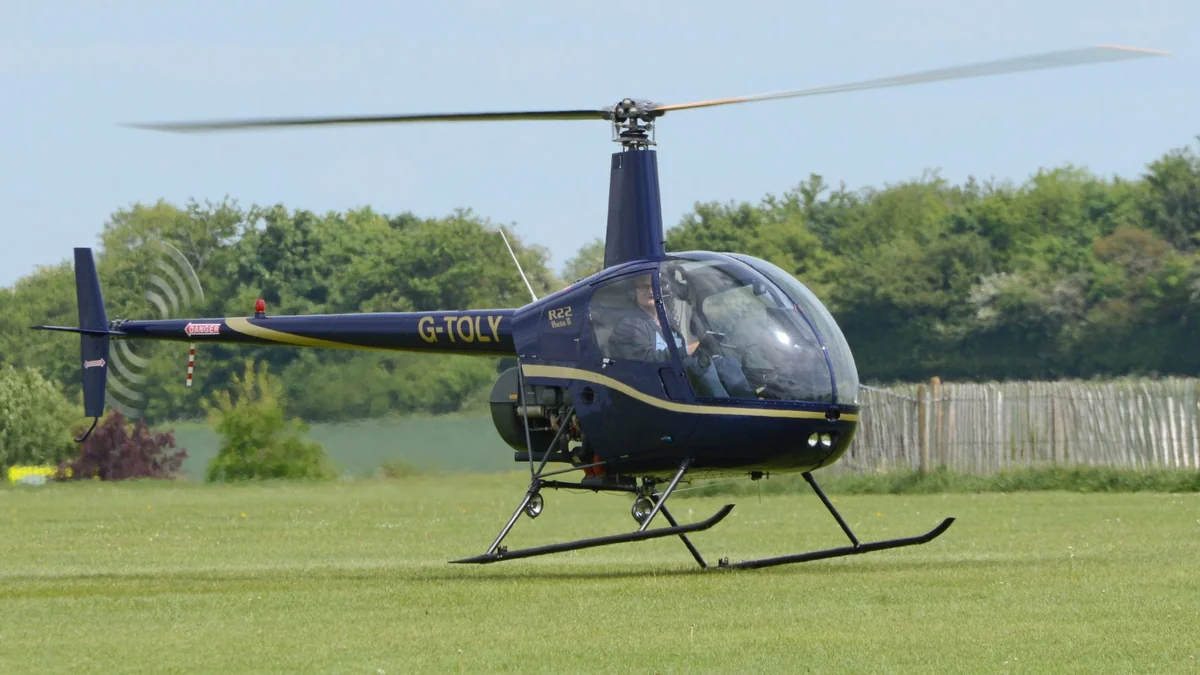
Cover: Robinson R22 Beta G-TOLY on a training flight at Sywell Aerodrome, UK, 2017. Photo: Alan Wilson, Wikimedia Commons, CC BY-SA 2.0, cropped. This aircraft has no connection with the McMinnville accident.
Sources
- FAA, Statements on Aviation Accidents and Incidents, entry for 29 October 2026
- OPB, "3 dead after two helicopters collide midair southeast of McMinnville", 30 October 2026 (quoting the Yamhill County Sheriff's Office)
- AVweb, "Three Killed in Oregon Helicopter Midair Collision"
- CBS News, "3 killed in midair collision involving 2 choppers near Oregon airport"
- BBC News, "Three dead after two helicopters collide midair near Oregon airport"
- AirNav, KMMV McMinnville Municipal Airport (FAA airport data and remarks)
- FAA, AC 90-48E, Pilots' Role in Collision Avoidance (PDF)
- FAA, AC 90-66C, Non-Towered Airport Flight Operations (PDF)
- Commission Implementing Regulation (EU) No 923/2012 (SERA), SERA.3201 and SERA.3225
