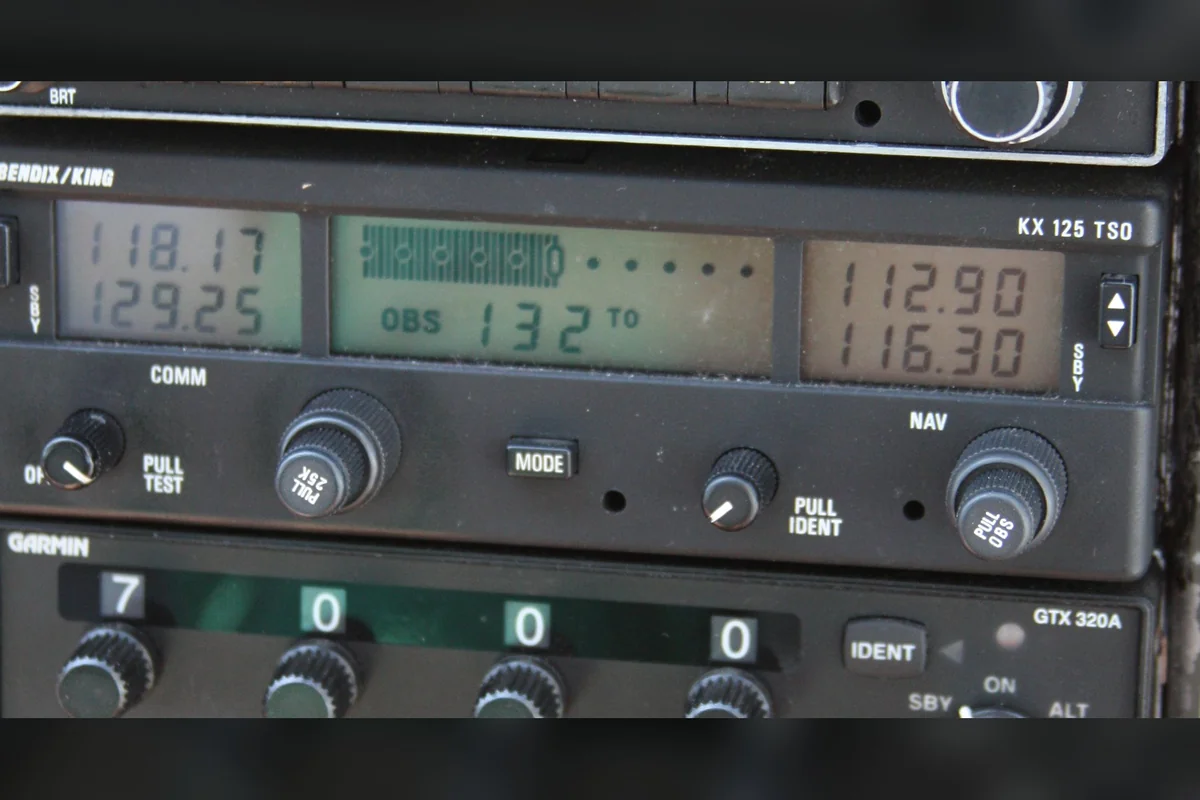
Four small knobs and a mode switch: the transponder is one of the simplest boxes in a light aircraft panel, and one of the most misunderstood. Student pilots learn "seven thousand" and "seven-seven-zero-zero", but the rules behind those numbers, the codes used on the other side of the Atlantic and the small habits that keep controllers from seeing a false emergency are rarely taught in one place. This guide covers what each common code means, what the European and American rules actually say, and how to use the box well on a VFR flight.
Why it is called "squawk"
The word comes from the Second World War. Early radar could detect an aircraft but not tell whether it was friendly, so the Allies fitted their aircraft with equipment that answered back when interrogated: Identification Friend or Foe, or IFF. In Britain the device was code-named "Parrot", and as The Conversation and AOPA both recount, the name did not last but the verb did. Today's civil transponder is the descendant of IFF, and air traffic control still tells you to "squawk" a code.
What the transponder actually sends
The transponder works with secondary surveillance radar (SSR). The ground station interrogates it, and it replies with information the radar cannot work out on its own:
- Mode A is the four-digit code you set. Each digit runs from 0 to 7, which gives 4,096 possible codes, as the FAA's Aeronautical Information Manual (AIM) 4-1-20 notes. Controllers read them digit by digit: 2102 is "two one zero two".
- Mode C adds your pressure altitude in 100 ft steps. That is the ALT position on most switches.
- Mode S transponders also send a unique aircraft address and your aircraft identification, which lets the controller see your call sign on the screen.
Two details matter here. First, the altitude encoder is set to standard pressure, so the altitude it sends does not depend on the QNH in your altimeter window. The ground system applies the local correction, as AIM 4-1-20 explains. A wrong QNH still matters, though, because you will be flying at a different altitude from the one you think. Second, under SERA.13015 a Mode S or ADS-B transmitter must send the aircraft identification in the flight plan or, when there is no flight plan, the aircraft registration. If you fly club or rental aircraft with Mode S, make sure the identification shown on the unit is the registration of the aircraft you are actually sitting in.
The basic rule: on, all the time
In Europe the Standardised European Rules of the Air are clear. SERA.13001 says that when an aircraft carries a serviceable SSR transponder, the pilot "shall operate the transponder at all times during flight, regardless of whether the aircraft is within or outside airspace where SSR is used for ATS purposes". SERA.13010 adds that if the aircraft has serviceable Mode C equipment, you operate it continuously unless ATC says otherwise. The only exemption is for aircraft without enough electrical power, such as many sailplanes, and it does not apply in airspace where a transponder is mandatory (a TMZ, explained in our guide to airspace classes).
The same article says you must not press IDENT unless ATS asks you to. IDENT makes your return stand out on the controller's screen for a few seconds, which is useful when it is requested and a distraction when it is not.
In the United States, AIM 4-1-20 says a transponder must be operated with altitude reporting whenever you are in controlled airspace and, if practicable, in uncontrolled airspace too. Aircraft with ADS-B Out must transmit at all times unless ATC asks otherwise.
Everyday codes for VFR flight
7000: the European VFR code
Under SERA.13005(b), when you are not receiving air traffic services you select 7000 "in order to improve the detection of suitably equipped aircraft unless otherwise prescribed by the competent authority". In practice this is the code for most VFR flying in EASA countries, including Spain, whenever no controller has given you a code. It is often called the conspicuity code: it does not mean anyone is watching you, but it makes you visible to radar and to other aircraft's collision-avoidance systems. The cover photo shows a Garmin GTX 320A set to exactly that code.
2000: no code assigned yet
The same article says that, in the absence of ATS instructions about code setting, the pilot selects 2000 or another code prescribed by the authority. In the UK, the CAA's Skyway Code describes 7000 as the VFR conspicuity code and 2000 as the IFR one.
1200: the American VFR code
In the United States the VFR code is 1200, not 7000. AIM 4-1-20 tells VFR pilots to squawk 1200 "regardless of altitude" unless an ATC facility instructs otherwise. The AIM also lists a few special VFR codes: 1202 for gliders, 1203 for the lead aircraft of a VFR formation not receiving ATC services, 1255 for firefighting aircraft not in contact with ATC, and 1277 for VFR search and rescue missions for the USAF or US Coast Guard. If you rent an aircraft in Florida after learning to fly in Europe, 1200 is the one to remember.
Assigned codes
When you ask for a flight information or radar service, or enter controlled airspace, the controller gives you a four-digit code, for example "squawk 4617". You read it back, set it, and keep it until you are told to change it. If a service ends and you haven't been told which code to select, ask rather than guess.
Listening squawks in the UK
The UK has a system worth knowing if you fly there: Frequency Monitoring Codes, usually called listening squawks. According to the UK AIP circular "The Use of Frequency Monitoring Codes in the United Kingdom Flight Information Regions", there are 27 of these codes. A pilot flying near controlled airspace who doesn't need a service selects the nearest unit's code to show that they are listening on its frequency, so the controller can call them quickly if they are about to infringe. The circular asks pilots to tune the frequency before selecting the code, use ALT, and go back to 7000 or 2000 before leaving the frequency. It also reminds pilots that the code is not a service and they remain responsible for their own navigation. The CAA's infringement tutorial suggests writing the relevant codes on your frequency card when you plan the flight.
The UK also uses 7004 for aerobatics. The CAA's Safety Sense leaflet on aerobatics says to set it five minutes before you start and make sure ALT is selected. Codes like these are national, so for any country you fly in, look them up in its AIP (normally section ENR 1.6) rather than assuming they apply everywhere.
The three emergency codes
SERA.13005(a) gives three codes for contingencies. They are the same worldwide and are worth knowing cold:
| Code | Meaning | What the rule says |
|---|---|---|
| 7700 | Emergency | Select it to indicate a state of emergency, unless ATC has already given you a code. Even then, you may select 7700 if you have a specific reason to think it is the best course of action. |
| 7600 | Radio failure | Select it to indicate a radio-communication failure. |
| 7500 | Unlawful interference | Attempt to select it to indicate unlawful interference (a hijack). If circumstances warrant, use 7700 instead. |
A few related rules are worth knowing:
- 7700 is a distress signal. Appendix 1 of SERA lists "setting of the transponder to Mode A Code 7700" among the distress signals, alongside MAYDAY on the radio. If you are already talking to a controller, keep the code they gave you unless switching helps. They already know where you are.
- Interception. Under SERA.11015, a civil aircraft that is intercepted must follow the interceptor's instructions, try to call on 121.5 MHz and, if it has a transponder, select 7700 unless ATS tells it otherwise.
- Radio failure on a VFR flight. SERA.14083 tells you to set 7600 and then, as a VFR flight, "continue to fly in visual meteorological conditions, land at the nearest suitable aerodrome, and report its arrival by the most expeditious means" to the appropriate ATS unit. If you are part of the traffic at a controlled aerodrome, keep a watch for instructions given by visual signals.
- Confirming 7500. EASA's guidance material says that if ATC asks you to confirm a 7500, you either confirm or don't reply at all. ATC will take silence as confirmation that the code was not selected by mistake.
Changing codes without a false alarm
On a transponder with four knobs, each digit changes on its own, so moving from one code to another can briefly pass through a code you don't want. AIM 4-1-20 gives the classic example: to change from 2700 to 7200, go to 2200 first and then 7200, not to 7700 and then 7200. Passing through 7500, or through any code in the 7600 or 7700 series, can set off a momentary alarm on the controller's screen. The habit is simple: plan the order of the digits so that none of those codes appears on the way.
The AIM also says that a civil pilot must never use 7777, which is reserved for military interceptor operations.
Mode C, your altimeter and "check altimeter setting"
When you first call a radar unit, give your exact altitude. AIM 4-1-20 asks for it to the nearest 100 ft, and under SERA.13010 the ATS unit verifies your Mode C readout on first contact. If the controller says your readout differs from what you reported, check your altimeter setting first. EASA's guidance describes what happens next if the difference persists: ATC may ask you to switch to another transponder if you have one, or to stop sending altitude while keeping your code.
If the transponder fails
Where a functioning transponder is mandatory, SERA.13020 covers failures. If it fails after departure, ATC will try to let you continue to your destination, although you may get restrictions. If it fails before departure and can't be fixed, you must tell ATS as soon as possible, preferably before filing a flight plan, put "N" under SSR in item 10 of the flight plan (or the letter for whatever capability remains) and follow any published procedure for an exemption. In practice, a VFR pilot whose route crosses a TMZ or controlled airspace with a transponder requirement should treat a dead transponder as a reason to replan.
A short transponder routine
- During the briefing: note the conspicuity code for the country, any listening squawks or TMZs along the route and the frequencies that go with them. Our VFR preflight briefing checklist covers the rest of the desk work.
- Before take-off: check the code and mode. In Europe the code is usually 7000 unless the tower has assigned one, and the mode should be ALT. On a Mode S unit, check that the identification is the registration.
- In flight: read back every assigned code, change digits in a safe order and press IDENT only when asked.
- When a service ends: select the code the controller gives you, usually the conspicuity code, and ask if you are not told.
- In an emergency: aviate, navigate, communicate. Then 7700, or 7600 for a radio failure, unless you are already working a controller who has you on their screen.
- After landing: follow the aerodrome's instructions. AIM 4-1-20 recommends keeping the transponder on while you are on the movement area and selecting standby or off only at the parking position.
Sources
- EASA, Easy Access Rules for Standardised European Rules of the Air (SERA), August 2025 edition: SERA.13001, SERA.13005, SERA.13010, SERA.13015, SERA.13020, SERA.11015, SERA.14083, Appendix 1 and related AMC and GM
- FAA, Aeronautical Information Manual, 4-1-20 Transponder and ADS-B Out Operation
- UK AIP circular, "The Use of Frequency Monitoring Codes in the United Kingdom Flight Information Regions" (PDF)
- UK CAA Infringement Tutorial, Frequency Monitoring Codes
- UK CAA, The Skyway Code (PDF)
- UK CAA, Safety Sense Leaflet: Aerobatics (PDF)
- The Conversation, "Curious Kids: what's the history of aircraft squawk codes and how do they work?"
- AOPA Flight Training, "What's all the squawking about?", August 2006
Cover: a Garmin GTX 320A transponder squawking 7000 in a Cessna 172. Photo by Bin im Garten, Wikimedia Commons, CC BY-SA 3.0, padded to 3:2.
