On 26 October 2026 the European Union Aviation Safety Agency (EASA) published its Annual Safety Review 2026, the yearly look at accidents and serious incidents in European aviation. This edition covers 2025 and compares it with the ten years before. For the first time it comes with a six-page summary that puts the headline figures for airlines, helicopters and general aviation side by side.
Most headlines will focus on airlines. For those of us who fly light aeroplanes, the interesting part is the chapter on non-commercial flying with small aeroplanes, and the news there is mostly good. The causes of the accidents that still kill people, though, are the same ones we read about every year.
What the review covers
The general aviation figures come from the section on non-commercial operations with aeroplanes other than complex aeroplanes. In plain words: private, club and training flying in aeroplanes registered in an EASA Member State, under 5,700 kg and without jet engines or more than one turboprop. That includes certified small aeroplanes, Light Sport Aeroplanes (LSA) and Very Light Aeroplanes (VLA). Microlights and ultralights fall outside EASA's rules and get their own short section.
2025 in numbers
| Non-commercial small aeroplanes | 2025 | Compared with 2015 to 2024 |
|---|---|---|
| Fatal accidents | 21 | 18% below the yearly average |
| Non-fatal accidents | 135 | 19% below the yearly average |
| Serious incidents | 31 | 54% below the yearly average |
| Fatalities | 40 | 21% below the yearly average (range 34 to 75) |
| Serious injuries | 16 | Lowest total from 2015 to 2025 |
Compared with 2024, fatal accidents fell from 25 to 21 and fatalities from 44 to 40. Over the decade, fatal accidents have ranged from 18 to 38 a year, with the worst year in 2018. So 2025 was a good year, but not an exceptional one, and one good year is not yet a trend.
Where the flying happens, the accidents happen. Pleasure flights account for the largest share, with 87 accidents and serious incidents in 2025 against a ten-year average of 119.5, followed by training and instructional flights with 70 against 89.1. Accidents also follow the seasons: in each of the last three years the numbers climbed in spring and summer, and in 2025 the peak month was June, with 22.
Most accidents are survivable, but not all
The review groups each event into ICAO occurrence categories. Across all 2025 accidents and serious incidents in this group, the most common were:
- Abnormal runway contact (hard or bounced landings, nose-gear collapses and similar): 51
- System or component failure other than the engine: 28
- Runway excursion: 27
- Engine failure or malfunction: 26
EASA notes that these are mostly non-fatal: hard landings, excursions in crosswind and technical failures that the occupants walk away from. Near mid-air collisions and airprox events (13) showed up mainly among the serious incidents, during circuit approaches and at uncontrolled aerodromes.
The fatal accidents tell a different story. For 2025, the largest category is still "unknown" (10 of 21), simply because those investigations aren't finished. Looking at the five previous years, the picture is clear: loss of control in flight was involved in 58 of the 129 fatal accidents from 2020 to 2024, which the review links to stalls, spins and departures from controlled flight too low to recover. Post-impact fire (29), controlled flight into terrain (16) and low-altitude operations (11) follow. In EASA's words, the fatality risk "remains concentrated in loss of control in-flight and controlled flight-into-terrain."
The risks EASA ranks highest
Separately, EASA scores the potential outcome of almost 20,000 reported occurrences from 2023 to 2025, asking what each one could have turned into. For small non-commercial aeroplanes the ranking is:
- Aircraft upset (loss of control): the most occurrences and the highest overall risk score.
- Terrain collision: fewer occurrences, but a high risk per occurrence.
- Airborne collision
- Excursion
- Obstacle collision in flight
For general aviation aeroplanes and helicopters, EASA's related Top Safety Topics are inadvertent entry into IMC and mid-air collision.
Beyond small aeroplanes
- Microlights: the trend went the other way. Fatal accidents involving non-commercially operated microlights rose to 34 in 2025 from 22 in 2024, and fatalities to 48 from 32. Both remain below the decade's worst year (2015).
- Sailplanes: 15 fatal accidents and 16 fatalities, slightly below the ten-year middle values. Loss of control was associated with 9 of the 15 fatal accidents.
- Balloons: one fatal accident; hard landings remained the most frequent type of occurrence.
- Non-commercial helicopters: 6 fatal accidents and 14 fatalities, above the ten-year middle values of 4 and 6. A mid-air collision between two helicopters caused five of those deaths.
What it means for your next flight
The review doesn't give individual advice, but its figures point to the same few habits that keep coming up in accident reports:
- Protect your margin above the stall, especially low and slow in the circuit, on go-arounds and after an engine problem. That is where loss of control turns fatal. Our posts on flying behind the power curve and plan continuation bias cover two of the routes into it.
- Treat deteriorating weather as a decision point, not an obstacle. Inadvertent IMC is one of EASA's Top Safety Topics for a reason. Check the forecast properly before you go, for example with a weather briefing and our VFR preflight checklist, and decide in advance where you will turn back. The JFK Jr. accident shows how quickly a legal VFR flight can lose its horizon.
- Look out and talk in the circuit. Airprox events concentrated at uncontrolled aerodromes. Make your position calls, keep your eyes outside, and know the airspace you are in.
- Practise landings, especially in crosswind. Abnormal runway contact and runway excursions rarely kill, but they remain the most common way a light aeroplane gets damaged.
Fewer accidents in 2025 is good news. But 40 people still died in light aeroplanes registered in EASA countries, and the reasons are well known. The full review is worth an hour of any pilot's time, and the six-page summary is worth ten minutes.
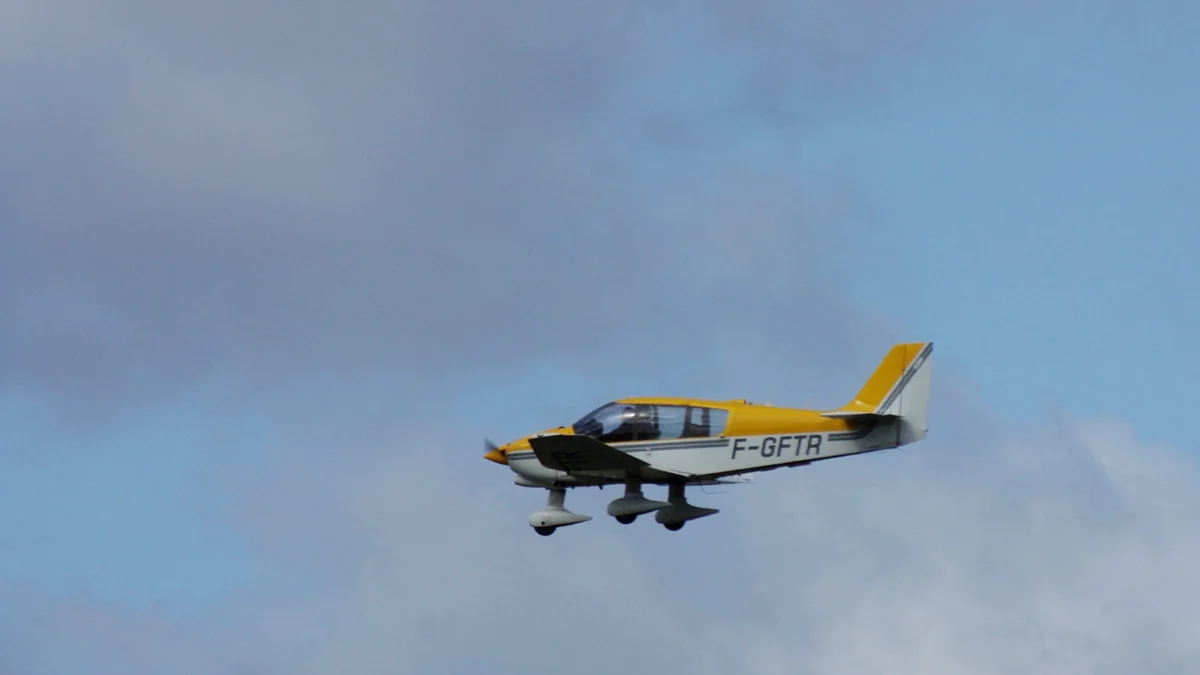
Cover: Robin DR400 F-GFTR on approach at Tours, France. Photo: Duch, Wikimedia Commons, CC BY-SA 4.0, cropped. The aircraft is not connected with any occurrence in the review.
