Full power, nose up, and the aeroplane still won't climb. Many pilots who have lived through that moment blamed the engine. France's accident investigation authority, the BEA, says that in a worrying number of accidents the engine was fine and the problem was the wing: the aeroplane had slowed into what French instructors call the second régime de vol, the "second regime of flight". English-speaking pilots know it as the region of reversed command, or flying behind the power curve.
In October 2026 the BEA published a safety study on exactly this. It looks at light-aircraft accidents it investigated between 2019 and 2025, explains why pilots end up behind the power curve without noticing, and suggests that the way the subject is taught falls short of the situations where it actually kills. FlightGlobal picked it up on 20 October. Here is what the study says.
The numbers
According to the study, about twenty of the light-aircraft accidents the BEA investigated from 2019 to 2025 are attributed, probably or for certain, to prolonged flight in the second regime. That is only 4% of accidents involving aeroplanes under 2.25 tonnes maximum take-off mass in France over the period, but 15% of the fatal accidents and 21% of the victims in that category.
The study's own sample is 20 accidents, all in general aviation, 12 of them fatal:
- 8 during flights in mountainous terrain;
- 7 during take-off or just after;
- 5 after an interrupted approach or landing (a go-around).
The BEA's web summary counts the cases slightly differently (21 accidents, 11 fatal, 30 people killed and 11 seriously injured), but the picture is the same: rare accidents, very often deadly.
The most telling finding is about awareness. Surviving pilots often did not realise the aeroplane was flying at a high angle of attack in the second regime, so they never tried to recover. Many interpreted what they felt as "a lack of engine power and an inability of the aeroplane to climb". The BEA thinks the same is likely true of the fatal accidents.
A quick refresher: what "behind the power curve" means
Drag has two parts. Parasite drag grows as you go faster. Induced drag, the price of making lift, grows as you go slower, because the wing needs more angle of attack. Add them up and the power needed to hold level flight is high at very low speed, lowest somewhere in the middle, and high again at high speed. The difference between the power the engine and propeller can deliver and the power required is the excess power, and that is what lets you climb or accelerate.
The BEA uses a simple definition for a piston aeroplane: the boundary between the two regimes is the point of maximum excess power, which corresponds to Vy, the best rate-of-climb speed.
- Faster than that (first regime): if speed drops a little, excess power grows and the aeroplane tends to accelerate back to its trimmed speed. Raising the nose in a climb gives you a better climb rate.
- Slower than that (second regime): if speed drops, excess power shrinks and the speed keeps decaying unless the pilot acts. Raising the nose now gives a worse climb rate, the opposite of what your hands expect. Below the speed where the climb rate reaches zero, there is no excess power left to accelerate in level flight at all.
Excess power shrinks as density altitude rises, as the aeroplane gets heavier, and it depends on the engine's maximum power. That is why the same aeroplane that climbs happily in winter, solo, can barely climb on a hot day with four people on board. We covered the hot-weather side in our guide to density altitude.
How to recognise it
The study lists the "symptoms" of flight in the second regime:
- a high angle of attack, visible as a nose attitude unusually high compared with the attitudes you normally set;
- difficulty, or inability, climbing or even holding level despite climb attitude and climb power;
- controls that feel soft and ineffective, with light stick forces;
- stronger secondary effects of the controls, and stronger engine effects;
- reduced stability around all three axes.
And the line every pilot should remember: unlike the approach to a stall, the aeroplane "may seem stable and 'slide' along without buffeting, masking the urgency of the situation". There is no shaking and maybe no stall warning yet, just an aeroplane that refuses to go up.
The way out
Getting out is a matter of trading energy. If there is power in reserve, add it and let the aeroplane accelerate. If there is height in reserve, lower the nose and use some of it to gain speed. Once you are back above the second regime, the aeroplane can climb again.
The hard part is the case the BEA singles out: when full power is already set and excess power is zero or negative, "the only solution to leave the second regime is to lower the attitude to accelerate". Close to the ground or close to rising terrain, that feels like the wrong thing to do, which is why these accidents happen where they do. The FAA's Airplane Flying Handbook describes the same move: on the backside of the power curve, pushing forward produces a brief energy-exchange descent that brings the aeroplane back to a speed where it has excess power again.
Scenario 1: climbing up a mountain valley
In all eight mountain accidents, the aeroplane was climbing between ridges or along a valley, with the pilot trying to gain enough height to cross a pass or a ridge line. Six were fatal. The BEA describes a pattern that repeats:
- A light aeroplane climbs at a gradient of roughly 5 to 10%. The valley floor often rises as steeply or more, and it steepens sharply near the pass. The study gives an example: 500 ft/min at 80 kt groundspeed is a gradient of about 6%, while a winding mountain road is usually steeper than 12%.
- There is no natural horizon. Facing rising ground, the pilot tends to raise the nose gradually, without realising it. Speed bleeds off and the aeroplane slides into the second regime, sometimes with a brief, misleading rise in vertical speed.
- An untrained pilot naturally flies down the middle of the valley, which leaves no room to turn back. The turn should be made from one side of the valley, early, while there is still height and energy to spare.
In every mountain case the BEA studied, the height on entering the valley was not enough to cross the pass with a safe margin on the chosen path, often a direct one. Four of the eight happened in summer heat, and six of the eight investigations found the pilot lacked mountain-flying knowledge, with little or no overall or recent mountain experience. Most happened in good weather.
The study also quotes two rules of thumb used by mountain pilots. A normally aspirated piston engine loses about 10% of its power per 3,000 ft, but the overall loss in climb performance is larger, around 5 to 7% per 1,000 ft. Its example: climbing through 3,000 ft at 34 °C puts you at a density altitude of about 6,000 ft, with a climb rate roughly 50% lower than at sea level in standard conditions.
Scenario 2: the take-off and the go-around
Twelve of the accidents, six of them fatal, happened on take-off or after a go-around. The BEA's explanation starts with something every student pilot does: rotation. On a light aeroplane, the rotation speed already sits in the second regime. Just after lift-off, ground effect temporarily reduces induced drag; above a height of about one wingspan, it disappears and the high angle of attack costs a lot of drag. After rotating, the pilot has to set an attitude that lets the engine accelerate the aeroplane to the chosen climb speed.
According to the study, staying in the second regime after take-off usually comes from one or more of these:
- too much nose-up attitude, or pitching up too fast, after rotation, so the speed decays;
- rotating below the published rotation speed, when excess power may be zero or negative and won't allow acceleration to climb speed;
- flying with too little excess power for the day: high density altitude, a heavy aeroplane, a short or soft or upsloping runway.
In ten of the twelve cases, performance was degraded by one or more of those factors and was lower than the pilot expected. Most involved aeroplanes with a relatively high weight-to-power ratio, so little excess power to begin with. The BEA's web page adds that four of the take-off accidents happened with the aeroplane near, or beyond, its mass or centre-of-gravity limits. A heavy aeroplane needs more angle of attack for the same lift, and an aft CG reduces longitudinal stability and the tailplane's effectiveness. If that sounds abstract, our step-by-step Cessna 172 weight and balance shows how quickly a full cabin uses up the envelope.
Two numbers from the study are worth keeping in mind. A common rule is that every extra 1,000 ft of pressure altitude adds about 10% to the take-off distance. And taking off from a sea-level airfield at 35 °C means a density altitude of about 2,600 ft and a take-off distance roughly 26% longer than at 15 °C.
Go-arounds have their own trap. The BEA notes that going from an approach descent to an actual climb, seen as the altimeter starting to wind up, can take several tens of seconds, depending on the aeroplane and on how quickly it is reconfigured (carburettor heat, propeller pitch, flaps, landing gear). Pitching up too quickly, or too far, for the aeroplane's performance and configuration keeps it in the second regime.
Other contributing factors listed in the study: poor monitoring of attitude, airspeed, altitude, power and balance; the wrong configuration (trim, flaps, carb heat, propeller); an engine not giving full power; and the context of the flight. Cost-sharing flights, commercial flights and having passengers on board can split the pilot's attention, and the BEA's web page notes that in some cases a sense of commitment to passengers the pilot did not know may have influenced the decision to fly in unusual conditions. That is a close cousin of plan continuation bias. Low recent experience, or low experience on type, also appears in several of the reports.
Why the BEA thinks training falls short
Student pilots do meet the second regime in training, mostly in the slow-flight lesson and sometimes during stall exercises. The BEA's point is that these are flown in level flight, at a safe height, at constant altitude and with less than full power. The accidents happened in other conditions: a gradual slide into the second regime during a full-power climb in the mountains or in a go-around, or staying there after a premature rotation, an excessive pitch-up, or a take-off with too little performance despite full power. Close to the ground, there may not be enough height left to recover.
The study puts forward ideas rather than formal recommendations:
- teach the typical scenarios described in the study, so pilots understand how they get into the second regime in each phase of flight;
- develop teaching material that shows how climb rate changes with indicated airspeed and how a pilot can drift into the second regime during a climb, with instructors adapting speeds to each aeroplane and environment;
- where relevant, consider practical exercises, but only after a prior assessment of the risks, given that flying slow at full power is hazardous in itself;
- adapt to private pilots the energy-management concepts that an ICAO training guide already covers for professional pilots after a series of loss-of-control accidents.
What to take from it before your next flight
- Do the performance numbers for today, not for the textbook day. Use the POH with the real mass and density altitude, and treat a hot, heavy, short-runway day as a different aeroplane. Our Briefing tool brings performance, weight and balance and fuel together in one place before you go.
- Rotate at Vr and fly an attitude, not a feeling. After lift-off, set the attitude that lets the aeroplane accelerate to its climb speed, and watch the airspeed.
- Know your go-around. Set power, pitch to the climb attitude your POH expects, and clean up in the published order. Expect the climb to take time to establish.
- If full power won't make it climb, suspect the wing before the engine. High nose, soft controls and no climb are the signature. If you have the height, lower the nose and let the speed build.
- Treat mountains as a separate skill. Enter valleys high, fly along one side, decide early where you will turn back, and get mountain training from an instructor who does it regularly before you try it on your own.
None of this is new aerodynamics; it is in every ground-school book. What makes this study worth reading is that it shows how quietly the second regime turns up in real flights, and how often the pilots involved didn't recognise it until it was too late.
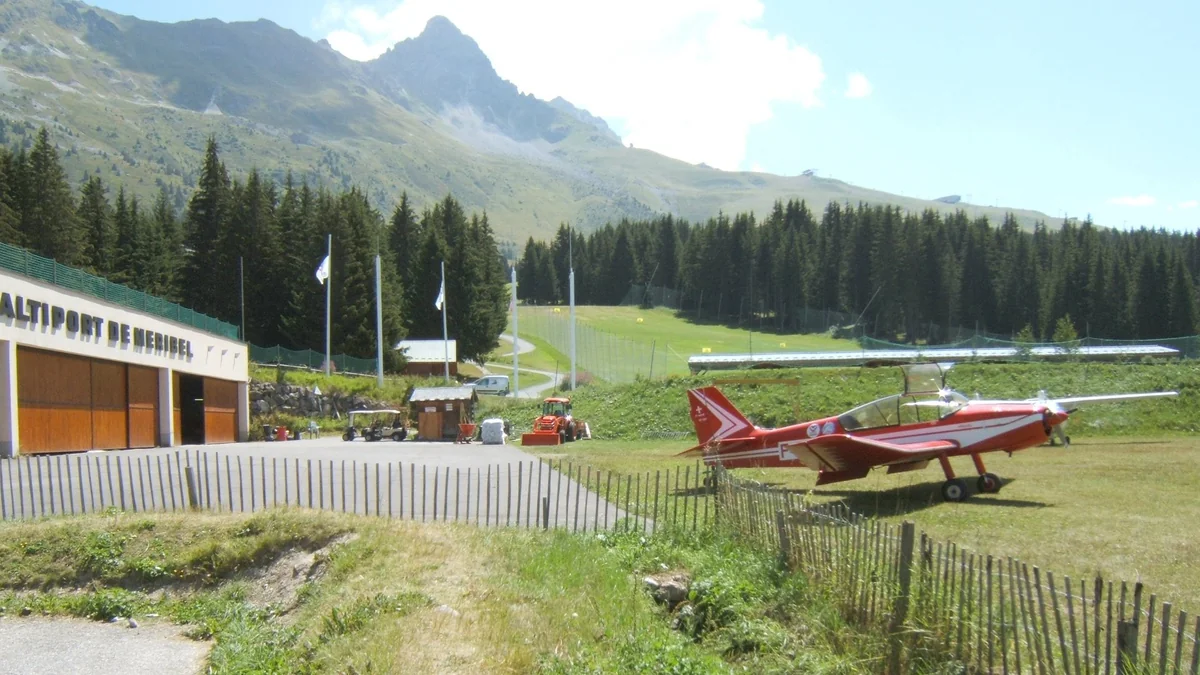
Cover: the Méribel altiport in the French Alps, a mountain airfield (2009). Photo: Rundvald, Wikimedia Commons, public domain, cropped. The aircraft shown is not connected with any accident in the study.
Sources
- BEA, "Second régime de vol", safety study, October 2026 (PDF, in French)
- BEA, safety topics: "Second régime" (in French)
- FlightGlobal, "Light aircraft pilot training needs to improve awareness of falling behind power curve: BEA", 20 October 2026
- FAA, Airplane Flying Handbook (FAA-H-8083-3C), chapter 4, "Energy Management: Mastering Altitude and Airspeed Control"
