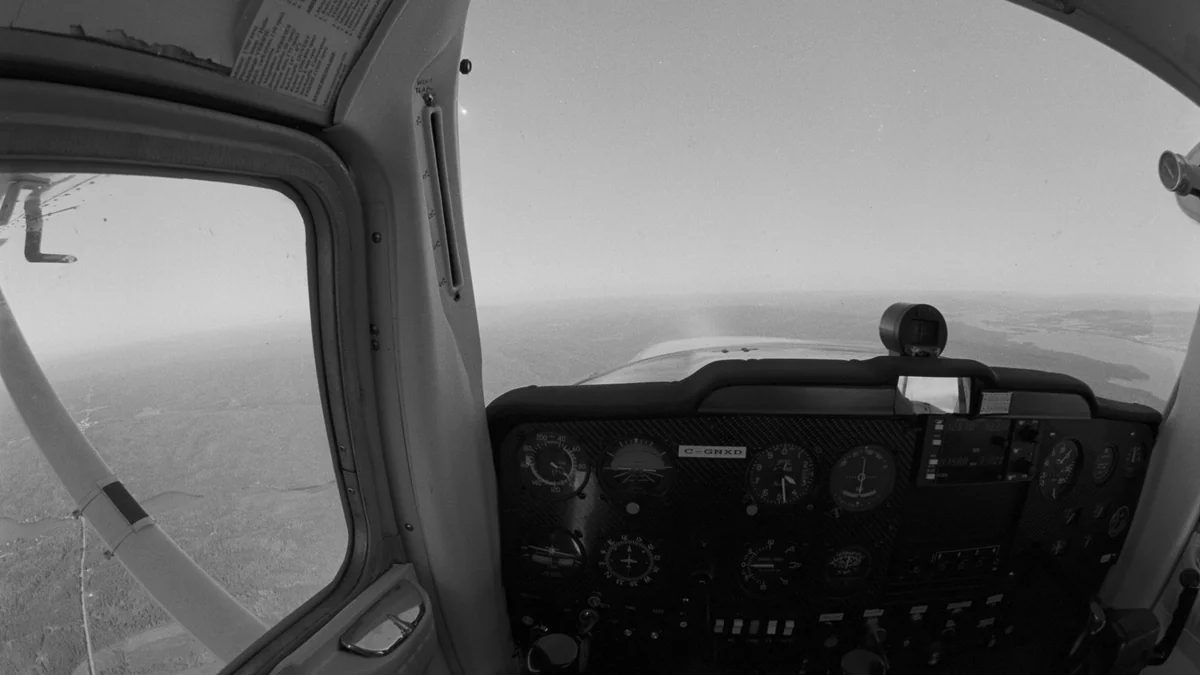
One of the pilots flying near Martha's Vineyard that night described the descent like this: "there was nothing to see. There was no horizon and no light." He had checked the weather and been told there were no adverse conditions. He was free of cloud the whole way. And he still had to hold altitude on the vertical speed indicator and the HSI, because the outside world had simply disappeared. He was so puzzled that he wondered whether the island had suffered a power cut.
That statement is in the NTSB final report on the accident that killed John F. Kennedy Jr., his wife Carolyn Bessette Kennedy and her sister Lauren Bessette on 16 July 1999. Strip away the famous names and what's left is one of the clearest case studies of spatial disorientation in general aviation. The weather was legal. Visual references weren't there.
We'll stick to what the report says. The point isn't to judge a pilot who can't answer back. It's to make sure the same trap doesn't catch any of us.
The flight
The aircraft was a Piper PA-32R-301 Saratoga II HP, N9253N, a high-performance single with retractable gear. The plan was to fly from Essex County Airport (Caldwell, New Jersey) to Martha's Vineyard, drop off one passenger, then continue to Hyannis. It was a private flight under VFR. No flight plan was filed and, according to the NTSB, there's no record of a weather briefing from a flight service station. The pilot did obtain weather forecasts, which showed VFR conditions with visibilities from 4 to 10 miles along the route.
Take-off was at about 20:40 local time. Sunset had been at 20:14. Over the sea, by the time the aircraft got there, it was properly dark: the moon was low in the west and about 19% illuminated.
The aircraft climbed to 5,500 feet and flew east along the Connecticut and Rhode Island coast, then out over the Rhode Island Sound. That last stretch is about 30 miles of open water before Martha's Vineyard.
The last three minutes
The NTSB performance study of the radar data is precise and hard to read without a knot in your stomach:
- About 34 miles west of Martha's Vineyard, the aircraft began a descent from 5,500 feet at 400 to 800 feet per minute, at about 160 knots.
- About 21:38 it began a right turn to the south. Some 30 seconds later it stopped descending at 2,200 feet and climbed. The turn stopped.
- About 21:39 it levelled at 2,500 feet, heading south-east.
- About 50 seconds later it entered a left turn and climbed to 2,600 feet, then started descending at about 900 feet per minute.
- At 21:40:15, still descending, it entered a right turn. The turn rate, descent rate and airspeed all increased. The descent rate eventually exceeded 4,700 feet per minute.
- The last radar return was at 21:40:34, at 1,100 feet.
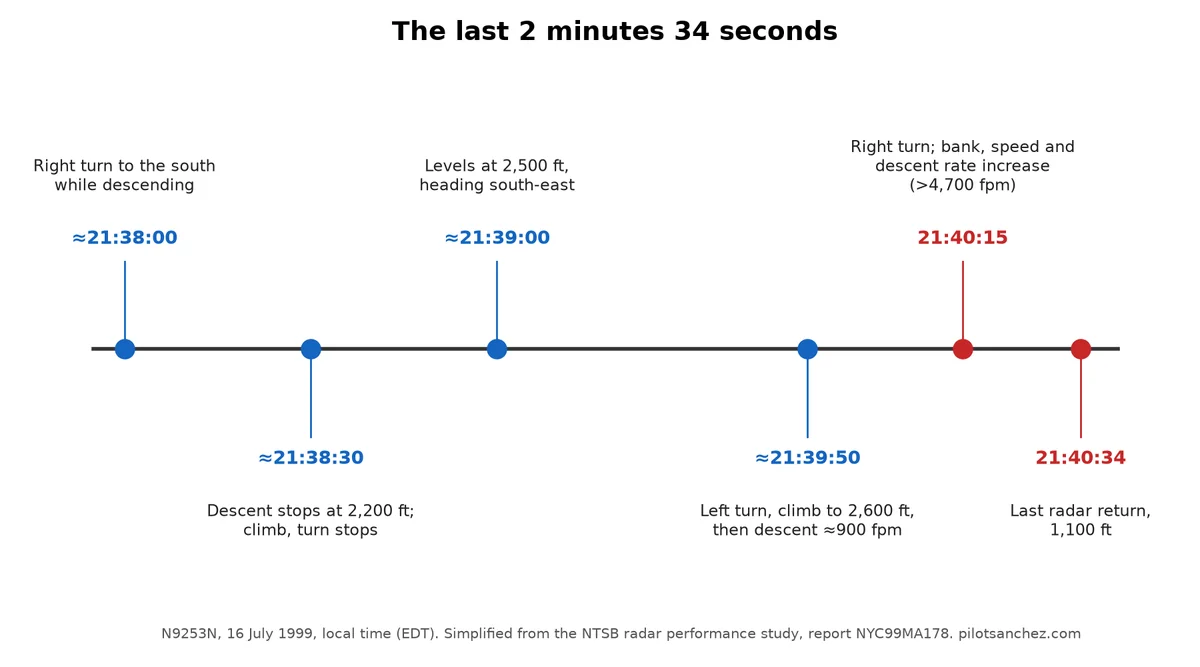
If you've flown unusual-attitude training, you recognise that sequence. Wandering heading, altitude that won't stay put, then a descending turn that tightens on its own. That's the classic graveyard spiral.
The NTSB's probable cause: "The pilot's failure to maintain control of the airplane during a descent over water at night, which was a result of spatial disorientation. Factors in the accident were haze, and the dark night." There was no evidence of any mechanical problem.
The pilot behind the numbers
The report estimates about 310 hours total, 55 of them at night. In the Saratoga, about 36 hours, 9.4 at night. Only about 3 hours in that aircraft were flown without an instructor on board, and only 0.8 hours of that at night. He had completed about half of a formal instrument course. One of his instructors told investigators he could fly the aircraft without a visible horizon but might have difficulty doing anything else at the same time. Another said he was capable of a night flight to Martha's Vineyard "as long as a visible horizon existed".
That last phrase is the whole accident in seven words.
Why "VMC" didn't mean "visual"
The reported weather was VMC, with visibilities of 5 to 8 miles at coastal airports. On paper, fine. But the report quotes FAA Advisory Circular 60-4A: surface references and the natural horizon can disappear even when visibility is above VFR minimums, especially over water, at night, over sparsely populated areas and in low visibility.
A pilot flying a similar route that night reported 3 to 5 miles in haze and no horizon over the water at all. Another pilot at the departure airfield cancelled his own flight to Martha's Vineyard that evening, judging the visibility to be about 4 miles and "extremely hazy".
Haze over water at night is the perfect recipe. The sea is black, the sky is black, the haze erases the line between them, and a few scattered lights below can look like stars above.
How quickly it happens
The same Advisory Circular says tests with qualified instrument pilots showed it can take as long as 35 seconds to establish full control by instruments after losing visual reference. That's for instrument pilots who know what's coming.
For VFR pilots it's worse. A classic study supported by the AOPA Air Safety Institute put the time between a VFR pilot flying into cloud and losing control of the aircraft at 178 seconds. Today AOPA puts the fatality rate for VFR-into-IMC accidents in non-commercial fixed-wing aircraft at 86%.
The inner ear is good at sensing changes and bad at sensing steady states. A gentle, sustained bank feels like straight and level after a few seconds. When you roll out, it feels like a bank the other way. Pull back to stop the "descent" in a banked aircraft and you tighten the spiral. The AC 61-27C illusions listed in the report (the leans, Coriolis, graveyard spiral, inversion, elevator, autokinesis) aren't exam trivia. They are exactly how a perfectly good aircraft ends up in the water.
Lessons for anyone flying VFR in Spain
1. Ask "will I have a horizon?", not just "is it VMC?"
Summer haze over the Mediterranean, calima in the south and the Canaries, and long crossings to the Balearics can all give you legal visibility with no usable horizon. If the honest answer is "probably not", it's an instrument flight, whatever the METAR says.
2. Choose the route with lights
Following the coast costs a few minutes. A straight line across dark water saves them and removes your references. At night, or in haze, the longer route is often the safer one.
3. Keep your instrument skills alive
Even without an instrument rating, practise flying on instruments with an instructor regularly, including recovery from unusual attitudes. When the outside view goes, go to the attitude indicator immediately. Wings level first, then pitch.
4. Be honest about recency in type and in conditions
Three hours solo in type, under one hour of it at night. It's legal, and it's thin. Experience in one aircraft and one set of conditions doesn't transfer automatically to another.
5. Watch the schedule pressure
Press reports at the time said this flight had originally been planned for earlier in the evening and slipped until after sunset. Whatever the reason, a late start that turns a dusk flight into a night flight changes the risk completely. If the flight you planned was a daylight flight, the flight you're about to do is a different one. Re-plan it, or don't do it.
6. Use the people on the radio
Talk to ATC. Ask for help early, not late. A FIS frequency, a squawk and a voice won't fly the aircraft for you, but they make it much easier to ask for vectors to better weather while you're still in control.
FAQ
What is spatial disorientation in aviation?
The pilot's inability to correctly sense the aircraft's attitude, motion or position relative to the ground, usually because visual references are lost and the inner ear gives false information.
What caused the JFK Jr. plane crash?
The NTSB concluded that the pilot lost control during a descent over water at night because of spatial disorientation, with haze and the dark night as factors. No mechanical fault was found.
Can spatial disorientation happen in VMC?
Yes. As the FAA notes, the horizon can be invisible even when visibility is above VFR minimums, especially at night, over water and in haze.
How do I recover from spatial disorientation?
Trust the instruments. Focus on the attitude indicator, level the wings, then correct pitch, and keep inputs small. Get proper training with an instructor before you ever need it.
Cover: a hazy horizon from the cockpit of a Cessna 150. Photo: Guillaume Legris, Wikimedia Commons, licensed CC BY 2.0, cropped. Not the accident aircraft.
