Running out of fuel sounds like a beginner's mistake. The accident data says otherwise. In its safety alert Flying on Empty, the US National Transportation Safety Board (NTSB) found that between 2011 and 2015 there were, on average, more than 50 general aviation accidents a year caused by fuel management. Fuel exhaustion (the tanks ran dry) accounted for 56% of them, and fuel starvation (fuel on board that never reached the engine) for another 35%. Almost half of the pilots involved held a commercial or airline transport certificate.
The NTSB adds two details that every VFR pilot should think about. About 80% of these accidents happened by day in visual conditions, and more than two thirds happened on flights to a different airport from the one the aircraft took off from. In other words, ordinary cross-country flights in good weather. This guide covers what the rules require, how to build a fuel plan that holds up, and what to do when it starts to fall apart.
What the rules require
Europe: EASA Part-NCO
Most private flying in EASA countries falls under Part-NCO (non-commercial operations with other-than-complex aircraft). Since 30 October 2022, its fuel rule, NCO.OP.125, no longer gives a fixed number of minutes. It asks the pilot-in-command to:
- carry enough fuel and oil, taking into account the weather, anything that affects the aircraft's performance, expected delays and any contingencies that may reasonably be expected;
- plan a quantity of final reserve fuel (FRF) to be protected to ensure a safe landing, sized first by how dangerous a forced landing after fuel starvation would be, and second by how likely it is that something unexpected eats into that reserve;
- only start the flight with enough fuel to reach the aerodrome of intended landing plus the final reserve, or, if a destination alternate is required, to reach the destination, then the alternate, plus the final reserve.
The numbers now sit in EASA's acceptable means of compliance, AMC1 NCO.OP.125(b). For aeroplanes, the final reserve should be no less than the fuel needed to fly:
| Type of flight (aeroplane) | EASA final reserve (AMC1 NCO.OP.125(b)) |
|---|---|
| VFR by day, taking off and landing at the same aerodrome and always remaining within sight of it | 10 minutes at maximum continuous cruise power at 1,500 ft above the destination |
| Other VFR flights by day | 30 minutes at holding speed at 1,500 ft above the destination |
| VFR by night, and IFR | 45 minutes at holding speed at 1,500 ft above the destination or destination alternate |
Two other parts of the EASA material matter just as much as the minutes. AMC2 says the final reserve should be planned before flight as an easily recalled figure against which you can check your fuel state at any moment. AMC3 says it must be protected: it is not contingency fuel, and if the fuel on board falls below it, you should treat the situation as an emergency.
United States: 14 CFR 91.151
The FAA rule for VFR flight in aeroplanes is shorter. Considering wind and forecast weather, you may not begin a flight unless there is enough fuel to fly to the first point of intended landing and then, at normal cruising speed, for at least 30 minutes by day or 45 minutes at night. For rotorcraft it is 20 minutes. There is no 10-minute local-flight option.
The UK, outside EASA since 2021, keeps essentially the same Part-NCO figures; the UK CAA's Safety Sense leaflet on VFR flight lists 10, 30 and 45 minutes for aeroplanes and 20 minutes for helicopters, and stresses that these "should be regarded as minimums".
Building a fuel plan, step by step
Airline fuel planning splits the total into named blocks, and the same structure works well for a light aircraft:
- Taxi fuel: start, warm-up, taxi and run-up. Small, but real at a busy airport.
- Trip fuel: climb, cruise and descent to the destination, using the forecast winds at your cruising altitude, not still-air figures. A 15-knot headwind on a 100-knot aircraft adds about 18% to the flight time.
- Contingency fuel: for the things you cannot predict exactly: a longer routing, a different runway, a slower climb. Part-NCO gives no fixed figure. For comparison, the acceptable means of compliance for specialised operations (Part-SPO), as published in the UK CAA's regulatory library, uses 5% of trip fuel or 5 minutes of holding, whichever is higher.
- Diversion fuel: Part-NCO only requires a destination alternate in some cases, but choosing one on a VFR cross-country, and carrying the fuel to get there, is good airmanship.
- Final reserve fuel: the protected figure from the table above.
- Extra fuel: anything you add at your own discretion, for example for weather you want the option to wait out.
Two adjustments make that plan more honest. First, use usable fuel, not total tank capacity: every aircraft has some unusable fuel, and the pilot's operating handbook (POH) tells you how much. Second, be sceptical of book consumption figures. The UK CAA's Safety Sense leaflet on good airmanship suggests that, because of service and wear, you should expect to use around 20% more fuel than the book figures as a rule of thumb.
A worked example
The figures below are example numbers for illustration only, not data from any particular aircraft's POH. Imagine a four-seat trainer that burns 30 litres an hour in cruise, on a 1 hour 20 minute trip (headwind included), with a diversion airfield 20 minutes beyond the destination:
| Block | Basis (example) | Litres |
|---|---|---|
| Taxi | Start, taxi and run-up | 3 |
| Trip | 1 h 20 min at 30 l/h | 40 |
| Contingency | 10% of trip (a personal choice, above the 5% Part-SPO figure) | 4 |
| Diversion | 20 min to the alternate | 10 |
| Final reserve | 30 min, VFR by day | 15 |
| Minimum at engine start | 72 |
Then translate the plan into the two numbers you will actually use in flight. The final reserve, 15 litres or 30 minutes, is the line you never cross. And your expected fuel on landing at the destination, here 72 − 3 − 40 = 29 litres, is the figure you compare against at every check. If the trip is running long, you see it early.
Remember that fuel is also mass. Filling the tanks to carry a generous reserve may push you over the maximum take-off mass with four people on board, so the fuel plan and the weight and balance calculation have to be done together. If you plan routes with the Pilot Sanchez VFR Planner, it uses your cruise speed and fuel burn to suggest fuel stops on longer trips; it does not confirm that fuel is actually available at those stops, so check that before you go.
In the air: monitoring and the calls to make
Planning is half the job. Part-NCO's in-flight rule, NCO.OP.185, requires the pilot-in-command to monitor the usable fuel remaining so that it is never less than what is needed to reach an aerodrome where a safe landing can be made, with the final reserve protected. A few habits make that practical:
- Dip or visually check the tanks before flight. The NTSB's first recommendation is to measure or visually confirm the fuel quantity and not rely only on the gauges.
- Keep a time-based fuel log. Note the time at engine start and at each tank change, and compare the fuel you should have with what the gauges show. A mismatch is a reason to find out why, not to pick the more comfortable number.
- Know your fuel system. Starvation, with fuel still on board, was more than a third of the NTSB's cases: a selector left on a nearly empty tank, a blocked vent, water in the fuel. Use the checklist for tank changes and sample the fuel before flight.
- Re-plan when the facts change. If the headwind is stronger than forecast, recalculate the fuel on arrival straight away. Deciding to land early for fuel is easy at the halfway point and very hard in the last ten minutes, which is exactly how plan continuation bias works.
If you are on a controlled flight, EASA's rules also tell you when to tell ATC. Declare "MINIMUM FUEL" when you have committed to land at a specific aerodrome and any change to your clearance, or any further delay, could mean landing with less than your planned final reserve. EASA's guidance is clear that this is not an emergency and does not give you priority, but it warns ATC that one is possible. Declare "MAYDAY MAYDAY MAYDAY FUEL" when the fuel you expect to have on landing at the nearest aerodrome where a safe landing can be made is less than the planned final reserve. EASA's guidance adds two useful points for private pilots: you may report your remaining endurance after either call, because ATC cannot know what your reserve is, and you may make both calls on an uncontrolled flight too if you think it is wise.
Personal minimums worth considering
The legal minimum is the same for a 20-minute hop in calm weather as for a two-hour trip over mountains. Your own minimum does not have to be. The UK CAA's good airmanship leaflet suggests always planning to land by the time the tanks are down to the greater of a quarter of a tank or 45 minutes' cruise flight, and reminds pilots that headwinds may be stronger than forecast and frequent use of carb heat reduces range. Other things that justify more fuel than the minimum:
- a destination with a single runway, or one that often has crosswinds;
- terrain, water or built-up areas along the route where a forced landing would be a bad option, which is the first factor EASA asks you to weigh;
- a forecast that could close your destination: check the METAR and TAF for the field and for your alternate;
- long flights in general. EASA's own guidance notes that the longer the flight, the more likely something has changed at the destination since you fuelled.
Finally, the quantity only matters if it is the right fuel. A thorough fuel plan is no help if the tanks contain the wrong grade, as our article on a Cessna 421 misfuelled with Jet A shows. The NTSB's own summary is hard to improve on: know how much fuel you have on board at all times, and do not stretch it. Stop and get fuel.
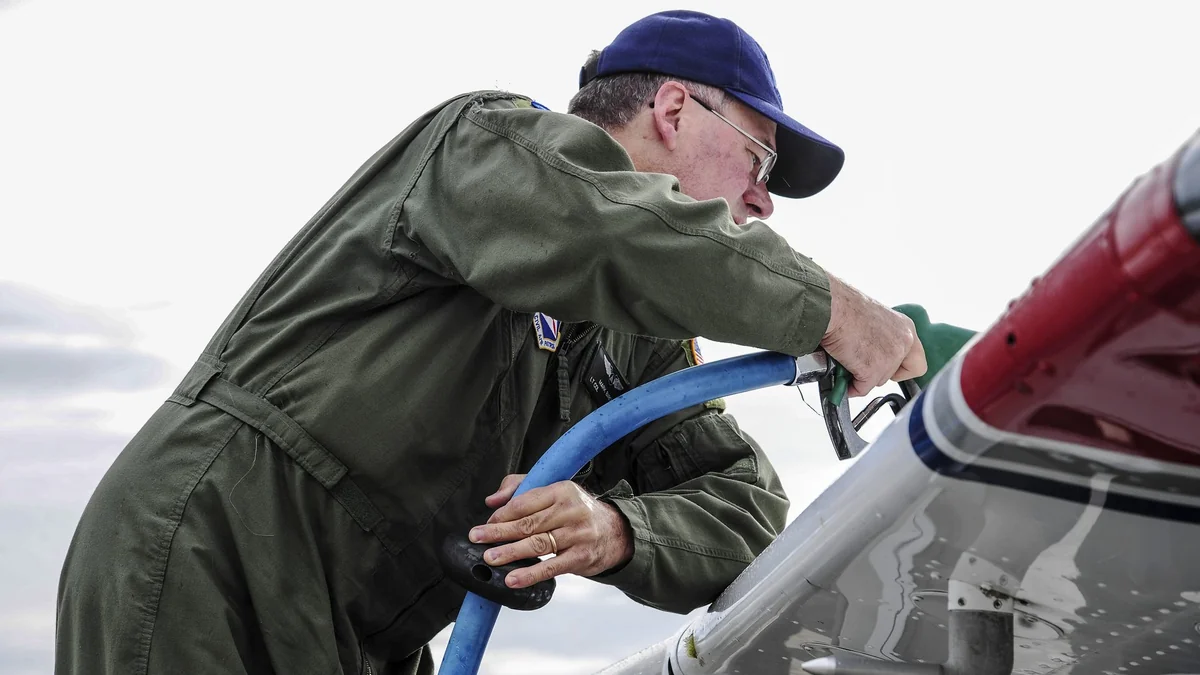
Cover: a Civil Air Patrol volunteer refuels a Cessna 172 at Eielson Air Force Base, Alaska, in 2013. U.S. Air Force photo by Senior Airman Zachary Perras, Wikimedia Commons, public domain, cropped.
Sources
- NTSB, Safety Alert SA-067, "Flying on Empty: Prevent the Preventable with Careful Fuel Management", August 2017 (PDF)
- Commission Implementing Regulation (EU) 2021/1296, amending Regulation (EU) No 965/2012 on fuel/energy planning and management (NCO.OP.125, NCO.OP.185)
- EASA, ED Decision 2022/005/R, "Fuel/energy planning and management — fuel schemes"
- EASA, AMC and GM to Part-NCO, Issue 2, Amendment 12 (AMC1–AMC3 and GM1–GM2 NCO.OP.125(b), GM1 NCO.OP.185(b)&(c)) (PDF)
- UK CAA regulatory library, AMC1 SPO.OP.131, fuel or energy scheme (contingency fuel for specialised operations)
- 14 CFR § 91.151, Fuel requirements for flight in VFR conditions
- UK CAA, Safety Sense Leaflet 05, "Flight under VFR" (PDF)
- UK CAA, Safety Sense Leaflet 01, "Good Airmanship", January 2013 (PDF)
