Four adults, bags for the weekend, and full tanks. On a Cessna 172 that sentence is often where the useful load runs out. Weight and balance is not a ground-school ritual you grow out of after the checkride. It is the five-minute check that tells you whether the aeroplane you want to fly is still the aeroplane the manufacturer certificated.
This guide walks through the same method the FAA teaches in the Aircraft Weight and Balance Handbook (FAA-H-8083-1B), then applies it to a published Cessna 172S sample loading problem from the Pilot's Operating Handbook. The numbers below are examples for learning. For any real flight you must use the POH, type data and current empty-weight record for that aeroplane.
The three numbers that matter
The FAA handbook reduces loading to three ideas:
- Weight — how heavy each item is, in pounds (or kilograms if your POH uses them).
- Arm — how far that item sits from the reference datum, usually in inches aft of the firewall on a 172.
- Moment — weight × arm. Moments are usually shown as pound-inches, or as a moment index (moment ÷ 1,000) to keep the arithmetic short.
Add every weight. Add every moment. Then:
CG = total moment ÷ total weight
That CG (centre of gravity), at that total weight, must fall inside the envelope drawn in Section 6 of the POH. If either the weight or the CG is outside the limits, the loading is not acceptable — even if the aeroplane "feels" fine on the ground.
Avgas weight is part of the same arithmetic. The handbook's fuel-density table lists aviation gasoline at about 6.01 lb per U.S. gallon at 59 °F (and 6.14 lb/gal at 32 °F). Many Cessna 172S loading worksheets simplify usable fuel to 6.0 lb/gal. Use the figure your POH tells you to use.
What you need before you start
- The current basic empty weight (BEW) and empty moment for this aeroplane — from the weight and balance report / equipment list in the aircraft, not from a random internet data sheet.
- Section 2 and Section 6 of the POH — weight limits, CG range, baggage limits, and the loading graph / moment envelope.
- Actual people and bag weights — guesswork is how aft CG and overloaded baggage compartments happen. Bathroom scales beat optimism.
- Planned usable fuel — in gallons, then converted to pounds with the POH figure.
On a typical late-model Skyhawk (172S) in the normal category, published type limits look like this — again, example figures from a 172S POH, not a blank cheque for every 172:
- Maximum ramp weight: 2,558 lb
- Maximum takeoff / landing weight: 2,550 lb
- Usable fuel: up to 53.0 U.S. gallons (56.0 total capacity; 3.0 unusable, already in the empty weight)
- Baggage area A (stations 82–108): 120 lb max; area B (108–142): 50 lb max; combined A+B: 120 lb
- Normal-category CG: forward limit from 35.0 in aft of datum at 1,950 lb or less, varying in a straight line to 41.0 in at 2,550 lb; aft limit 47.3 in at all weights
Utility category is tighter (2,200 lb takeoff, aft CG 40.5 in, no rear seat, empty baggage). If you are doing spins or other utility manoeuvres, load to that envelope, not the normal one.
Step by step: the sample loading problem
Cessna's own 172S POH includes a worked "sample airplane" column in Figure 6-5. Walking through it is the fastest way to see the method. The sample uses these items (all from that POH sample — not your aeroplane):
| Item | Weight (lb) | Moment/1,000 |
|---|---|---|
| Basic empty weight (sample) | 1,642 | 62.6 |
| Usable fuel (30 gal × 6 lb/gal) | 180 | 8.6 |
| Pilot and front passenger (sta. 34–46) | 340 | 12.6 |
| Rear passengers | 340 | 24.8 |
| Baggage area 1 (56 lb; 120 max) | 56 | 4.6 |
| Ramp weight and moment | 2,558 | 113.2 |
| Less fuel for start, taxi and run-up | −8.0 | −0.4 |
| Takeoff weight and moment | 2,550 | 112.8 |
That takeoff point — 2,550 lb at a moment index of 112.8 — is then plotted on the centre-of-gravity moment envelope in the POH. In the sample, it falls inside the envelope, so the loading is acceptable.
Notice what the sample is teaching:
- Start from BEW, which already includes unusable fuel and full oil.
- Add only usable fuel, people and baggage.
- Check ramp weight first (here exactly at the 2,558 lb limit), then subtract the published taxi/run-up fuel allowance to get takeoff weight.
- Plot weight against moment index on the envelope — do not stop at "we are under max gross."
How to run it for your next flight
- Write BEW and empty moment from this aeroplane's current record into the left column of the POH worksheet (or your electronic equivalent).
- Enter usable fuel for the flight you actually plan — not "full" by habit. Convert gallons × POH lb/gal.
- Enter occupant weights in the front and rear seat rows. Use the station ranges in the POH if seats are adjustable.
- Enter baggage by compartment, respecting area A, area B and the combined limit.
- Add to ramp weight. If you are over ramp or takeoff max, something has to come out: fuel, a bag, or a person.
- Subtract start/taxi/run-up fuel if your POH shows that line, then plot takeoff weight and moment on the envelope.
- Think about landing weight after fuel burn. On some types the landing limit is lower than takeoff; on the 172S sample above they match at 2,550 lb, but fuel burn still moves the CG. Recheck if you are near an aft or forward limit at takeoff.
Traps that catch 172 pilots
- Four adults and full fuel. With a BEW around 1,640–1,720 lb, useful load is often only about 830–910 lb. Four 180 lb adults are already 720 lb before bags and fuel. Full usable fuel alone is about 318 lb (53 × 6). Something usually has to give.
- Heavy bags behind the rear seats. Area B has a long arm. Aft CG hurts pitch stability and can make recovery from a stall more difficult. The aft limit exists for a reason.
- Using last year's empty weight. A new GPS, a different interior, or a fresh weigh can move BEW by tens of pounds. The PIC is responsible for current data.
- Ignoring density altitude. Being inside the weight envelope does not restore the climb performance you lose on a hot day at a high field — see our notes on density altitude. Weight and balance says you may go; performance says whether you should.
- Utility-category habits in a normal-category load. Rear seat occupied or bags aft means you are not in the utility envelope, whatever the sticker on the panel says.
FAQ
Do I have to calculate weight and balance before every flight?
You must know that the aeroplane is within weight and CG limits for that flight. A documented loading that matches what you are about to do is enough; reinventing the arithmetic from scratch every time is not required if the numbers have not changed. When people, bags or fuel change, recalculate.
Why does the POH use moment/1,000 instead of inches?
Because raw moments are large (tens of thousands of pound-inches). Dividing by 1,000 keeps the worksheet readable. The envelope is drawn in the same units, so the plot still works.
Is the sample 1,642 lb empty weight typical?
It is the sample aeroplane in one published 172S POH. Real Skyhawks vary with options and modifications — flight-school data sheets often show empty weights from roughly the mid-1,600s into the low 1,700s. Always take the figure from the aircraft you are flying.
What if I only have a metric POH?
Same method: mass × arm = moment, then total moment ÷ total mass = CG. Stay inside the envelope drawn for those units. Do not convert halfway through the worksheet.
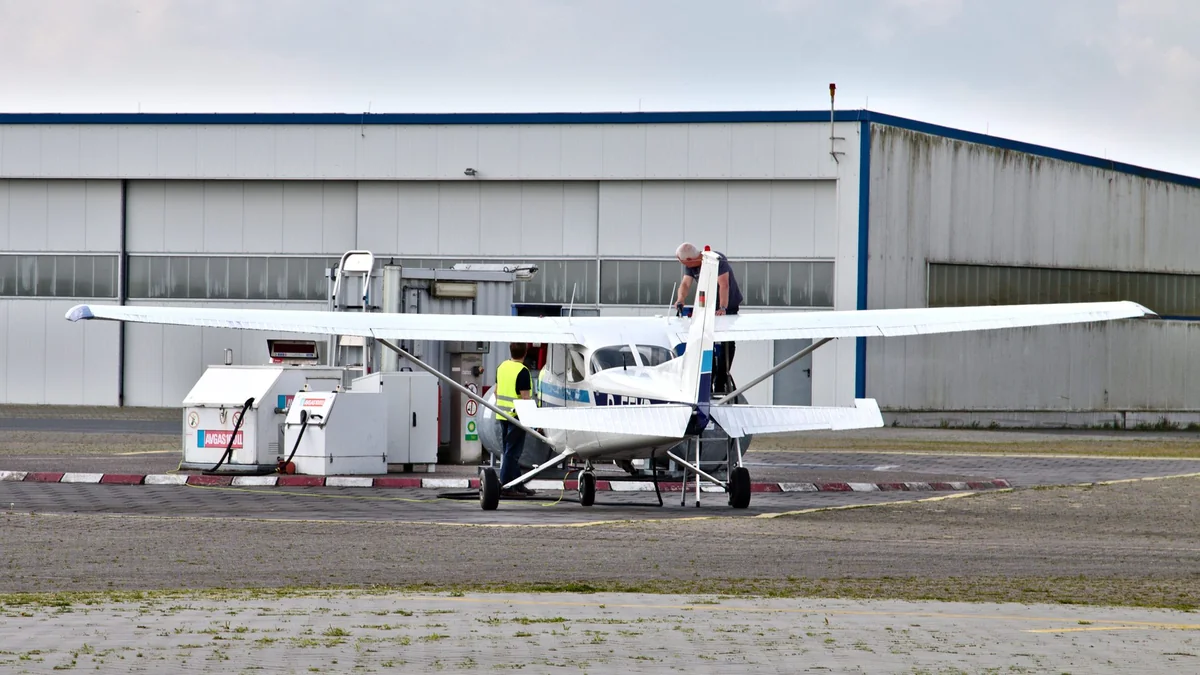
Cover: Cessna 172M D-EEVB refuelling at JadeWeserAirport (Mariensiel), Germany. Photo: Jacek Rużyczka, Wikimedia Commons, licensed CC BY-SA 4.0, cropped.
Sources
- FAA, Aircraft Weight and Balance Handbook, FAA-H-8083-1B (PDF) — theory, fuel density table, single-engine loading methods (Chapter 5)
- FAA, Pilot's Handbook of Aeronautical Knowledge, FAA-H-8083-25C, Chapter 10: Weight and Balance
- Cessna Model 172S Nav III Pilot's Operating Handbook (sample loading problem Figure 6-5; Section 2 weight and CG limits) — example figures only; use the POH for the aeroplane you fly
- FAA Aviation Handbooks & Manuals index (current handbook list, including the October 2025 W&B addendum)
