On a hot August afternoon in 2026, a Cessna 421C took off from Blytheville, Arkansas, on an IFR flight to Lima, Ohio, with four people on board. About half an hour later it was sitting in a Kentucky cornfield with a broken engine mount. Everyone survived, two of them with serious injuries.
The National Transportation Safety Board (NTSB) published its final report on 1 October 2026 (accident number ERA26LA314), and the cause is one of the oldest in general aviation: the aeroplane had been topped off with jet fuel. All 145 gallons of it.
There's no mystery here and no need to guess. The report is short and the facts are plain. That's exactly why it's worth reading, because every link in the chain is one that any of us could leave open on a busy day.
What the NTSB found
According to the report, the pilot noticed during the climb that the No. 1 cylinder on the right engine was running hot. He levelled off at 5,000 ft, but the temperature stayed high, so he feathered the propeller and shut the engine down. While he was heading for an airport, the left engine began to deteriorate too. He could no longer hold altitude, and about two miles short of the airport he made a forced landing in a cornfield. The 421 was substantially damaged: right engine mount, fuselage and tail.
A first responder dabbed fuel from one of the tanks onto a paper towel. She reported that it had no colour and smelled like diesel. 100LL avgas is dyed blue.
The fueler at the departure airport told investigators he had topped the aeroplane off with "pre-mixed Jet-A", about 70 gallons on the right and 75 on the left. The airport manager confirmed it and produced the fuel receipt, signed by the pilot, showing 145 gallons of Jet A. AvWeb's account adds that the fueler said he'd only been asked to top it off, and assumed Jet A because pilots who wanted 100LL usually used the self-service pump nearby.
The pilot told the NTSB he hadn't specifically asked for 100LL. He did read the receipt after fuelling, but they "wanted to get home", so they "got in the airplane and left." He didn't inspect or sample the fuel after it went in.
The NTSB's probable cause: the misfuelling of the airplane by the refueler, with the pilot's failure to verify that the airplane had been properly fuelled as a contributing factor.
That "wanted to get home" deserves a second look. It's the same pressure behind plan continuation bias: the goal is so close that the small voice saying "hang on" gets talked over.
Not the first 421, and not the last
In 2016 the NTSB issued a safety alert for pilots, SA-050, "Pilots: Fueling Mistakes". Three of the four accidents it lists are Cessna 421s that lost power on takeoff or climb after being fuelled with Jet A. One of them killed the pilot, two medical crew members and a patient. In two of those cases the pilot signed a receipt that said Jet A. In one, the pilot even sumped the fuel and it looked like avgas.
Nothing in these reports points to a problem with the type itself. The 421 is a big piston twin that shares ramps with turbine aircraft, and in some of those earlier cases the fuel trucks had been modified in ways that let the wrong nozzle fit. The lesson applies to any aeroplane with a spark-ignition engine.
Why jet fuel and a piston engine don't mix
An avgas engine is built around a fuel that resists detonation. Kerosene does the opposite: in a spark-ignition engine it burns erratically and detonates, temperatures climb, and the engine loses power and can destroy itself. A running-hot cylinder followed by a failing engine, as in this report, is what that looks like from the cockpit.
The cruel part is the timing. The NTSB alert notes that once the wrong fuel is in, a misfueling can be hard or even impossible to detect, and that a mix of Jet A and avgas can look like plain avgas. In the accidents it describes, the trouble showed up during takeoff and climb, which is the worst possible moment to lose an engine.
The hardware is supposed to stop this
There is a physical defence, and it's been around since the 1980s. The FAA's Advisory Circular 20-122A describes it:
- Avgas aircraft can have filler adapter rings that reduce the opening from 3 inches to 2.3 inches in diameter.
- Jet fuel nozzles are meant to have a spout of at least 2.6 inches, flattened like a duck's bill, so they physically won't go into a restricted avgas filler.
- Since 1 January 1985, new aeroplanes from GAMA (General Aviation Manufacturers Association) members have had filler ports that meet the SAE AS1852 dimensions.
The weak point is people working around the hardware. The NTSB found fuel operators who fitted small round nozzles to their Jet A trucks so they could fuel turbine helicopters with small filler ports. Others had to deal with aeroplanes converted from piston to turbine engines under a supplemental type certificate (STC) that never changed the filler size. Once a round Jet A nozzle exists on the field, the duck bill no longer protects anyone. The same model of aeroplane can also need different fuels depending on its engines.
That last point matters in Europe too. A Diamond DA42 or DA40 NG with diesel engines burns Jet A-1, while a near-identical-looking aeroplane on the next stand may need 100LL. "Small aeroplane, so avgas" is as unsafe an assumption as "big twin, so jet fuel."
A misfueling checklist that takes two minutes
Most of this comes straight from the NTSB's alert. None of it is complicated, which is the point.
- Say the registration and the fuel grade out loud. Not "top it off, please", but "Golf-Charlie-Delta, 100LL, both mains to full." Tell them which tanks, too.
- Watch it go in. If you can't, at least look at the truck or pump and the nozzle before they start. A duck-bill nozzle going towards your avgas filler is your cue to stop everything.
- Read the receipt before you sign it. The NTSB keeps finding receipts that say Jet A, signed by the pilot of a piston aeroplane. The ticket isn't paperwork, it's the last cross-check.
- Sample every drain after fuelling. Check colour (100LL is blue, jet fuel is clear to pale straw) and smell (paraffin or diesel instead of petrol). A drop on a paper towel helps: avgas evaporates quickly, jet fuel leaves an oily mark. Remember that a mix can still look like avgas, so this check backs up steps 1 to 3 and doesn't replace them.
- Keep your placards readable. Faded fuel decals by the fillers are an invitation to guess. The NTSB specifically asks pilots to make sure they're correct and easy to read.
- If anything is wrong, don't fly. Tell the operator and get maintenance involved before the engine runs on that fuel. A day lost on the ground is nothing next to an engine failure on climb-out.
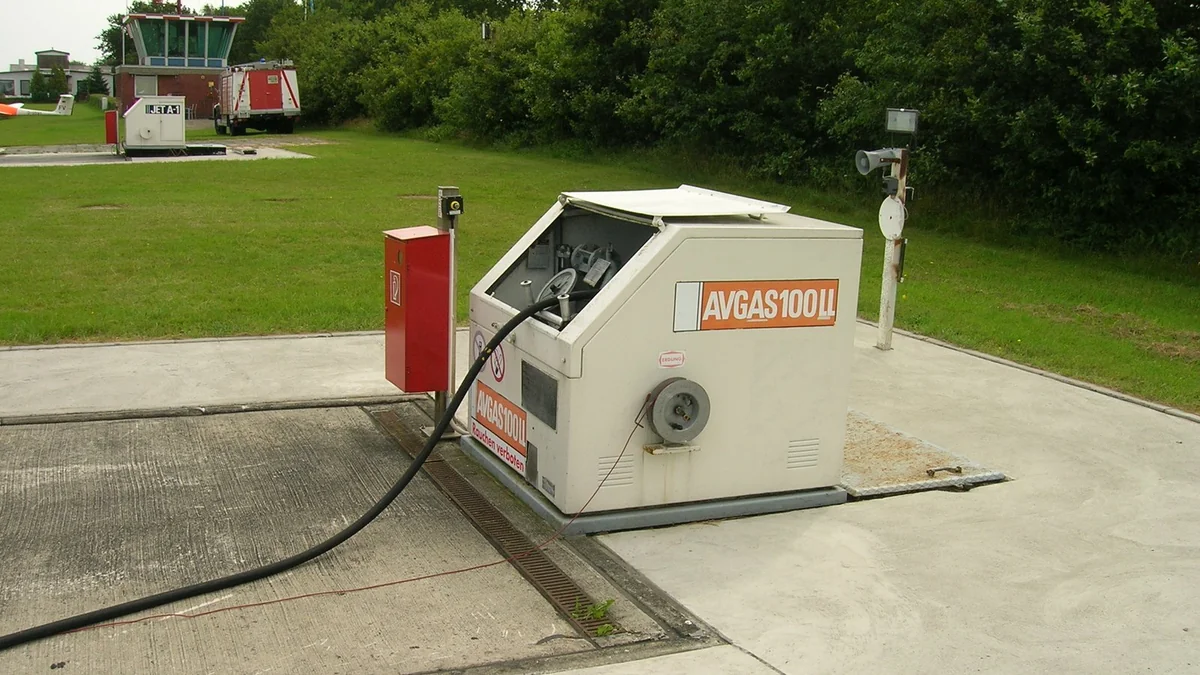
At many small airfields in Europe you fuel the aeroplane yourself, like at the pump on the cover. That removes the fueler from the chain, but not the risk: the person holding the nozzle still has to read the label on the pump. Same checks, just with nobody else to blame.
FAQ
What colour is avgas 100LL?
Blue. Jet A and Jet A-1 are clear to pale straw-coloured, and smell like paraffin or diesel.
Can a piston aircraft engine run on Jet A?
Only if it's a compression-ignition (diesel) engine designed for it, such as those on the Diamond DA42 or DA40 NG. A spark-ignition engine designed for avgas cannot, and running it on jet fuel can cause detonation, overheating and engine failure.
What is an anti-misfueling restrictor?
An adapter ring that reduces an avgas filler opening to 2.3 inches, so a standard jet fuel nozzle (at least 2.6 inches) won't fit. It only works if jet fuel nozzles on the field haven't been swapped for smaller round ones.
Who was found responsible in the Cessna 421 accident?
The NTSB doesn't assign blame. It found the probable cause was the misfuelling by the refueler, with the pilot's failure to check the fuel before departure as a contributing factor.
Cover: the AVGAS 100LL pump at Sankt Michaelisdonn airfield in Germany, with the JET A-1 pump in the background. Photo: El Grafo, Wikimedia Commons, licensed CC BY-SA 3.0, cropped.
Sources
- NTSB, Aviation Investigation Final Report ERA26LA314, Cessna 421C N28RH, Fulton, Kentucky (PDF)
- NTSB Safety Alert SA-050, "Pilots: Fueling Mistakes" (PDF)
- NTSB Safety Alert SA-051, "Prevent Misfueling through Standardized Procedures" (PDF)
- FAA, AC 20-122A Change 1, Anti-Misfueling Devices: Their Availability and Use (PDF)
- AvWeb, "Jet-A Misfueling Blamed For Cessna 421 Accident", 7 October 2026
