A defect in one small engine part now concerns some of the most common engines in light aviation. On 9 November 2026 the US Federal Aviation Administration (FAA) published Airworthiness Directive (AD) 2026-22-13, which replaces the Lycoming piston pin AD issued in August and extends it to many models of the four-cylinder O-320 family, including the IO-320, AIO-320, LIO-320 and AEIO-320, and to the VO-435 and TVO-435 helicopter engines. The O-235 and 17 O-540 and IO-540 models stay on the list. The new AD takes effect on 24 November 2026.
The O-235 and O-320 power many of the aircraft that people learn to fly in, including the Cessna 152 and several Cessna 172 models. This post explains what the AD says, which trainers it can affect, why it matters in Europe and what to ask before your next flight. It is a summary, not a substitute for the AD, Lycoming's documents or your maintenance organisation.
The Part: One Piston Pin, One Production Window
The piston pin (also called the gudgeon pin or wrist pin) connects each piston to its connecting rod. In Mandatory Service Bulletin (MSB) 667A, dated 12 March 2026, Lycoming says that thin-wall LW-13445 pins with an FAA Form 8130-3 release date between 7 January 2021 and 15 December 2025 "may contain undesirable manufacturing artifacts in the inside bore". That covers pins installed in engines, sold as spares or supplied in cylinder kits. The bulletin's warning is blunt: "Piston pin failure can cause an uncommanded and complete loss of power."
The FAA's first AD on the subject, AD 2026-17-10, was published on 28 August and took effect on 14 September. It was prompted by "several reports of piston pin failure that resulted in metal particulate contamination in the engine oil and engine failure". The new AD cites Lycoming reports of metal found in the oil at oil changes, and two engine failures. The FAA adopted it without prior public comment because "piston pin microcracks and inclusions are difficult to detect prior to failure" and can lead to an in-flight shutdown and loss of control. The AD defines the window by the pin's date of manufacture instead.
What Changes with AD 2026-22-13
- More engine models. Listed models of the O-320, IO-320, AIO-320, LIO-320, AEIO-320, VO-435 and TVO-435 series join the O-235. The O-540 and IO-540 lists are cut to 17 models between them, because Lycoming found that some engines in the August AD are not affected.
- No serial number list. The August AD applied only to engines whose serial numbers appeared in the Lycoming bulletin. The new one applies to any engine of a listed model with an affected pin. As AeroCorner notes, that turns the engine records into the first thing to check.
- Unknown counts as affected. A pin with an unknown date of manufacture is treated as an affected pin. If the LW-13445 pins were installed before 7 January 2021, the AD does not apply.
- Two groups with different deadlines. Group 1 covers pins made between 7 January 2021 and 22 March 2023. Group 2 covers pins made between 23 March 2023 and 15 December 2025, or of unknown date.
What the AD Requires, and by When
Deadlines are hours time in service after 24 November 2026, the effective date. The 150-hour figures are not counted from that date: one is time in service on that date, the other is time since the pins were installed.
- Within 5 hours: an oil change and a visual inspection of the oil filter, the oil pressure screen and the oil suction screen for metal. This applies to Group 1 engines and to Group 2 engines with less than 150 hours.
- If metal is found: the affected pins must be replaced before further flight.
- Group 2 engines with 150 hours or more: the pins must be replaced before further flight.
- Group 2 engines with less than 150 hours: the pins must be replaced within 25 hours, or before they reach 150 hours since installation, whichever comes first.
- Group 1 engines with clean oil: the pins can wait until the next removal of a cylinder with an affected pin or the next overhaul, whichever comes first, without exceeding the time between overhauls in Lycoming Service Instruction 1009BF.
The AD also prohibits installing an affected pin on any engine. Special flight permits to reach a maintenance base are possible for the pin replacement, but only if no metal was found, and they are not allowed for the oil and screen inspection itself. For Group 2 engines with 150 hours or more, an oil change showing no metal is needed before a permit can be issued. The FAA estimates that the AD affects 957 engines on US-registered aircraft, at 25 work-hours and $4,325 per engine ($4,139,025 in total), and says Lycoming indicated some of the cost may be covered under warranty.
Which Trainers Does It Affect?
The AD lists engines, not aircraft, so the exact engine model on the data plate and in the engine logbook is what counts. The FAA type certificate data sheets give a sense of which models are in scope:
- The Cessna 152 was certified with the Lycoming O-235-L2C or O-235-N2C (TCDS 3A19). Both engines are on the list. The older Cessna 150, with its Continental O-200, is not.
- The Cessna 172I, K, L and M were certified with the O-320-E2D, and the 172P with the O-320-D2J (TCDS 3A12). Both engines are on the list.
- The Cessna 172N was certified with the O-320-H2AD, and the 172R and 172S with the IO-360-L2A. None of these appears in the AD's table.
Many aircraft have had engines changed or modified over the years, so treat this only as a first guide. And having a listed engine does not mean the aircraft is grounded: only engines that actually carry an LW-13445 pin from the 2021 to 2025 window, or one whose date cannot be shown, are affected. In practice, the most likely candidates are engines built, overhauled, or fitted with new cylinders, pistons or pins since early 2021.
Does This Apply in Europe?
Yes. Lycoming is a US manufacturer, so the FAA is the authority of the State of Design for these engines. EASA explains that an AD issued by the State of Design becomes valid in Europe on the day it takes effect, unless EASA issues a different decision. At the time of writing (10 November), EASA's AD publication tool was still down for maintenance, so we could not confirm whether EASA has issued a different decision, such as a deviating AD. We will update this post once we can. For European-registered aircraft, tracking it is the job of whoever manages continuing airworthiness: the CAMO or CAO, or the owner under Part-ML. Our post on who makes the rules of the air explains why a US document can apply to an aircraft registered in Spain.
What Pilots Can Do Now
- Ask before you book. If you rent or fly a club aircraft with an O-235 or O-320, ask whether the engine has been assessed against AD 2026-22-13 and which group it falls into. The oil check is due within 5 flight hours after 24 November, which on a busy school aircraft can mean a few days, and some engines may need new pins before further flight.
- If you own the aircraft, start with the records. Overhauls, cylinder changes and the release paperwork for any pins fitted since 2021 determine whether the AD applies. Without records, the pin counts as affected. Our post on a proposed fine over one unapproved gauge shows why parts paperwork matters.
- Keep engine failure drills fresh. The AD exists because a failed pin can stop an engine without warning. Brief your options for every phase of flight before you go, including where you would land straight ahead after takeoff. Our VFR preflight briefing checklist and the lessons from the NTSB's Beverly Mooney report are good places to start.
The FAA is taking comments on the AD until 24 December 2026, so it could still be revised. If it is, we will update this post.
Sources
- FAA, AD 2026-22-13, Lycoming Engines, Federal Register, 9 November 2026 (91 FR 70781)
- FAA, AD 2026-17-10, Lycoming Engines, Federal Register, 28 August 2026
- Lycoming, Mandatory Service Bulletin 667A, Piston Pin Replacement, 12 March 2026
- FAA, Type Certificate Data Sheet 3A12, Cessna 172 (rev. 89), via OpenAirDocs
- FAA, Type Certificate Data Sheet 3A19, Cessna 150/152, via OpenAirDocs
- EASA, FAQ 19480, applicability in Europe of ADs issued by a foreign State of Design
- AeroCorner, "FAA Widens the Lycoming Piston Pin AD to O-320 Engines", 6 November 2026
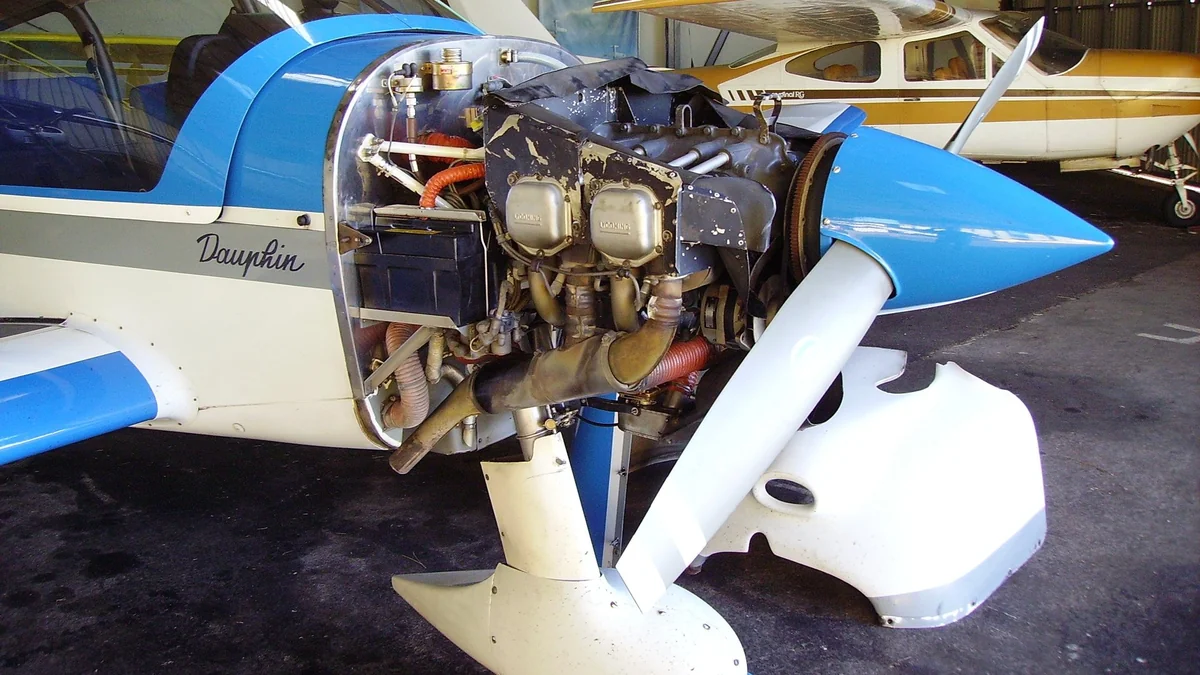
Cover: the Lycoming O-320-D2A of a Robin DR400-140B Dauphin with the cowling removed, Cosne-sur-Loire, France. Photo: Cjp24, Wikimedia Commons, CC BY-SA 4.0, cropped.
