A bang from the engine, a puff of dark smoke, a sudden drop in power just after lift-off. Every pilot has rehearsed that moment in their head. The US National Transportation Safety Board (NTSB) has now published its final report on an accident where it really happened, and its conclusion is one every piston pilot should hear: the engine problem was real, but it was not what brought the aeroplane down.
The report, ERA25FA230, was published on 16 October 2026. It covers the crash of a 1966 Mooney M20F shortly after take-off from Beverly Regional Airport, Massachusetts, on 19 June 2025. The pilot and his passenger were killed. Our thoughts are with their families. What follows is based on the NTSB's final report; we add no theories of our own.
What happened
The Mooney was cleared for take-off from runway 16 at Beverly for an IFR flight to upstate New York, in visual conditions with a broken layer at 900 ft. The pilot held a commercial certificate with an instrument rating and had about 429 hours in total, 77 of them in this aeroplane.
Shortly after the aeroplane became airborne, airport cameras recorded the sound of the engine backfiring, followed by a sudden drop and then a rise in power. The tower controller saw dark smoke trailing under the belly, asked if everything was okay and cleared the Mooney to land on any runway. The pilot replied that he had engine trouble and would "head up and turn back". The controller cleared him for runway 09.
The aeroplane first turned right, towards runway 09, then turned left into a steep bank and descended behind trees. A flight instructor watching from the airport described what looked like a "stalled" state. The last radar return showed the Mooney about 110 ft above the ground at a groundspeed of 65 knots, which the NTSB notes is near its published stall speed. It struck a grass berm and a light pole by a road just off the airport.
What the engine was really doing
The aeroplane's engine monitor told the investigators a lot. In the last 25 seconds of the flight, the rpm fell from 2,600 to 1,500 and then came back to about 2,500, with fuel flow and manifold pressure following it. The NTSB reads that as the pilot quickly pulling the throttle to idle and then pushing it back to full power, possibly considering a landing before deciding to circle to another runway. Crucially, the engine was operating near full power as the aeroplane descended to the ground.
When the engine was examined, the bottom spark plug in the No. 2 cylinder was loose, with exhaust staining around the port showing it had been leaking combustion gas before the crash. The logbook showed the plugs had been "cleaned, gapped, tested, and rotated" at the last annual inspection, about 37 flight hours earlier, with no later entry for removing them. Lycoming's spark plug installation guidance (Service Instruction 1042AH) calls for 420 in-lb (35 ft-lb) of torque on every plug.
The investigators also found other loose ends, none of which the NTSB considered causal:
- The No. 1 cylinder's exhaust gas temperature (EGT) reading had been erratic since that same annual inspection. One wire of the EGT probe was not connected.
- Some water, corrosion and sand-like debris were found in parts of the fuel system, but the components tested within specification and nothing stopped fuel from reaching the engine.
- The owner's manual calls for the electric boost pump to be on for take-off; its switch was found off. The report records this without listing it as a factor.
The probable cause
The NTSB determined the probable cause to be "the pilot's failure to maintain control of the airplane while maneuvering to return to the airport which resulted in an aerodynamic stall." Contributing was "the improperly installed No. 2 cylinder bottom spark plug by maintenance personnel, which came loose and resulted in an engine backfire on takeoff."
In plain words: a maintenance error started the chain, but the aeroplane still had power to fly. The stall in a low, steep turn is what turned a scary moment into a fatal accident.
Why the turn is so dangerous
The numbers in the report make the point on their own. With take-off flap and the gear up, the M20F's owner's manual gives a stall speed of about 55 knots in wings-level flight. In a 60° bank, that rises to roughly 80 knots. The emergency checklist found in the cockpit told the pilot to hold 87 knots after an engine problem on take-off. A steep turn at low speed, close to the ground, eats that margin in seconds.
The FAA's Airplane Flying Handbook is blunt about turning back after a low-altitude engine failure, the so-called "impossible turn". It says that continuing straight ahead or making a slight turn "usually represents the option with the lowest risk", that a pilot who turns back "without due consideration and training will need considerable luck", and that if the nose is not lowered enough in the turn, "an accelerated stall and fatal crash may occur". Its advice: know how much height your aeroplane loses in the turn, practise it at a safe altitude, and do not attempt it "unless a successful turn back will result".
And this was not even a total failure. When the engine is still giving most of its power, the aeroplane can usually keep climbing straight ahead to a height where a normal, gentle circuit back to the runway is possible. We wrote recently about how slow, high-drag flight can trap pilots who blame the engine for what the wing is doing, in our piece on the BEA's new study on flying behind the power curve. The physics is the same here.
What we can take from it
- Brief the take-off emergency before you roll. Decide out loud what you will do with a total failure below a certain height, above it, and with partial power. A decision made on the ground is faster than one made in the smoke.
- Rough running is not a failed engine. If the engine is still making power, fly the aeroplane first: hold the speed your checklist gives, climb straight ahead if you can, and come back with a normal, shallow circuit once you have height.
- Watch the bank angle and the airspeed together. Stall speed goes up quickly with bank. Near the ground, a steep turn at low speed is the most dangerous thing you can do with a healthy wing.
- Treat the first flights after maintenance with extra care. Run-ups, engine monitor readings and how the engine sounds deserve a closer look. Something that behaves differently since the last inspection, like an EGT that has gone erratic, is worth a question to your engineer.
- Follow the checklist items that seem minor. Boost pump, mixture, fuel selector: they are on the take-off checklist for a reason, even if they had nothing to do with this outcome.
Maintenance errors are rare, and so are backfires that end in tragedy. What the Beverly report shows is how a recoverable problem became a fatal one in under 30 seconds. For another case where a maintenance-side slip set off a chain of events, see our article on a Cessna 421 misfuelled with Jet A.
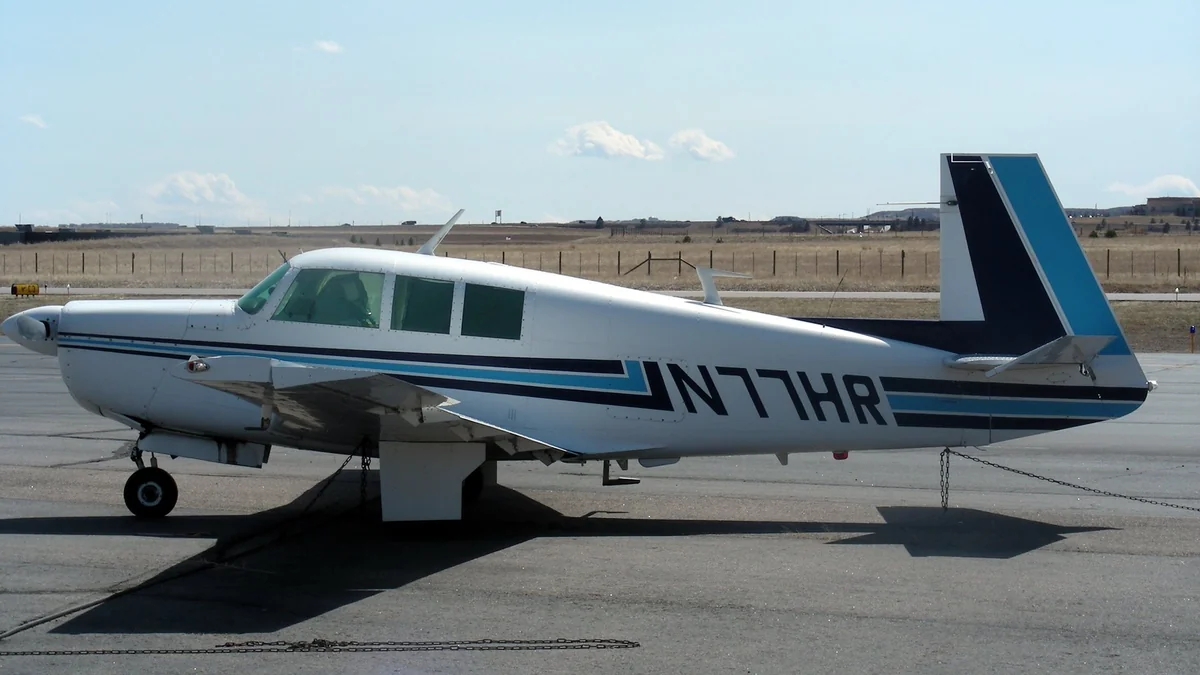
Cover: a Mooney M20F Executive (N77HR) at Centennial Airport, Colorado, the same model as the accident aircraft. Photo: Avitya, Wikimedia Commons, public domain, cropped. This aircraft was not involved in the accident.
Sources
- NTSB, Aviation Investigation Final Report ERA25FA230, Mooney M20F N9573M, Beverly, Massachusetts, published 16 October 2026 (PDF)
- NTSB, investigation docket for ERA25FA230
- FAA, Airplane Flying Handbook (FAA-H-8083-3C), chapter 18, "Emergency Procedures" (PDF)
- AeroCorner, "NTSB: A Loose Spark Plug Made the Beverly Mooney Backfire, but the Steep Turn Back Caused the Crash", 21 October 2026
