Ask three pilots where the rules of the air come from and you may get three answers: "ICAO", "EASA", "AESA" — or, if they fly in the United States, "the FAA". All of those answers are partly right, and that is why the topic confuses people. The names sit on different layers. One layer writes international standards. Another turns them into European law. A third fills in what each State still decides. And on a separate branch, independent bodies investigate accidents: deliberately not the same people who write the rules.
This post is a map of those layers. It focuses on Europe and Spain, with a short comparison to the United States and a few other authorities. It is not legal advice and it does not replace the official texts.
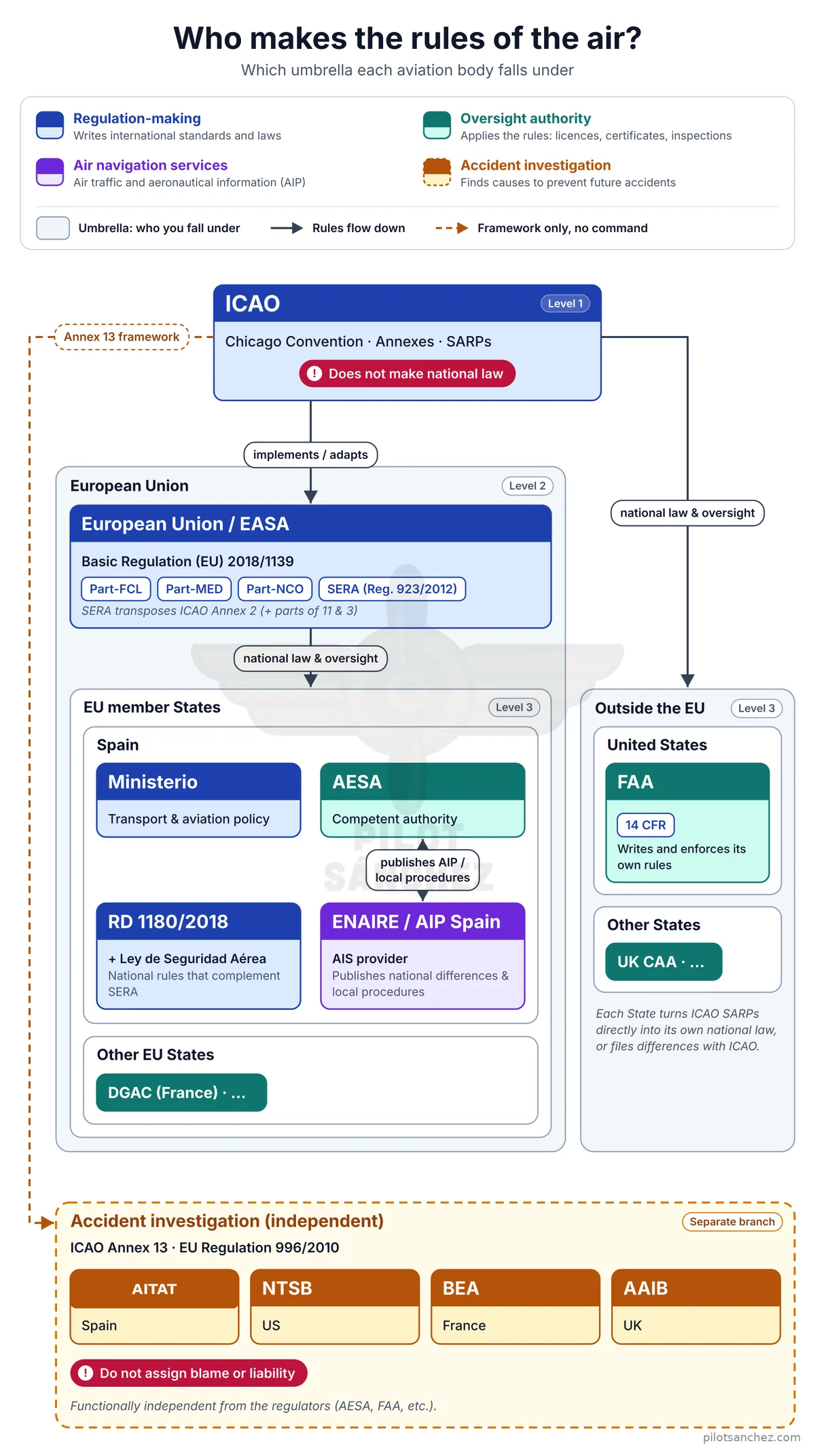
Here is the map of those layers at a glance — ICAO at the top, the EU/EASA path and the authorities outside it, and accident investigation on a separate branch:
ICAO: The Global Framework, Not Your National Law
The International Civil Aviation Organization (ICAO) is a specialized agency of the United Nations, created by the 1944 Chicago Convention (Convention on International Civil Aviation) so that countries could share the sky with common technical standards. Today it helps 193 Member States cooperate on safety, air navigation and related topics.
ICAO's Council adopts Standards and Recommended Practices (SARPs) and groups them in Annexes to the Chicago Convention. There are 19 Annexes. The ones VFR pilots bump into most often include:
- Annex 1 — Personnel Licensing
- Annex 2 — Rules of the Air
- Annex 3 — Meteorological Service
- Annex 11 — Air Traffic Services
- Annex 13 — Aircraft Accident and Incident Investigation
- Annex 15 — Aeronautical Information Services (the AIP world)
Two points matter more than the list:
- ICAO does not make your national law. SARPs are addressed to States. Each State incorporates them into its own rules (in Europe, largely through EU regulations). It is each State — not the EU — that notifies ICAO if it differs from a Standard (Article 38 of the Chicago Convention).
- "Standard" and "Recommended Practice" are not the same. A Standard is something States must apply, or else formally notify ICAO that they differ. A Recommended Practice is something States should try to follow: desirable, but not mandatory.
So when someone says "ICAO requires…", the accurate follow-up is usually: "…and which national or EU rule turns that into something that obliges me?"
The European Union and EASA
In the EU, most civil aviation safety rules are set at EU level. The cornerstone is Regulation (EU) 2018/1139, usually called the Basic Regulation. It sets common essential requirements and is the current legal basis of the European Union Aviation Safety Agency (EASA), which has existed since 2002.
Under that umbrella, the European Commission adopts detailed rules. The ones that matter most to private pilots include:
- Part-FCL (Annex I to Regulation (EU) No 1178/2011) — flight crew licensing: licences, ratings, recent experience.
- Part-MED (Annex IV to the same regulation) — medical certificates and aeromedical examiners.
- Part-NCO (Annex VII to Regulation (EU) No 965/2012) — non-commercial operations with other-than-complex motor-powered aircraft: the operating rules for most club and private flying.
EASA drafts these rules, but the European Commission adopts them, and that is what makes them binding law. EASA also publishes Acceptable Means of Compliance (AMC) and Guidance Material (GM): they are not law, but following an AMC is the accepted way to show you comply.
EU regulations of this kind are directly applicable in Member States. No Spanish law is needed to "transpose" Part-FCL before it binds you. What Spain still does is designate the authority that oversees you, fill the gaps the EU leaves to States, and publish national procedures.
What SERA Is
SERA means Standardised European Rules of the Air. The legal text is Commission Implementing Regulation (EU) No 923/2012, as amended. It lays down the common rules of the air and operational provisions for air navigation services and procedures.
In substance, SERA brings ICAO's rules of the air (mainly Annex 2) into EU law, together with related parts of Annex 11 (air traffic services) and Annex 3 (meteorology), so that VFR and IFR rules, airspace classes, VMC minima, transponder use, ATC clearances and similar topics are written once for Europe.
That is why airspace classes A to G keep quoting SERA for Europe and 14 CFR for the United States: same ICAO letters, different legal instruments.
Spain: National Law, AESA and Royal Decree 1180/2018
Even with SERA and the Basic Regulation in place, Spain still has national aviation law. Two texts matter for this map:
- Ley 21/2003, de 7 de julio, de Seguridad Aérea — Spain's Air Safety Act, passed by Parliament. It sets out the national aviation safety system, accident investigation and the penalty regime (the fines AESA can impose).
- Real Decreto 1180/2018, de 21 de septiembre — approved by the Spanish Government, it implements and supplements SERA in Spain: the national application rules for the rules of the air and common air-navigation procedures, including points SERA leaves to each State. Breaching SERA or this decree is an administrative offence under Ley 21/2003.
Spain also has a Dirección General de Aviación Civil (DGAC) in the Ministry of Transport, which shapes aviation policy and drafts national regulations. Do not confuse it with France's DGAC.
The Agencia Estatal de Seguridad Aérea (AESA) is Spain's competent authority for civil aviation safety oversight in the areas assigned to it: licences, medicals, operations, airworthiness, air navigation service providers, and so on. In everyday terms, AESA is the closest Spanish equivalent of the FAA as the authority that oversees you. The difference: the FAA also writes the US rules and runs air traffic control. In Spain, most rules come from the EU or the Spanish Government, and air traffic services are provided by ENAIRE and other certified providers. AESA works inside the EU/EASA framework, not instead of it.
So a Spanish PPL holder is typically subject at once to: ICAO standards in the background, EU rules drafted by EASA (Part-FCL, Part-MED, Part-NCO), SERA for the rules of the air, and Spanish law (Ley 21/2003, RD 1180/2018) plus AESA oversight for what remains national.
ENAIRE and the AIP: Where Local Reality Lives
The Aeronautical Information Publication (AIP) is the State's official book of lasting aeronautical information. In Spain the AIS portal is run by ENAIRE (aip.enaire.es).
The AIP is where you find:
- FIR boundaries, airspace classifications and controlled, prohibited, restricted and danger areas
- aerodrome charts, frequencies, procedures and opening hours
- national differences from ICAO SARPs (the places Spain does not follow a Standard exactly)
- local procedures that no European regulation tries to spell out aerodrome by aerodrome
ENAIRE is mainly a service provider (air navigation and aeronautical information). AESA is the authority. Mixing those two roles is another common source of confusion: ENAIRE publishes the AIP, but publishing is not regulating — AESA remains the authority.
The AIP is where the State publishes many local requirements you must comply with (airspace, restricted areas, aerodrome procedures). Their legal force comes from the rule or decision behind them, but "it's only in the AIP" is never a reason to ignore them.
Before a cross-country, your preflight briefing still has to include the AIP and NOTAMs. Tools help — the Briefing and the Planner gather weather, performance and routing — but they do not replace the official AIP entry for the aerodromes you intend to use.
How the Layers Fit and Where Each One Stops
Think of four questions, from the top down:
- What have States agreed to apply worldwide? → ICAO Annexes / SARPs.
- Which EU rules bind you directly? → Basic Regulation, Part-FCL, Part-MED, Part-NCO, SERA, and the rest of the EU aviation rulebook.
- What does this State still decide or spell out? → national statutes and decrees (in Spain, Ley 21/2003 and RD 1180/2018), plus the AIP and NOTAMs.
- Who oversees me day to day? → the national competent authority (AESA in Spain; the FAA in the US; the UK CAA after Brexit; France's DGAC, and so on).
Where the reach ends is just as important:
- ICAO cannot fine you or suspend your licence.
- EASA drafts many common rules and checks how national authorities apply them. Your licence is issued by your national authority (AESA in Spain), and your medical certificate by an aeromedical examiner or centre under its oversight.
- SERA standardises the rules of the air; it does not list every Spanish aerodrome procedure — that is AIP territory.
- The AIP publishes many local requirements you must follow; their force comes from the rule or decision behind them, not from the PDF alone.
For Comparison: The FAA and Other National Authorities
Outside the EU system the picture is simpler to draw and easy to misread.
- United States — FAA. The Federal Aviation Administration is both the rule-maker and the oversight authority for civil aviation under Title 14 of the Code of Federal Regulations (14 CFR), and it runs most US air traffic control. US rules also track ICAO SARPs, with differences filed where needed. For US medications the reference is the FAA — see the MedGuide — not EASA Part-MED.
- United Kingdom — UK CAA. Since the end of the Brexit transition period (1 January 2021), the UK CAA has been the regulator for rules that used to come from EASA. The UK kept those EU rules as UK law and now amends them itself.
- France — DGAC. The Direction générale de l'Aviation civile is France's national civil aviation authority. France is an EU Member State, so French GA pilots are subject to EASA rules and DGAC oversight, much as Spanish pilots are subject to EASA rules and AESA oversight.
The pattern repeats: ICAO in the background, then either a regional block (EU/EASA) or a single national code (14 CFR), then a national authority that actually oversees people and organisations.
Accident Investigators: A Separate, Independent Branch
Accident and serious-incident investigation is built to be independent from the regulators. The international frame is ICAO Annex 13. In the EU, Regulation (EU) No 996/2010 requires each Member State to have a permanent safety investigation authority that is functionally independent from the authorities that certify aircraft, issue licences or provide ATC, and that does not seek or take instructions from anyone.
Examples you will see cited in reports:
- Spain — AITAT (Autoridad Administrativa Independiente para la Investigación Técnica de Accidentes e Incidentes ferroviarios, marítimos y de aviación civil). Until it was constituted, the CIAIAC kept investigating under the transitional rules of Ley 2/2024 and Real Decreto 141/2026. AITAT's Council held its constitutive session on 15 July 2026; from that date the CIAIAC was replaced by AITAT. Older Spanish reports still carry the CIAIAC name.
- NTSB — National Transportation Safety Board (United States). Its reports speak of probable cause: that is a safety finding, not a finding of guilt.
- BEA — Bureau d'Enquêtes et d'Analyses (France)
- AAIB — Air Accidents Investigation Branch (United Kingdom)
Their job, in Annex 13 and EU language, is to improve safety: establish the facts, analyse them, draw conclusions and issue safety recommendations. They are not there to assign blame or liability. Court cases, insurance claims and administrative sanctions are separate processes.
A Practical Way to Read Any Rule
When a forum post or an instructor says "the rule is…", ask four short questions:
- Which layer? ICAO Annex, EU regulation (SERA, Part-FCL…), national decree, or AIP/NOTAM?
- Who oversees me here? AESA, FAA, UK CAA, DGAC…
- Does this come from an accident investigation? If it is Annex 13 / CIAIAC / AITAT / NTSB / BEA / AAIB, read it for lessons, not as a guilty verdict.
- What did I actually prepare for this flight? Weather, fuel, airspace and the AIP entry still sit with you as pilot-in-command.
Keep this map handy: the acronyms get less scary once you know which layer each one belongs to.
Diagram: Pilot Sanchez. Not an official organisation chart of any authority.
Sources
- ICAO, About ICAO
- Regulation (EU) 2018/1139 (Basic Regulation), EUR-Lex
- EASA, Basic Regulation page
- Commission Regulation (EU) No 1178/2011 (Aircrew: Part-FCL, Part-MED), EASA
- Commission Regulation (EU) No 965/2012 (Air Operations, including Part-NCO), EASA
- Commission Implementing Regulation (EU) No 923/2012 (SERA), EUR-Lex
- EASA, Easy Access Rules for SERA
- Ley 21/2003, de 7 de julio, de Seguridad Aérea (BOE)
- Real Decreto 1180/2018 (BOE)
- AESA (Agencia Estatal de Seguridad Aérea)
- ENAIRE, AIP Spain
- Regulation (EU) No 996/2010 (accident investigation), EUR-Lex
- CIAIAC, presentation (Ministerio de Transportes)
- Ley 2/2024 (creates AITAT), BOE
- Real Decreto 141/2026 (organic statute of AITAT; CIAIAC suppressed on constitution), BOE
- FAA, mission
- 14 CFR (eCFR)
- UK Civil Aviation Authority
- DGAC (France), official page
- NTSB, About
- BEA, The BEA
- AAIB (UK)
