Very few runways point straight into the wind. Most days there is some angle between the windsock and the centreline, and on some days that angle and the wind strength together make the last 50 feet of the flight the hardest part of it. Crosswind landings are a skill every pilot learns during training, and one that fades quickly without practice. This guide covers how to work out what you are dealing with, the two standard techniques, what happens after touchdown, and how to decide when the answer is a different runway.
First, work out the crosswind component
The number that matters is not the wind speed but the part of it blowing across the runway. That crosswind component depends on the angle between the wind and the runway:
- At 30° off the runway, the crosswind is half the wind speed (sin 30° = 0.50).
- At 45°, it is about 70% (sin 45° ≈ 0.71).
- At 60°, it is about 87% (sin 60° ≈ 0.87).
- At 90°, all of it is crosswind.
An example: you are landing on runway 27 and the wind is 300° at 15 knots. The angle is 30°, so the crosswind is about 7.5 knots and the headwind about 13. If the wind backs to 330° at the same speed, the angle is 60° and the crosswind becomes about 13 knots. A small change in direction makes a big difference. Many pilots remember this with the "clock" rule of thumb (15° is a quarter, 30° is half, 45° about three quarters, 60° or more is nearly all of it), and the crosswind component chart in the FAA's Airplane Flying Handbook, chapter 9 does the same job graphically.
Two details catch people out:
- True or magnetic. Runway numbers are magnetic (our post on runway numbers explains why). The wind in a METAR or TAF is given in degrees true, while the wind on the ATIS and from the tower is magnetic, as the Flight Safety Foundation's ALAR Briefing Note 8.6 on wind information and the FAA's AIP GEN 2.1 both state. Where magnetic variation is small it hardly matters; where it is large, convert before you do the sum.
- Gusts. The same briefing note explains that ATIS and tower winds are normally a two-minute average, with the gust being the peak over the last 10 minutes. For planning, work out the crosswind with the gust value as well as the steady wind. If the gust figure is beyond what you are comfortable with, that is your answer.
If you need a refresher on decoding the wind group (30015G25KT, variable winds such as 270V330), see How to Read a METAR and TAF. Our Briefing tool loads the departure weather, which is a good moment to do this sum before you even get to the aircraft.
What "maximum demonstrated crosswind" really means
Your POH or AFM gives a crosswind figure, and it is often misunderstood. According to the Airplane Flying Handbook, before an aeroplane is type certificated by the FAA it must show that it is satisfactorily controllable, "with no exceptional degree of skill or alertness on the part of the pilot", in 90° crosswinds up to 0.2 VSO, that is, two tenths of its power-off stall speed in the landing configuration. An aeroplane that stalls at 50 knots in that configuration has to be shown controllable in a 10-knot direct crosswind. The demonstrated value is placarded in aeroplanes certificated after 3 May 1962.
The Flight Safety Foundation's briefing note adds three points worth remembering. The maximum demonstrated crosswind is the highest crosswind component actually met and documented during certification or later tests. It is not an operating limitation unless the manual says it is. And it is not necessarily the most the aircraft can handle, and it generally applies to a steady wind.
In other words, it is not a legal limit, but it is not a challenge either. It is the point beyond which you become a test pilot. For the Cessna 172, NTSB reports quote the manufacturer's figure: the Carson City report on a 172M gives a maximum demonstrated crosswind of 15 knots, and the Lebanon, Kentucky report quotes the POH saying that "with average pilot technique, direct crosswinds of 15 knots can be handled with safety". Check the figure in the manual of the aircraft you are actually flying.
The two techniques
The Airplane Flying Handbook describes two usual methods: the crab and the wing-low, or sideslip. It recommends the wing-low method in most cases, says a combination of both may be used, and adds that pilots should learn both.
The crab
With the crab method you turn the nose into the wind just enough for your wings-level track to follow the extended centreline. The aircraft points one way and moves another. It is comfortable and easy to hold on a long final. The difficulty comes at the end: just before touchdown you have to use rudder to swing the nose into line with the runway, and the handbook warns that doing it too early or too late lands the aircraft with a side load on the gear. A common approach is to crab on the early part of final and change smoothly to the wing-low method before the flare.
The wing-low (sideslip)
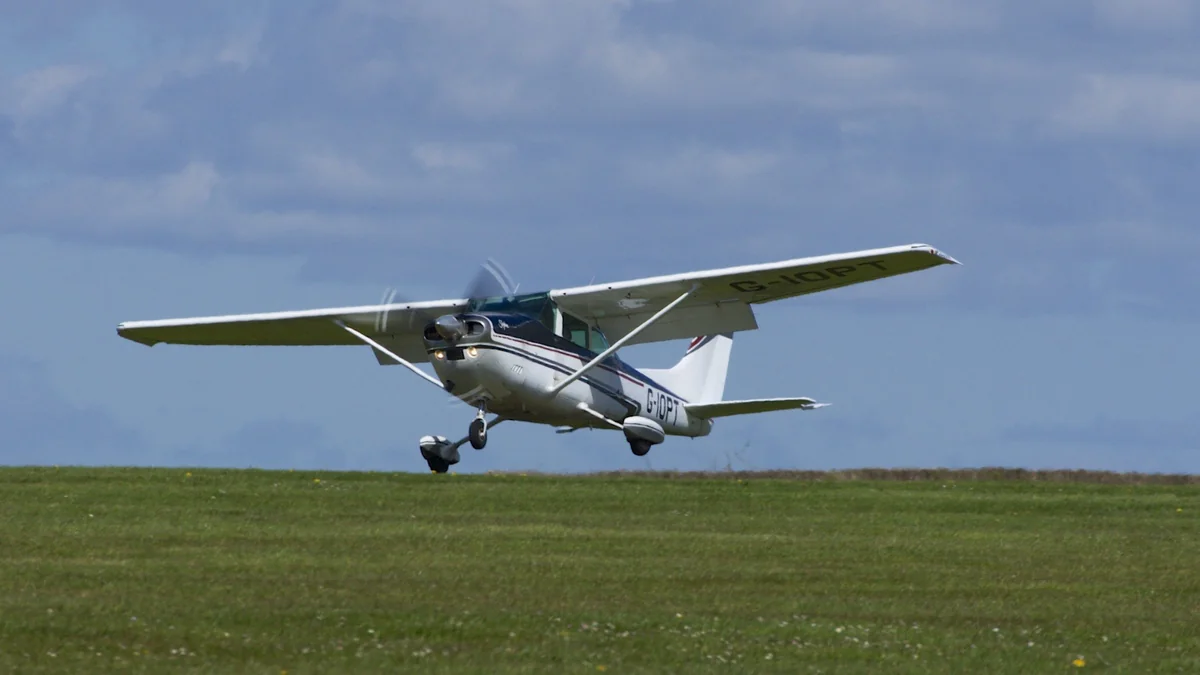
With the wing-low method you use rudder to line the nose up with the runway, see which way you drift, and then lower the upwind wing with aileron just enough to stop the drift. Rudder keeps the nose straight, aileron keeps you on the centreline. If the aircraft drifts downwind, add bank. If it starts moving upwind, take a little off. The great advantage is that the correction is already set up long before touchdown, so there is no last-second heading change. The cover photo shows exactly this: a Cessna 182 arriving on grass with its upwind wing down.
The handbook makes an important point here. As the crosswind gets stronger you need more bank and more opposite rudder. In some aircraft there is not enough rudder travel to stop the turn caused by a steep bank. If full opposite rudder no longer keeps you straight, the wind is too strong for that runway, and you need a better-aligned runway or another aerodrome. That is the honest test of your aircraft's capability on the day, and you find it on short final, not in the flare.
Flare, touchdown and rollout
The flare is where most crosswind landings go wrong, because the controls become less effective as the airspeed decreases. The handbook's advice is to keep increasing the rudder and aileron deflection through the round out to hold the same correction, and to keep the upwind wing down. If you level the wings, the aircraft drifts and touches down sideways. With the wing-low method the first contact is on the upwind main wheel, and the downwind wheel settles as the aircraft slows down.
In aircraft whose nosewheel steering is connected to the rudder pedals, the nosewheel is not aligned with the runway when the mains touch down, because you are still holding opposite rudder. The handbook says to relax that rudder pressure as the nosewheel touches down, or the aircraft will swerve.
The landing is not over at touchdown. On the ground the aircraft can no longer drift with the air mass, and because there is more side area behind the main wheels than in front of them, it tends to weathervane into the wind. As you slow down, the relative wind comes more and more from the side, the ailerons lose effectiveness, and the upwind wing gets more lift. So you need more aileron into the wind as the aircraft decelerates, ending with the control fully into wind when you stop. The handbook also warns that touching down while drifting can create a side load on a tyre big enough to lift one main wheel and tip a high-wing tricycle-gear aircraft over, and that brakes will not prevent it.
For gusty conditions the handbook suggests partial flaps and adding half the gust factor to the normal approach speed (with a normal 70 knots and gusts of 15 knots, about 77 knots), always within what the AFM or POH recommends. It also suggests keeping some power on until the main wheels are on the ground.
And on take-off
The same physics apply in reverse. The handbook's chapter on take-offs says to start the roll with full aileron into the wind and rudder to stay straight, then reduce the aileron as it becomes effective, without letting the upwind wing rise. If the wing comes up, the aircraft can start "skipping" sideways in small bounces, which puts severe side loads on the gear. In a significant crosswind, hold the main wheels on the ground a little longer for a clean, definite lift-off, then turn into wind to crab along the extended centreline in the climb.
What the accident reports show
Crosswind accidents in light aircraft are rarely dramatic in flight. They happen on the runway, at low speed, after the pilot thinks the hard part is over. Three short reports show the pattern:
- In Kentucky in 2019, a Cessna 172 encountered what the pilot called a "big gust of wind" during the landing roll, veered left, left the runway, hit a ditch and nosed over. The weather station reported 190° at 10 knots gusting 18 about ten minutes later, and the NTSB calculated a crosswind component of about 14 knots, close to the POH figure quoted above (NTSB GAA19CA367).
- In Georgia in 2021, a Cessna 172R pilot knew the wind was gusting 12 to 20 knots, "on the high end of his personal minimums". He flew a sensible approach with 10° of flap and extra speed, but after the nosewheel was down and he started braking, a gust pushed the aircraft off the edge of the runway, and the propeller and a wingtip struck the ground (NTSB ERA21LA119).
- In South Australia in 1997, a student pilot in a Cessna 172M said that when the speed had dropped to about 30 knots he relaxed too soon and did not keep enough aileron into wind. A gust swung the aircraft, the wingtip touched the ground and it nosed over onto its back (ATSB 199702714).
In all three, the aircraft was already on the ground. That is a good reason to keep flying the aircraft, with full control inputs, until it has stopped.
Practical habits that help
- Set a personal crosswind limit below the demonstrated figure, and lower it when you are out of practice or flying an unfamiliar type. Decide it on the ground, not on final.
- Do the sum before departure for your destination and your alternates, using both the steady wind and the gust. A strong wind that is straight down the runway at one aerodrome can be a direct crosswind at the next.
- Know your local winds. In southern Spain, for example, the Levante and Poniente can blow strongly and gust, often at an angle to the runway in use; our guide to Levante and Poniente covers how they behave.
- Look at the windsock on short final, not just the reported wind. The FSF note points out that the wind sensor may be some distance from the touchdown zone.
- Go around early if you cannot keep the nose straight and the aircraft on the centreline with the controls you have left. A go-around is a normal manoeuvre, and another runway or aerodrome is a perfectly good plan.
- Practise with an instructor on a day with a moderate, steady crosswind. It is the best way to keep the skill fresh before you need it on a gusty day.
Sources
- FAA, Airplane Flying Handbook (FAA-H-8083-3C), chapter 9: Approaches and Landings and chapter 6: Takeoffs and Departure Climbs.
- Flight Safety Foundation, ALAR Briefing Note 8.6: Wind Information.
- FAA, AIP GEN 2.1: Measuring System (wind direction units).
- NTSB final reports GAA19CA367, ERA21LA119 and LAX94LA310; ATSB investigation 199702714.
This article is general information and does not replace your aircraft's POH or AFM, or training with a qualified instructor.
Cover: Cessna 182P G-IOPT landing in a strong crosswind at Compton Abbas, Dorset. Photo by Ian Kirk, Wikimedia Commons, CC BY 2.0.
