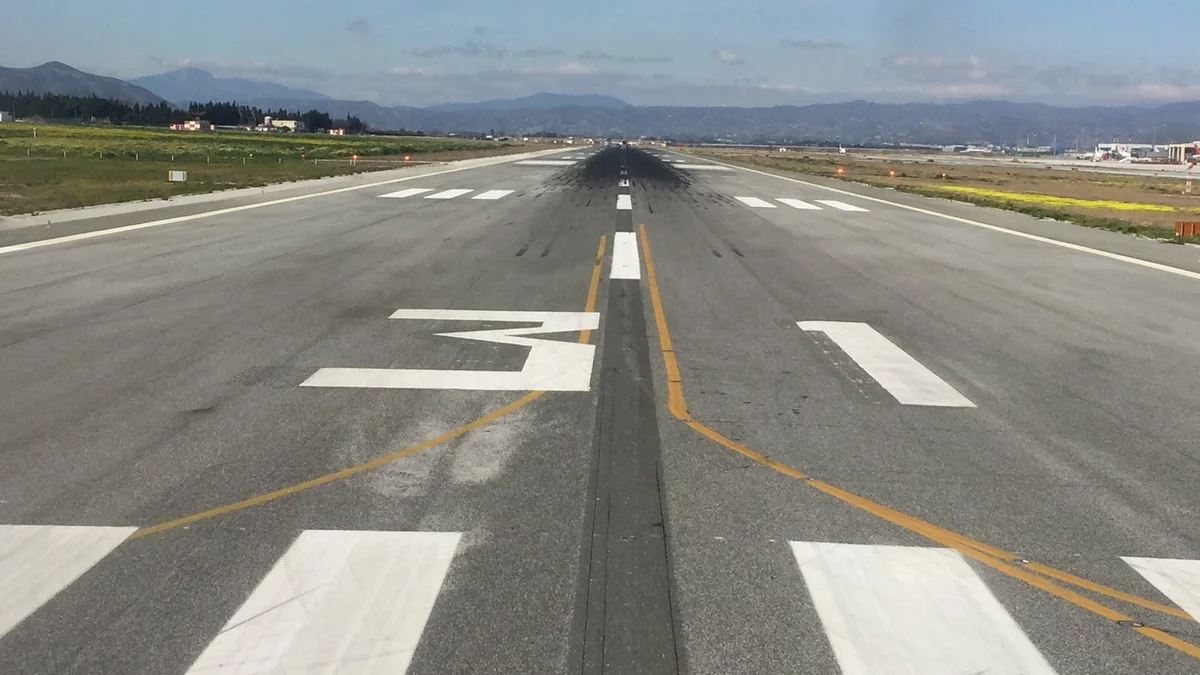
On the evening of 19 September 2012, crews at Madrid-Barajas went out with paint rollers and new signs. By five the next morning, the two southern runways that pilots had known for years as 15L/33R and 15R/33L were officially 14R/32L and 14L/32R. Nothing had been dug up or rotated. The concrete was exactly where it had always been.
What had moved was magnetic north.
Runway numbers look like the most boring thing on an aerodrome chart. They are actually a slow-motion record of the Earth's magnetic field, with a few odd rules and exceptions that are worth knowing whether you fly a Cessna out of a grass strip or just like watching approaches at Málaga.
The basic rule: magnetic heading, divided by ten
A runway's number is its magnetic bearing, rounded to the nearest ten degrees, with the last zero dropped. Line up on a runway pointing 143° magnetic and you are on runway 14. Turn round and look the other way, 323°, and the same strip of asphalt is runway 32. The two ends of a runway always differ by 18, because they differ by 180°.
A few consequences follow from that:
There is no runway 0. A runway pointing north is 36, not 00.
Single digits get a leading zero under ICAO practice: runway 06, "zero six". Most US civil airports drop the zero (runway 6), which is why you sometimes hear American pilots and European controllers saying the same runway slightly differently.
Digits are read individually on the radio: "runway one four left", never "runway fourteen".
The real bearing is published in the AIP, and it is rarely a round number. The ENAIRE AIP lists Barajas runway 14L at 142.21° true and 143° magnetic, and runway 18L at 179.76° true and 180° magnetic. In other words, at Madrid today, magnetic and true north are almost on top of each other.
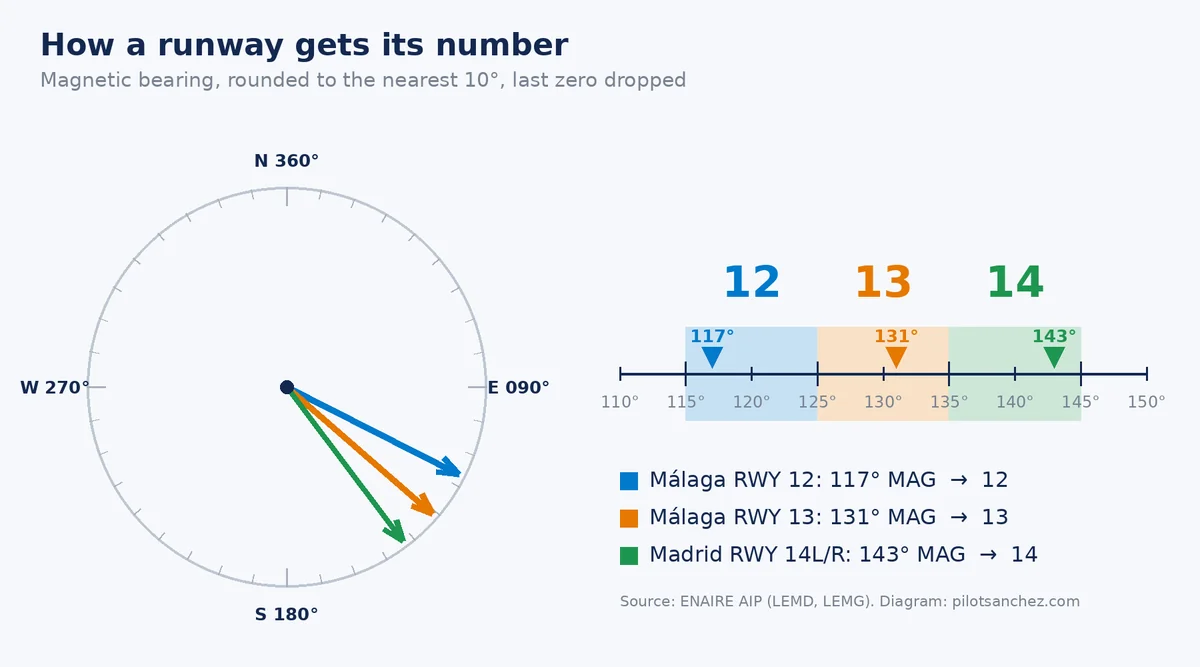
How the magnetic bearing becomes the number. Bearings from the ENAIRE AIP for Madrid-Barajas (LEMD) and Málaga (LEMG).
Why magnetic, and why that causes trouble
Runways were numbered to match what pilots actually saw on the instrument they trusted most: the magnetic compass. Line up, glance at the compass or the heading indicator, and the number on the tarmac should agree with the number in front of you. It is a simple, powerful cross-check.
The catch is that magnetic north wanders. The difference between true and magnetic north (magnetic variation, or declination) changes year by year, and the published figures show it. The ENAIRE AIP gives Madrid-Barajas a magnetic variation of 0° (2020) with an annual change of 8.1' east. For Málaga it gives 0° (2025) with an annual change of 9.1' east.
A few minutes of arc a year doesn't sound like much. But runway numbers are rounded to ten degrees, so a runway sitting near a boundary only needs a small shift to tip over. Both of those annual changes point east, and when variation moves east, the magnetic bearing of a runway that hasn't moved gets slightly smaller. That's consistent with the two big Spanish renumberings of recent years, which both went down:
Madrid-Barajas, 20 September 2012: 15L/33R and 15R/33L became 14R/32L and 14L/32R. According to Telemadrid, around 40 signs had to be changed, along with charts, documents and information systems. Note the letters too: the old 15L became 14R.
Barcelona-El Prat, 24 March 2022: the parallel runways 07L/25R and 07R/25L became 06L/24R and 06R/24L. Aena explained that the runways were no longer oriented on headings of 070° and 250° but of 060° and 240°.
It happens everywhere. London Stansted went from 05/23 to 04/22 overnight in 2009. In Alaska, where the field changes faster, Fairbanks International has renamed its runways roughly every 24 years, according to NOAA's National Centers for Environmental Information.
Left, Centre, Right (and when the system runs out of letters)
When an aerodrome has parallel runways, letters separate them as seen by a pilot approaching from that direction: L for left, R for right, and C for centre if there are three. So runway 14L, used the other way, becomes 32R.
Four or more parallels break the system, so the biggest airports cheat by shifting one pair by ten degrees. Los Angeles has 6L, 6R, 7L and 7R, all roughly parallel. Dallas/Fort Worth has five parallel runways named 17L, 17C, 17R, 18L and 18R, all on the same heading of about 175°. The numbers are "wrong" on purpose, because clarity on the radio matters more than precision on the compass.
Barajas, by the way, isn't one set of four parallels but two pairs: 14L/R and 18L/R, about 37° apart, which is why its numbers look the way they do.
Málaga's two runways that are only one number apart
Málaga-Costa del Sol is a nice example for anyone flying around the Costa del Sol. It has two runways, 13/31 and 12/30, and they are not parallel. The AIP gives runway 13 at 131° magnetic and runway 12 at 117° magnetic. The difference is 14°, but rounding puts them only one number apart.
That has a practical consequence. If you are working out a crosswind for runway 12 and you assume it points at 120°, you are off by three degrees. Not a disaster in most cases, but it is a habit worth breaking: use the published magnetic bearing, not the runway number times ten, when it matters.
Places where north is "true"
Near the magnetic pole, compasses become unreliable, so some aerodromes number their runways from true north instead and add a T. Thule Air Base in Greenland (now Pituffik Space Base) has used runway 08T/26T. In northern Canada, runways inside the Northern Domestic Airspace are designated from true north, which also means they never need renumbering. NAV CANADA has even argued for the whole industry to move to true north eventually.
Bonus: the stripes tell you the width
The "piano keys" at the threshold aren't decoration either. Under ICAO Annex 14, the number of stripes depends on the runway width: 4 stripes for 18 m, 6 for 23 m, 8 for 30 m, 12 for 45 m and 16 for 60 m. Next time you line up at a big airport, count them.
What this means in the cockpit
Use the number as a cross-check. Before take-off, confirm that your heading indicator agrees with the runway number you were cleared for. It is one of the simplest defences against lining up on the wrong runway.
Read the AIP or the aerodrome chart, not just the number. When the exact bearing matters, as in a crosswind calculation, use the published QFU.
Know which winds are true and which are magnetic. Under ICAO practice, wind in METARs and TAFs is given in degrees true, while the wind passed by the tower or ATIS for take-off and landing is magnetic. In most of Spain today the difference is close to zero, but it isn't elsewhere, so it's a good habit to get right.
Check for renumbering. If you are using an old printed chart, a downloaded procedure or a memorised mental picture of an aerodrome you haven't visited in years, check the current AIP. The runway may have a new name.
If you are planning a VFR trip, our VFR planner is a good place to sketch the route, check airspace and fuel. Then open the AIP for each aerodrome and note the runway bearings, not just the numbers.
FAQ
What do runway numbers mean?
They are the runway's magnetic bearing rounded to the nearest 10° with the last digit dropped. Runway 27 points roughly 270° magnetic (west); runway 09 points roughly 090° (east).
Why are runways renumbered?
Because magnetic variation changes over time. When a runway's magnetic bearing crosses a rounding boundary, the airport repaints the numbers and updates signs and charts. Madrid-Barajas did it in 2012 and Barcelona-El Prat in 2022.
Why is there no runway 0?
A runway pointing north is designated 36 (360°) rather than 00.
What do L, C and R mean after a runway number?
Left, Centre and Right. They identify parallel runways as seen by a pilot approaching or departing in that direction.
Sources
Aena press release, 19 September 2012: Madrid-Barajas changes runway designations 15/33 to 14/32
Telemadrid, 20 September 2012: Barajas runways operating under new names
Aena, 24 March 2022: Barcelona-El Prat parallel runways change designation
ENAIRE AIP AD 2 LEMD (Madrid-Barajas): runway bearings and magnetic variation
ENAIRE AIP AD 2 LEMG (Málaga-Costa del Sol): runway bearings and magnetic variation
NAV CANADA: Switching to True, pulling away from magnetic north
ICAO A40-WP/224: Annex 14 runway threshold markings (stripe numbers by width)
Wikipedia: Runway (naming, suffixes, renumbering; citing FAA and Jeppesen material)
Cover: runway markings at Málaga-Costa del Sol (LEMG). Photo by Andrew Nash, Wikimedia Commons, licensed CC BY-SA 2.0, cropped. Diagram: pilotsanchez.com, based on ENAIRE AIP data.
