
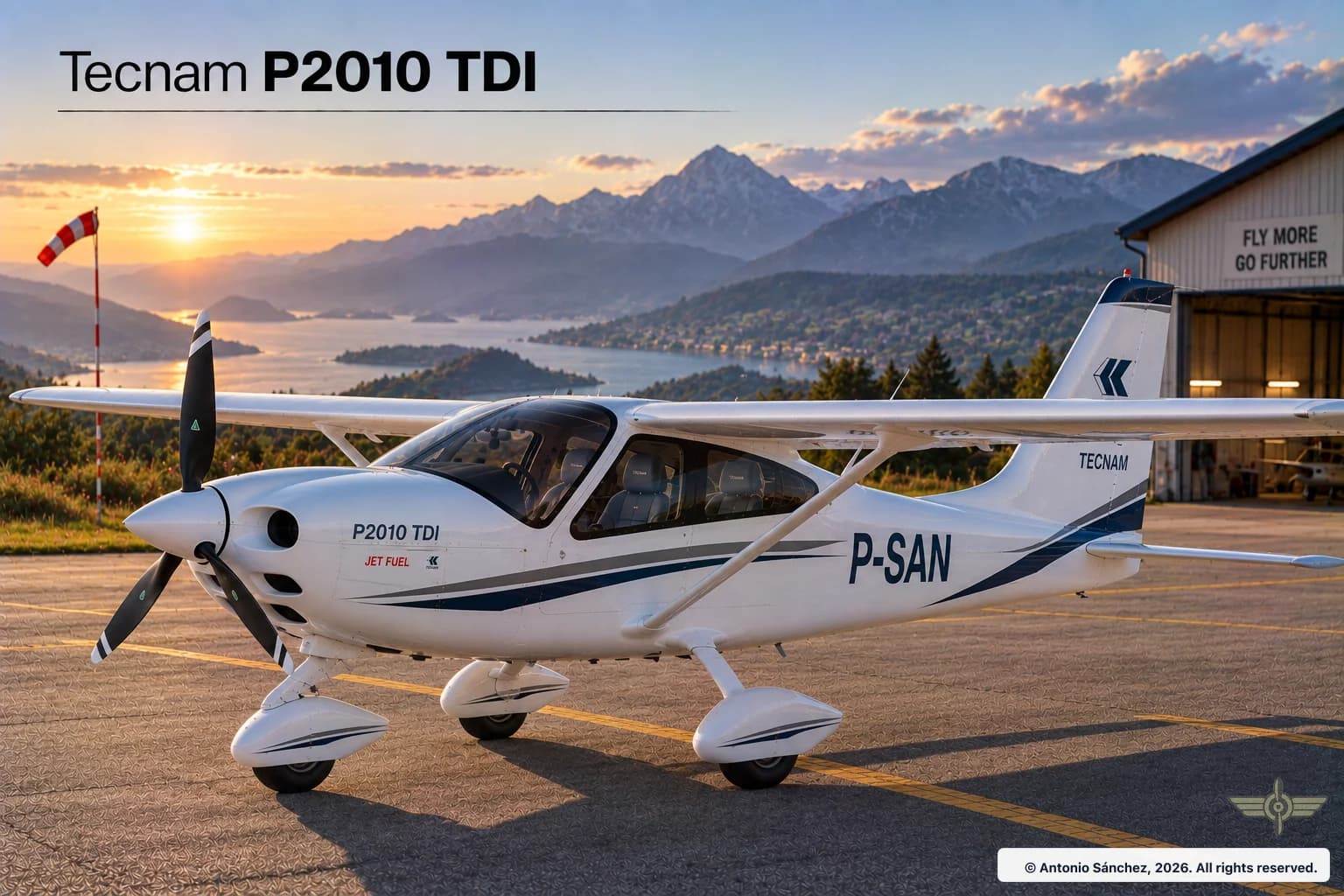
Tecnam P2010 TDI Pilot Briefing Guide
The Tecnam P2010 TDI is a modern aircraft featuring a diesel engine, which presents unique operational characteristics compared to the avgas variants. This guide focuses on briefing pilots on the performance data contained in the Pilot Operating Handbook (POH) and offers practical insights to ensure safe and efficient flying.
V-Speed Categories
| Speed | Value (Knots) |
|---|---|
| Vso (stalling speed in landing configuration) | 45 |
| Vs (stalling speed in clean configuration) | 50 |
| Vx (best angle of climb speed) | 61 |
| Vy (best rate of climb speed) | 73 |
| Vfe (maximum flap extended speed) | 110 |
| Vno (maximum structural cruising speed) | 122 |
| Vne (never exceed speed) | 160 |
Weight & Balance Considerations
When briefing on weight and balance, emphasize the importance of understanding the specific loading characteristics of the P2010 TDI. Typical flight schools may have a standard loading configuration for training purposes, which often includes multiple students and fuel for extended flight. This can lead to a scenario where the aircraft is loaded near its maximum weight, impacting performance significantly.
In contrast, private operators might fly with varying payloads, which can lead to different center of gravity (CG) positions. Pilots must be diligent in calculating weight and balance for each flight, considering both the payload and fuel load. Remind students that even small deviations in weight can lead to substantial differences in climb performance, landing distance, and overall handling characteristics.
Density Altitude and Hot-Day Takeoff
Density altitude plays a critical role in the P2010 TDI’s performance. On hot days, pilots need to adjust their mindset and calculations accordingly. The diesel engine has different performance characteristics than the avgas engine, particularly in climb performance.
Encourage pilots to utilize the density altitude table in the POH to determine their takeoff distances under various conditions. Emphasize that on hot days, the aircraft's takeoff distance will increase, and climb rates will decrease. Remind them to plan for longer takeoff rolls and reduced climb performance, which may necessitate a longer runway or an alternate departure procedure.
Flap and Power Technique Differences
Pilots transitioning from other aircraft types often confuse flap and power techniques. The P2010 TDI has specific flap settings that should be adhered to for optimal performance.
For takeoff, the recommended flap setting is 0° or 10°, depending on the runway length and conditions. Pilots should avoid deploying flaps beyond the recommended settings as this can lead to increased drag and reduced takeoff performance.
In terms of power management, the P2010 TDI is equipped with a Continental TAE 125-02-125 engine that requires careful throttle management. Unlike the avgas variants, the diesel engine operates optimally at specific RPMs. Pilots should be trained to maintain RPM within the green arc of the tachometer to ensure efficient fuel consumption and climb rates.
Takeoff and Landing Distance Briefing
When briefing takeoff and landing distances, focus on the critical variables that influence these calculations. The POH provides detailed tables that account for weight, configuration, and environmental conditions.
For takeoff, ensure pilots understand that both the ground roll and the total distance over a 50-foot obstacle are critical metrics. Factors such as density altitude, wind, and aircraft weight will significantly impact these distances.
For landing, remind pilots to consider the landing distance over the same 50-foot obstacle, which can vary dramatically based on flap settings and approach speed. Pilots should always reference the appropriate tables in the POH to ensure they are making informed decisions based on current conditions.
Cruise Fuel and Reserve Discipline
Fuel management is paramount, especially in a diesel engine like the one in the P2010 TDI. Pilots should be briefed on the importance of cruise fuel consumption rates as outlined in the POH.
Highlight the need for discipline in fuel reserves. The POH specifies minimum fuel requirements for go/no-go decisions, which should not be overlooked. Pilots must always plan to have sufficient fuel reserves to reach their destination with a comfortable margin.
Instruct pilots to regularly check their fuel flow and calculate remaining fuel based on current consumption rates. Emphasize that while it may be legal to operate with minimal fuel, it’s essential to prioritize safety and operational integrity.
When to Say No-Go Despite Legal Limits
In aviation, just because something is legal does not mean it is safe. Encourage pilots to develop a strong safety mindset. Conditions that may necessitate a no-go decision include:
- Excessive weight: If the aircraft is loaded to the maximum limits with little margin for error.
- Adverse weather: Poor visibility, strong winds, or significant turbulence can all impact safety.
- Unfamiliarity with the aircraft: If a pilot does not feel confident in their knowledge of the P2010 TDI’s systems or performance.
- Poor pre-flight planning: If the pilot is unprepared for the flight, including lack of route planning or fuel calculations.
Pilots should be reminded that their safety and that of their passengers should always come first, regardless of legal limits.
Using Pilot Sanchez
- Briefing: Use the Tecnam P2010 TDI briefing to prepare for flights with accurate performance data.
- Planner: Reference the How to plan with your plane guide to ensure thorough pre-flight planning.
- Analysis: Post-flight, utilize the Flight analysis guide for performance review and learning.
About this model
The Tecnam P2010 TDI appeals to operators due to its compatibility with Jet-A logistics, making it an efficient choice for flight schools and private pilots alike. The diesel engine not only allows for broader fuel availability but also presents unique operational characteristics that pilots must adapt to.
Transitioning from avgas-powered aircraft, pilots often need to unlearn certain climb habits. The P2010 TDI’s climb profile is inherently different, with a focus on maintaining optimal RPM and understanding how the diesel engine performs under various weight and density altitude conditions.
A thorough understanding of these nuances ensures that pilots can maximize the performance of the P2010 TDI while maintaining safety and efficiency in their flying operations.