
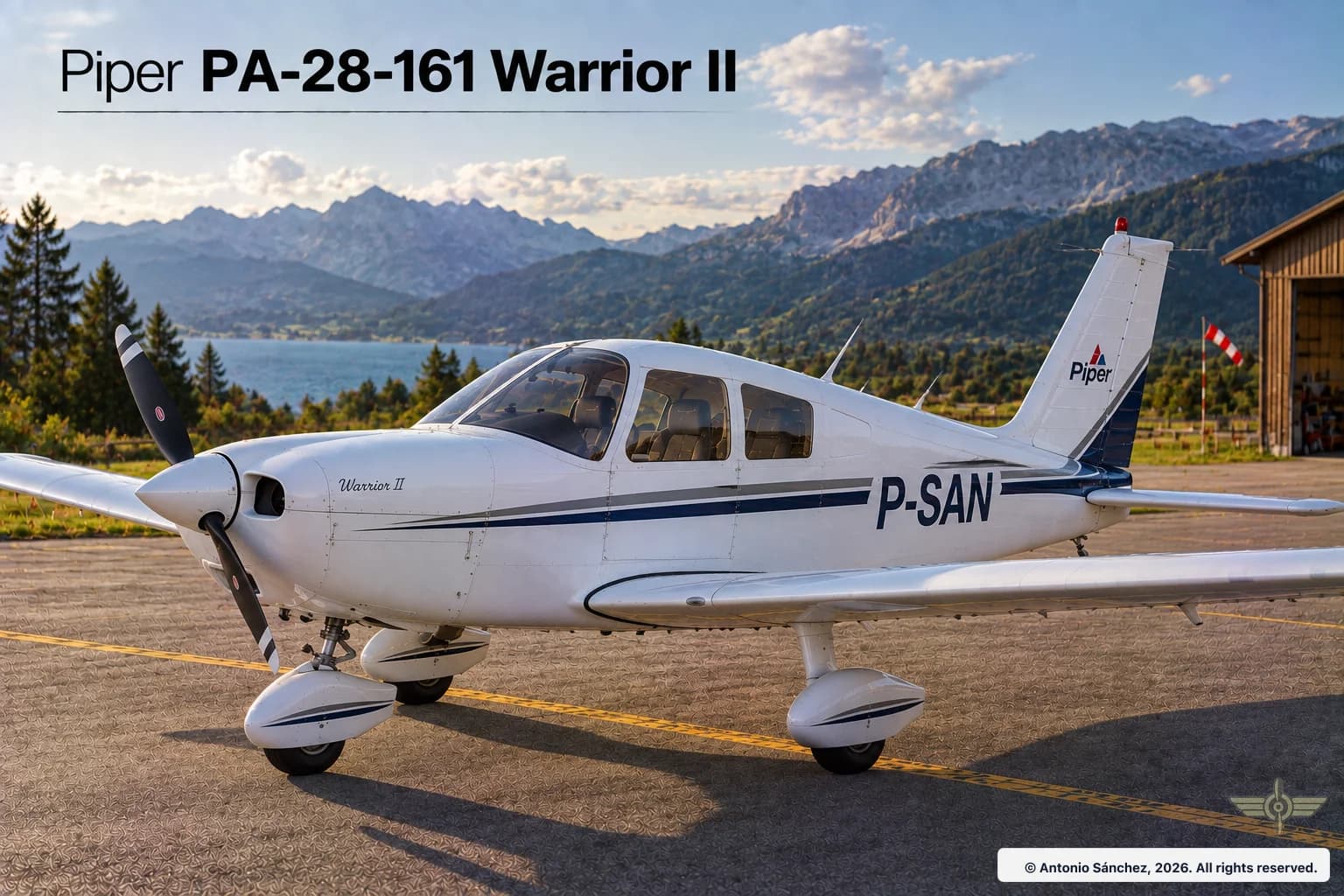
Piper PA-28-161 Warrior II Briefing Guide
The Piper PA-28-161 Warrior II is a well-regarded low-wing aircraft that serves as a primary trainer and touring aircraft. Understanding its performance parameters and characteristics is crucial for effective and safe operation. This guide will focus on the key aspects of briefing the Warrior II using the Pilot's Operating Handbook (POH) performance section.
V-Speed Categories
| V-Speeds | Knots (KIAS) |
|---|---|
| Vso (stalling speed in landing configuration) | 47 |
| Vs (stalling speed in clean configuration) | 61 |
| Vx (best angle of climb speed) | 64 |
| Vy (best rate of climb speed) | 75 |
| Vfe (maximum flap extended speed) | 102 |
| Vno (maximum structural cruising speed) | 125 |
| Vne (never exceed speed) | 150 |
Weight & Balance Pitfalls
One of the most critical aspects of flight preparation is ensuring proper weight and balance. The Warrior II has a maximum takeoff weight of 2,550 lbs. However, it is vital to consider how the aircraft is loaded, especially in school versus private flight scenarios.
In a typical school environment, multiple students may share the aircraft, leading to inconsistent loading practices that may not be ideal for performance. For example, students often overlook the impact of baggage placement and fuel load on aircraft balance. Always ensure that the center of gravity (CG) falls within the limits specified in the POH.
When conducting weight and balance calculations, use the most current weight and balance sheet and consider the following:
- Total weight versus maximum weight limits.
- CG location and its effect on aircraft handling.
- Fuel load and its distribution.
Density Altitude / Hot-Day Take-off Mindset
Density altitude plays a significant role in aircraft performance. On hot days or at high elevations, the aircraft will require longer takeoff distances, reduced climb rates, and potentially increased landing distances.
As a rule of thumb, for every 1,000 feet above sea level, decrease your aircraft performance by approximately 10%. Always refer to the POH performance charts for the specific impact of density altitude on takeoff and landing distances.
-
Takeoff Planning: When operating in high-density altitude conditions, plan for longer takeoff rolls. Use the POH to assess the required takeoff distance and consider reducing payload if necessary.
-
Climb Considerations: Be prepared for reduced climb rates. Use Vy to maximize your climb performance in these conditions.
Flap and Power Technique Differences
Students often confuse flap and power techniques between the Warrior II and other aircraft, especially the Cessna 172.
In the Warrior II:
-
Flaps: The aircraft has a maximum flap extension speed (Vfe) of 102 KIAS. The flaps should be deployed for short-field takeoffs and landings, but the approach and landing techniques differ from the Cessna. Students should practice using flaps in conjunction with power settings to manage airspeed effectively.
-
Power Settings: The Warrior II requires specific power settings for various phases of flight. For example, during a short-field takeoff, apply full power without hesitation, and maintain directional control.
Encourage students to become familiar with the flap configurations and power settings specific to the Warrior II to build muscle memory.
Take-off and Landing Distance Briefing
Takeoff and landing distances are critical for ensuring safety, especially in confined spaces. The POH provides charts detailing takeoff and landing distances based on weight, temperature, and altitude.
Key Inputs for Take-off and Landing Distances:
- Weight: Heavier weights require longer distances.
- Altitude: Higher altitudes will increase takeoff and landing distances.
- Temperature: Hot conditions will impact performance.
Always calculate takeoff and landing distances based on the worst-case scenario, and factor in a safety margin. For instance, if the takeoff distance is calculated at 1,000 feet, aim for a runway that is at least 1,500 feet long.
Cruise Fuel and Reserve Discipline
The Warrior II has a fuel capacity of 50 gallons, with 48 gallons usable. Fuel management is essential for safe flight operations.
-
Cruise Consumption: Be aware of the fuel consumption rate, which is approximately 8 to 10 gallons per hour at cruising speed.
-
Reserve Fuel: Always maintain a minimum reserve of 30 minutes of fuel, ideally 1 hour, to account for unforeseen circumstances.
Encourage students to perform fuel calculations prior to flight and to regularly check fuel levels during the flight to prevent running low.
When to Say No-Go Despite Legal Limits
It is essential to prioritize safety over regulatory compliance. Legal limits may allow you to operate under certain conditions, but if those conditions compromise safety, it's wise to say no-go.
-
Weather Conditions: If conditions deteriorate beyond personal or aircraft capabilities, do not hesitate to cancel the flight.
-
Aircraft Performance: If weight and balance calculations indicate that the aircraft cannot safely take off or land within the available runway, cancel the flight.
-
Pilot Readiness: If you or your students do not feel prepared or confident for the flight, it’s better to err on the side of caution.
Using Pilot Sanchez
- Brief your flight using the Piper PA-28-161 Warrior II briefing.
- Plan your flight with the How to plan with your plane.
- Review your flight performance with the Flight analysis guide.
About this model
The Piper PA-28-161 Warrior II has trained generations of low-wing pilots, providing a stable platform for learning and mastering flying skills. The aircraft's design emphasizes simplicity and reliability, making it an ideal choice for flight schools.
When briefing students, be sure to highlight the differences in flap settings compared to other types, such as the Cessna 172. Many of the POH examples assume specific flap settings for short-field operations, which may differ from the muscle memory developed in other aircraft. Ensuring that students understand these nuances will promote safe and effective flying habits.
In conclusion, thorough preparation and understanding of the PA-28-161 Warrior II’s performance characteristics are crucial for safe flight operations. Always refer to the POH and local SOP for the most accurate and relevant information.