
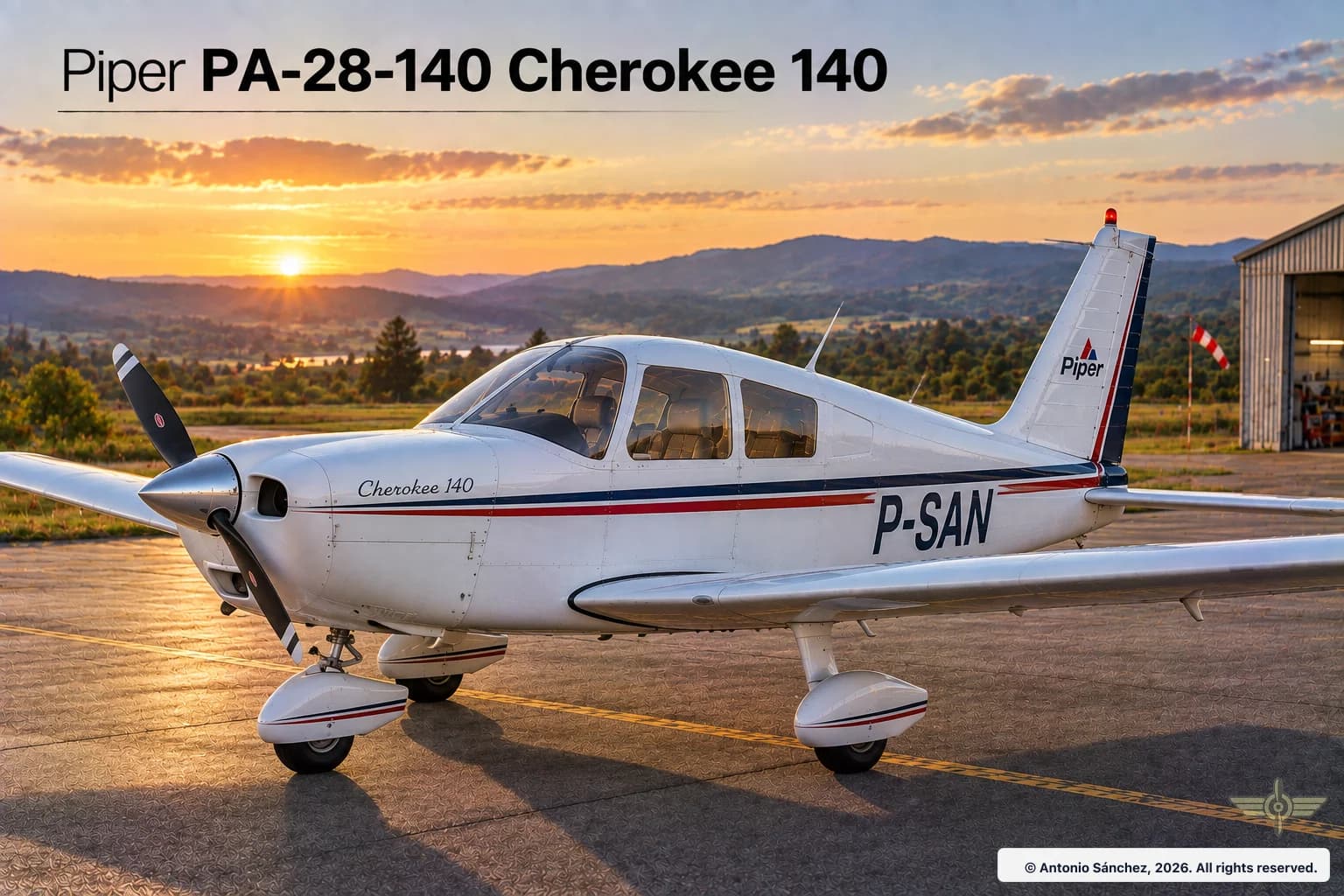
Piper PA-28-140 Cherokee 140 Briefing Guide
Imagine you’re about to conduct a training flight in a Piper PA-28-140 Cherokee 140. The aircraft is prepped, and your student is eager to get started. As the instructor, you know that a thorough pre-flight briefing is essential for safe and effective flight operation.
In this scenario, you’ll guide your student through crucial aspects of operating the Cherokee 140, focusing on performance data from the Pilot's Operating Handbook (POH). This will include weight and balance considerations, take-off and landing techniques, and the unique operational characteristics of the Cherokee 140.
Decision Points
-
Weight & Balance: The first step is to review the weight and balance calculations. The Cherokee 140 has a maximum gross weight of 2,550 lbs. Ensure that the loading reflects typical school versus private use. In many flight schools, students often overload the aircraft with equipment or fail to account for fuel, leading to unsafe CG positions. Emphasize the importance of using proper loading procedures and refer to the POH for specific weight limits and balance calculations.
-
Density Altitude Considerations: On hot days, density altitude can significantly affect aircraft performance. Discuss how increased altitude reduces engine power and lift, leading to longer take-off distances. Use the POH performance charts to illustrate how temperature and pressure affect take-off distances. Encourage students to always calculate density altitude and to be conservative with weight when flying in high-density altitude conditions.
-
Flap and Power Techniques: The Cherokee 140 employs a low-wing design that necessitates different flap and power techniques compared to high-wing trainers like the Cessna 172. Explain the flap settings: 0°, 10° (for take-off), and 30° (for landing). Emphasize that using 10° flaps for take-off can provide a better climb rate and shorter take-off distance, but this is often misunderstood by those transitioning from other aircraft types.
-
Take-off and Landing Distances: Review the take-off and landing performance charts in the POH. The important factors include aircraft weight, flap settings, and wind conditions. Explain how to interpret the charts and the significance of the "ground roll" and "total distance." For example, at max gross weight on a hot day, the take-off distance can significantly increase. Discuss the importance of planning for these variables and using the performance data to make informed go/no-go decisions.
-
Cruise Fuel and Reserve Discipline: Discuss fuel management during cruise flight. The Lycoming O-320-E2A engine consumes approximately 8-10 gallons per hour. Remind students to maintain a reserve of at least 30 minutes of fuel to account for changes in flight conditions or unexpected diversions. Use the POH to illustrate fuel burn rates and how to calculate fuel needs based on flight time and conditions.
-
Go/No-Go Decision: Finally, instill the mindset of making conservative decisions. Just because the performance figures allow for a flight does not mean it’s safe to proceed. Encourage students to consider the overall flight environment, including weather, aircraft condition, and personal limits.
POH Workflow
-
Pre-Flight Review: Start with the weight and balance section of the POH. Calculate the loading based on your student’s specific flight and ensure it stays within limits.
-
Density Altitude Calculation: Use the local temperature and pressure settings to calculate the density altitude. Cross-reference this with the take-off performance charts to determine the necessary take-off distance.
-
Flaps and Power Settings: Confirm the flap settings before take-off. Review the take-off technique: advance throttle smoothly to full power, check for engine instruments, and ensure the student understands the correct rotation speed (Vr) of 65 knots.
-
Take-off and Landing Data: Use the POH to determine the required take-off and landing distances. Discuss how to adjust for any crosswinds, consider obstacle clearance, and plan alternate landing sites if necessary.
-
Flight Planning: Reference the fuel consumption figures in the POH to calculate how much fuel will be needed for the planned flight, ensuring there's sufficient reserve.
-
Post-Flight Analysis: After the flight, review the performance achieved against the POH data. Discuss any discrepancies and plan for adjustments in future flights.
Using Pilot Sanchez
- Briefing: Use the Piper PA-28-140 Cherokee 140 briefing to prepare for the flight.
- Planner: Check the How to plan with your plane guide for comprehensive flight planning.
- Analysis: After the flight, refer to the Flight analysis guide to evaluate performance and identify areas for improvement.
About this model
The Piper PA-28-140 Cherokee 140 remains a popular choice among flying clubs in Europe. Its robust design, coupled with simple handling characteristics, makes it an ideal aircraft for both training and recreational flying. However, it is crucial to understand the nuances of its low-wing configuration, particularly in flap operation and landing techniques.
Many pilots transitioning from Cessna models may find the flap settings and low-wing dynamics of the Cherokee 140 different. The POH provides essential guidance on these operational differences, so a thorough review of the handbook is necessary before each flight. Emphasizing the importance of proper flap usage not only enhances safety but also improves overall flight performance.
In conclusion, the Piper PA-28-140 Cherokee 140 is an excellent training aircraft, but it requires a disciplined approach to flight preparation. By adhering to the guidelines in the POH and focusing on the specific characteristics of this aircraft, you can ensure a safe and efficient flight experience for you and your students.