
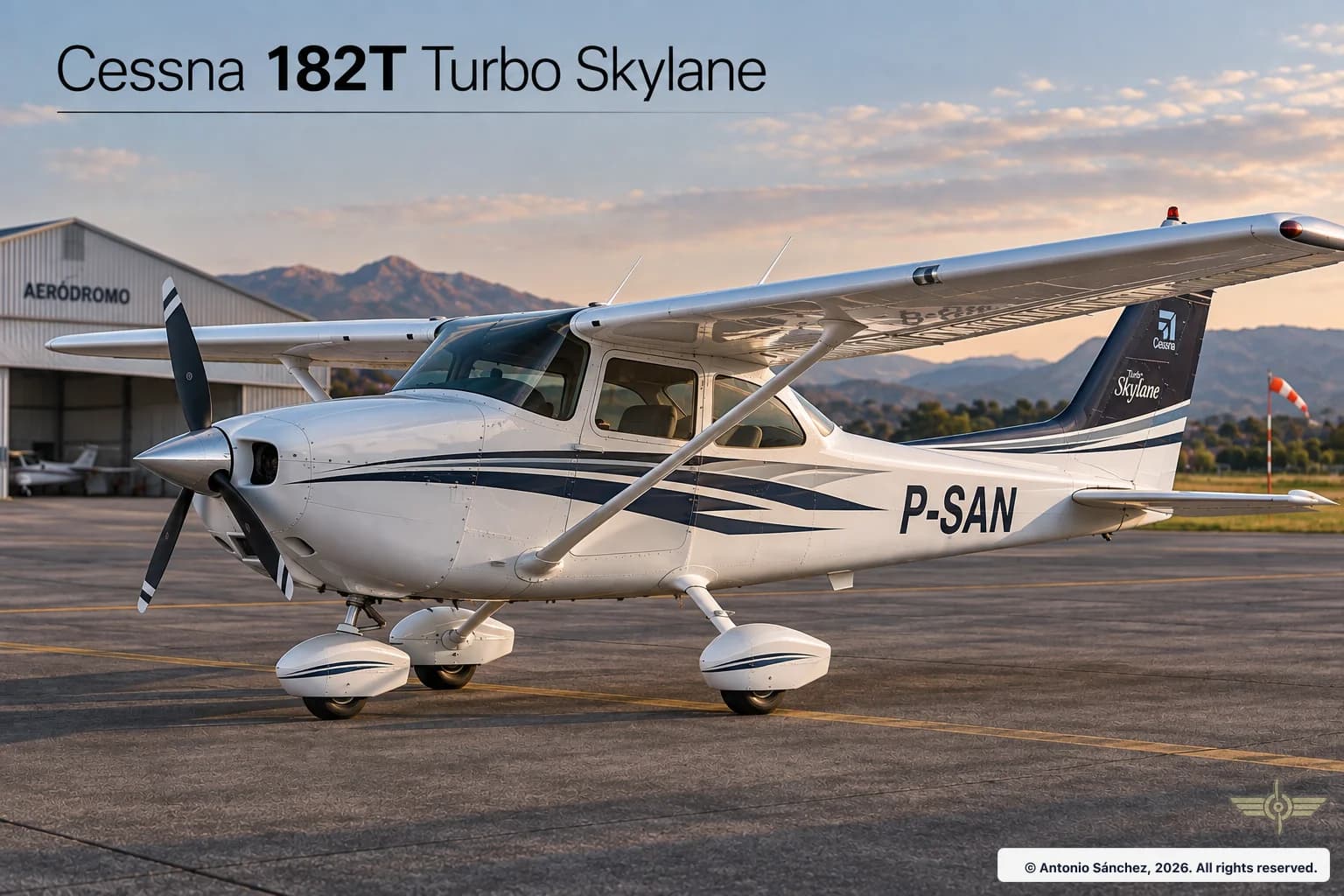
Cessna 182T Turbo Skylane Flight Briefing Guide
The Cessna 182T Turbo Skylane is a versatile high-performance single-engine aircraft. This guide outlines the essential points to consider when briefing for flight operations, focusing on POH performance data, weight and balance, and critical operational techniques.
V-Speed Table
| V-Speeds | Knots |
|---|---|
| Vso (stalling speed, landing configuration) | 50 |
| Vs1 (stalling speed, clean configuration) | 56 |
| Vx (best angle of climb speed) | 64 |
| Vy (best rate of climb speed) | 74 |
| Vfe (maximum flap extended speed) | 100 |
| Vno (maximum structural cruising speed) | 125 |
| Vne (never exceed speed) | 160 |
Weight & Balance Pitfalls
Typical Loading Scenarios
When briefing on weight and balance, emphasize the differences between typical school operations and private pilot loading. The Cessna 182T has a maximum take-off weight (MTOW) of 3,100 lbs, and it is crucial to ensure that the weight distribution is within limits.
-
School Operations: Often, flight schools may load the aircraft with students and baggage without considering the center of gravity (CG) limits carefully. The CG can shift dramatically with different student configurations, leading to adverse handling characteristics.
-
Private Operations: Private pilots may load the aircraft for cross-country flights, sometimes exceeding the useful load if not calculated properly. Always compute the weight and balance for the specific flight, taking into account fuel, passengers, and baggage.
Calculation and Tools
Use the provided Cessna 182T Turbo Skylane briefing calculator to assist in weight and balance computations.
Density Altitude / Hot-Day Take-off Mindset
A critical factor in the performance of the Cessna 182T is density altitude. On hot days, the aircraft's performance can significantly degrade due to reduced engine power and lift.
Take-off Planning
-
Assess Density Altitude: Always calculate the density altitude before take-off, especially in warm conditions. This will affect your take-off distance and climb performance.
-
Longer Runway Considerations: If operating near MTOW on a hot day, opt for longer runways. This is essential to ensure adequate take-off performance, and you should never hesitate to abort if conditions seem marginal.
Flap and Power Technique Differences
Students often confuse flap and power techniques with other aircraft types. In the Cessna 182T:
-
Flap Usage: The aircraft can utilize flaps for both take-off and landing. For take-off, using flaps is generally not necessary unless you are operating from a short or soft field, where 10 degrees of flaps can help with lift-off at lower speeds.
-
Power Management: The turbocharged engine provides significant power, but it requires proper leaning techniques to optimize performance. During the climb, ensure the engine is leaned appropriately to prevent excessive fuel consumption and engine roughness.
Take-off and Landing Distance Briefing
Key POH Inputs
When discussing take-off and landing distances, focus on the following inputs from the POH:
- Weight: Heavier weights significantly increase take-off distances.
- Flaps: Flap settings can alter the necessary distance for take-off and landing. Use the correct settings as per your mission.
- Density Altitude: As previously mentioned, this plays a crucial role in both take-off and landing performance.
Practical Application
Always refer to the performance tables in the POH and calculate distances using the current conditions, including wind and runway slope.
Cruise Fuel and Reserve Discipline
Maintaining disciplined fuel management is essential for the Cessna 182T. The aircraft has a fuel capacity of 56 gallons, and it is critical to calculate the fuel burn rate accurately.
Fuel Burn Rates
- Typical Cruise: Approximately 12-14 gallons per hour at cruise power settings.
- Reserve Fuel: Always plan for a minimum of 30 minutes reserve fuel at cruise settings, which is a good practice for cross-country flights.
Planning and Discipline
Encourage pilots to monitor fuel levels closely and always err on the side of caution. Use the Planner walkthrough to ensure fuel calculations are accurate.
When to Say No-Go Despite Legal Limits
Legal limits do not always equate to safe limits. Pilots should always be vigilant and ready to call off a flight if conditions are not ideal.
- Weather Conditions: If weather conditions are marginal, especially regarding visibility and wind, do not hesitate to cancel the flight.
- Aircraft Performance: If the aircraft is loaded near its limits or if density altitude is high, and performance seems inadequate, consider delaying the flight until conditions improve.
Using Pilot Sanchez
- Briefing: Start with a thorough briefing using the POH and performance data.
- Planner: Utilize the Flight analysis guide to assess the performance and fuel needs.
- Analysis: After the flight, use the My Hangar feature to review and analyze your performance.
About this model
Turbo Skylane pilots learn quickly that the POH take-off tables assume proper leaning and often a different mindset for runway length at MTOW. The turbocharged engine allows for enhanced performance at altitude, but it requires careful management of engine parameters and understanding of how aircraft weight and density altitude affect take-off performance.
The Cessna 182T is designed for versatility, but this comes with the responsibility of understanding its limitations. Pilots must be diligent in their pre-flight planning, ensuring that they are equipped with the knowledge needed for safe operations in all conditions. Proper use of the POH combined with practical experience will ensure successful flights in this capable aircraft.