
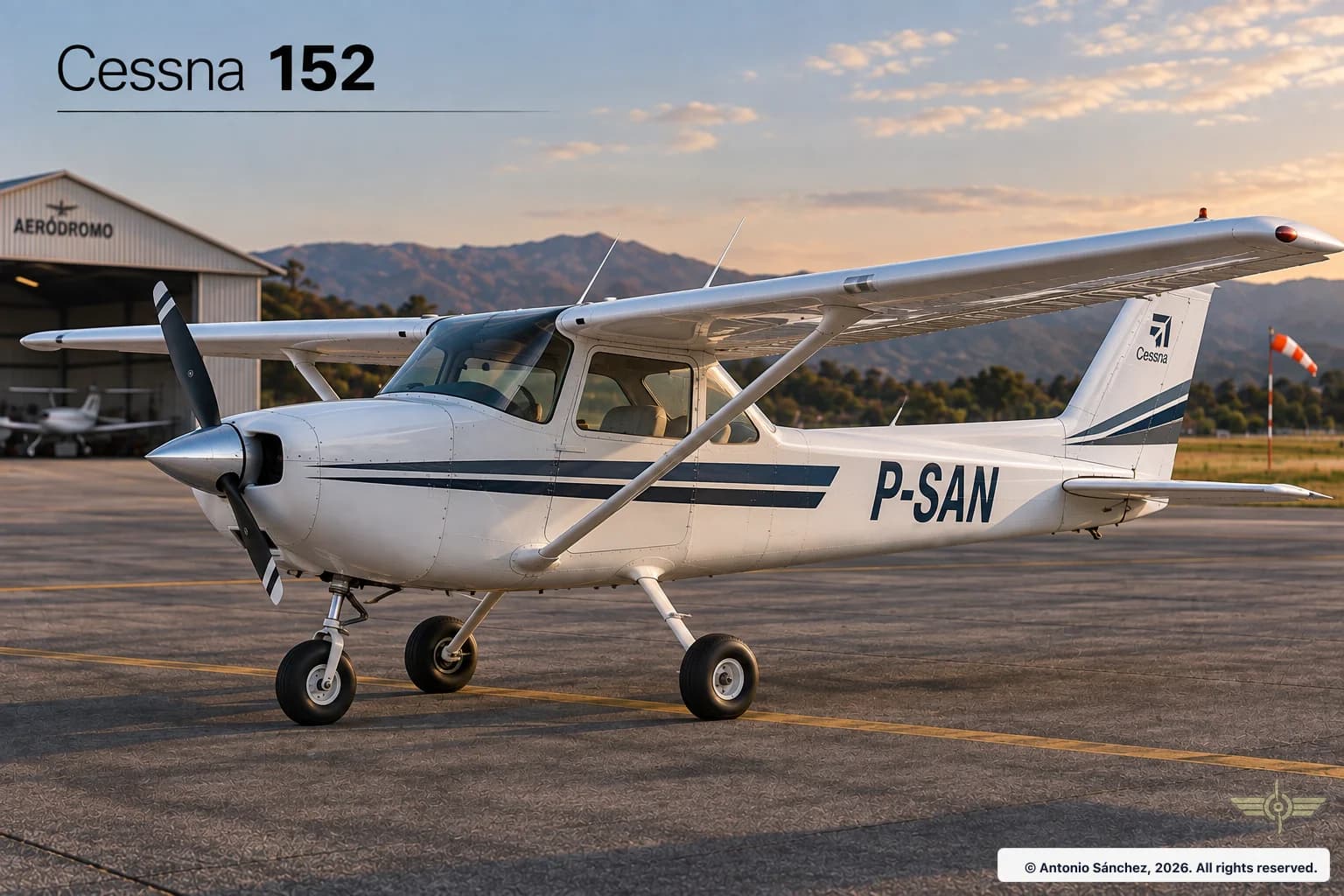
Cessna Model 152 Briefing Guide
This guide provides a structured approach for briefing the Cessna Model 152, focusing on critical performance data from the Pilot's Operating Handbook (POH) and key operational considerations.
Before flight
-
Review POH Performance Data
- Familiarise yourself with the Cessna Model 152 POH (1978 edition).
- Focus on performance charts, especially take-off and landing distances, climb performance, and fuel consumption.
-
Calculate Weight & Balance
- Use the Cessna Model 152 briefing calculator to determine loading.
- Be aware of typical school versus private loading. Schools often overload with students and equipment; ensure you account for this.
-
Density Altitude Awareness
- Assess current weather conditions and calculate density altitude.
- Understand how temperature affects aircraft performance, particularly on warm days.
-
Plan for Flaps and Power Settings
- Review the correct flap settings for take-off and landing; students often confuse these with other aircraft.
- Acknowledge that the C152 performs differently with flaps extended compared to other models.
At the aircraft
-
Pre-Flight Inspection
- Conduct a thorough pre-flight inspection, checking fuel levels (100LL), oil, control surfaces, and pitot-static system.
- Verify fuel quantity and ensure it meets the calculated requirements for your planned flight.
-
Weight & Balance Confirmation
- Confirm actual weights against calculated weights.
- Ensure that the centre of gravity (CG) is within limits; this is crucial for stable flight performance.
-
Discuss Take-off and Landing Distances
- Emphasise the importance of the runway length and surface conditions.
- Use appropriate POH inputs: weight, wind, temperature, and elevation when calculating take-off and landing distances.
-
Instruct on Fuel Management
- Discuss cruise fuel consumption and reserve discipline.
- Ensure students understand the need for a minimum reserve (typically 30 minutes of fuel) and the implications of fuel burn on flight planning.
After numbers
-
Evaluate Take-off Performance
- Confirm that take-off distances are within limits based on the current weight and density altitude.
- Discuss the importance of a short field technique when necessary.
-
Monitor Climb Performance
- Review the climb rate and any adjustments needed for temperature and weight.
- Discuss how to lean the Lycoming O-235 during climb for optimal performance.
-
Adjust for Summer Density Altitude
- Reinforce the impact of high temperatures on climb performance and engine efficiency.
- Be prepared to make decisions regarding no-go conditions based on performance calculations.
-
Conduct Landing Briefing
- Confirm approach speeds and configurations.
- Discuss the importance of maintaining appropriate power settings on final approach, as the C152 can easily stall if mismanaged.
-
Decision Making on No-Go Conditions
- Instill a mindset of safety; if take-off or landing distances exceed calculated limits, do not hesitate to call a no-go.
- Discuss how legal limits do not always equate to safe operational limits.
Using Pilot Sanchez
- Briefing: Use this guide to prepare for a thorough pre-flight briefing.
- Planner: Refer to How to plan with your plane for flight planning integration.
- Analysis: After the flight, consult the Flight analysis guide for performance review.
About this model
The Cessna Model 152 has been a staple in flight training since its production years from 1977 to 1985. Flight schools often retained these aircraft for decades, primarily due to their predictable fuel burn and docile stall characteristics, which made scheduling and budgeting straightforward. The Lycoming O-235 engine provides reliable performance, making the C152 a trusted choice for ab-initio training.
The aircraft’s simplicity and ease of handling allow new pilots to build confidence quickly while learning fundamental flying skills. As a trainer, it excels in providing a stable platform for students to grasp the basics of aviation without overwhelming them with complex systems. This reliability has made the Cessna 152 an enduring favourite among flight schools and private pilots alike, ensuring its place in aviation history.