On 29 October 2026 the US National Transportation Safety Board (NTSB) issued Safety Alert SA-109, "Sticking Exhaust Valves", subtitled "Identify and Treat Before Engine Failure". Between 2015 and 2025 the NTSB investigated 42 accidents in which a stuck valve caused a loss of engine power. Those accidents killed five people and seriously injured 12.
The NTSB's point is simple. A rough-running engine on a cold morning is easy to dismiss, yet it can be the first sign of a problem that is far easier to deal with on the ground, often without removing a cylinder, than in the air. This post summarises the alert and adds the maintenance guidance that the NTSB itself points to. A safety alert is advice, not a regulation, and it does not replace the instructions for your own engine.
What a Sticking Valve Is
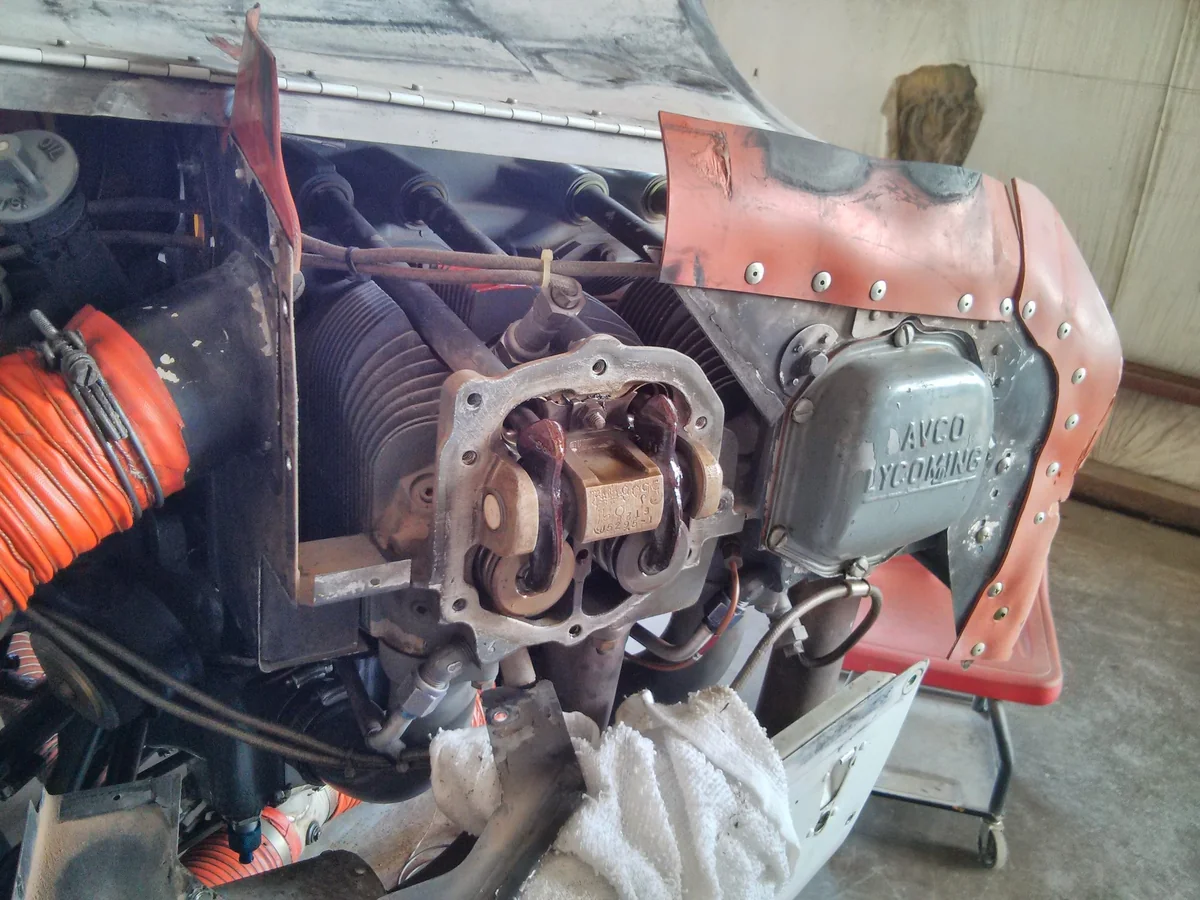
In a piston engine, each exhaust valve slides up and down in a metal sleeve called the valve guide. According to the NTSB, a valve sticks when deposits build up on the valve stem or in the guide. A sticking, or stuck, valve can interrupt the combustion cycle, causing severe vibration and a partial loss of engine power. Depending on where the valve sticks in its guide, the pushrods can also bend.
What Makes Valves Stick
The alert lists several factors that contribute to the deposits:
- localised overheating inside the engine cowling;
- infrequent flying;
- sudden engine cooling;
- an incorrect air/fuel mixture;
- high ambient temperatures;
- low-airspeed flight with reduced cooling;
- fuel with a high lead content.
The NTSB says these conditions are seen often in piston helicopters, because of their higher operating temperatures, and in flight-school aircraft, because of rich mixture settings and constant pattern work. Heat takes a toll on the engine, not just on performance: our post on density altitude in Spain covers what a hot day does to the airplane.
Lycoming's Service Instruction 1425A, which the NTSB lists among its references, describes the same mechanism: contaminants in the oil are deposited on the valve stems, and the rate of build-up increases with high ambient temperatures, slow flight with reduced cooling and fuel with a high lead content. It also names sudden cooling as a cause, for example "a rapid descent with the power reduced, or shutting the engine down before it has sufficiently cooled down".
How It Shows Up
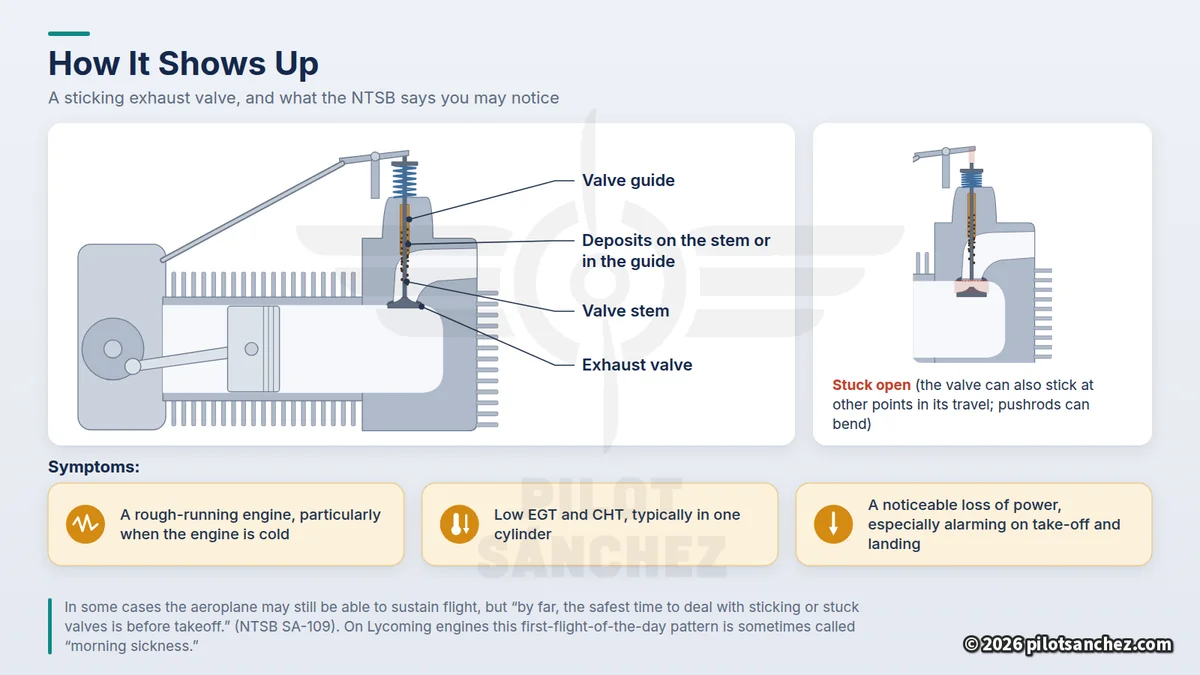
The alert says the symptoms are often misdiagnosed in flight and are rarely discussed in basic flight training. The signs it lists are:
- a rough-running engine, particularly when the engine is cold;
- low exhaust gas temperature (EGT) and cylinder head temperature (CHT), typically in one cylinder;
- noticeable loss of power, which can be particularly alarming on takeoff and landing.
The NTSB adds that, in some cases, the airplane may still be able to sustain flight, but that "by far, the safest time to deal with sticking or stuck valves is before takeoff". AOPA's maintenance columnist Jeff Simon describes the same pattern on Lycoming engines: if a valve is too tight in its guide, often because of baked-on oil and carbon deposits, it can stick open. This happens most often on the first flight of the day, which is why it is known as Lycoming "morning sickness".
Three Cases from the NTSB
The alert summarises three representative accidents. We stick to what the NTSB reported.
- Zenair CH750 STOL, Paducah, Kentucky, 29 June 2019 (CEN19LA199): the engine lost all power during a descent. The pilot could not restart it and made a forced landing; the airplane touched down hard and nosed over. The pilot was seriously injured. Recovered data showed that after a power reduction for the descent, the exhaust gas temperature on two cylinders fell while the other two rose by about 60 °C. The post-accident examination found the No. 3 exhaust valve stuck open.
- Cessna 172F, Show Low, Arizona, 25 May 2022 (WPR22FA188): the pilot aborted a first takeoff, taxied back for an engine run-up and tried a second takeoff. Witnesses said the engine was "sputtering" and "sounded bad" during the first takeoff and the taxi back; on the second attempt, one described it as "running rich, like it was bogged down". The accident happened during that second takeoff, and the pilot and passenger were killed. The No. 4 exhaust valve was stuck by a build-up of material on the valve stem. The NTSB wrote that the accident likely could have been avoided if the pilot had the airplane examined by maintenance personnel before attempting the second takeoff.
- Piper PA-32, 8 May 2024 (ERA24LA211): the airplane lost partial power after takeoff and could not hold altitude, and the pilots made a forced landing. Carbon had built up on the exhaust guides of five cylinders, and the NTSB found indications of an excessively rich mixture. The NTSB also found an improperly seated thermostatic oil cooler bypass valve in the oil filter adapter, which caused elevated oil temperature. The pilot reported three earlier events with a loss of power, and the maintenance records showed no evidence of compliance with an engine manufacturer service bulletin on determining exhaust valve and guide condition. The NTSB wrote that following the recommended inspection procedures would likely have found the carbon build-up.
In two of the three cases there was a warning or an inspection that could have caught the problem on the ground.
What Owners and Pilots Can Do
Here is what the NTSB recommends to owners and operators, together with guidance from the Lycoming and AOPA documents it cites:
- Change the oil, the oil filter and the air filter at the manufacturer's intervals. Lycoming's Service Instruction 1425A calls contaminants in the oil and oil filter the prime cause of valve sticking. In the 1988 version hosted on the NTSB's site, Lycoming recommends a 50-hour oil change and filter replacement for engines with a full-flow filter, and a 25-hour oil change with screen cleaning for pressure-screen systems. It advises shorter intervals for aircraft that do not fly often: every 25 hours, or every four months if the aircraft has not flown 25 hours in that time. These figures come from that 1988 document; always check the current instructions for your engine.
- Learn the symptoms. A cold engine that runs rough, or one cylinder with a low EGT or CHT, is a reason to ask for an inspection and not to hope it clears up.
- Lean properly. Use the leaning technique in your pilot's operating handbook (POH) or engine manual. AOPA says to lean whenever you are below 75 percent power, always following the POH, and warns that over-leaning at high power can damage the engine.
- Avoid shock cooling. Plan a gradual descent instead of a rapid descent at idle, and let the engine cool before shutdown. Both Lycoming and AOPA warn about sudden cooling.
- Fly the engine. AOPA advises flying an engine at least an hour a week and points out that far more engines rust out than wear out. The NTSB lists infrequent flying as a contributing factor to valve deposits.
- Use an engine monitor if you have one. The NTSB tells mechanics to use engine-monitoring data to troubleshoot rough running, and tells owners to recognise the EGT and CHT patterns above.
The NTSB asks mechanics to educate pilots and owners on oil-change intervals, keep the cooling baffles and baffle strips in good condition to prevent localised overheating of cylinders, be familiar with the aircraft and operations most susceptible to stuck valves, and follow the engine manufacturer's instructions to diagnose, measure or clear stuck valves.
The alert lists the relevant manufacturer documents: Lycoming Service Bulletin 388C (inspection of exhaust valve and guide condition), Lycoming Service Letter L197A, Lycoming Service Instruction 1425A and Continental Service Bulletin M77-3. In his AOPA column, Jeff Simon calls the 388C inspection a critical procedure that should be done at least every 400 hours. He adds that an annual borescope inspection together with 388C should catch most exhaust-valve problems early. Ask your maintenance organisation which of these apply to your engine and how often.
If It Happens in the Air
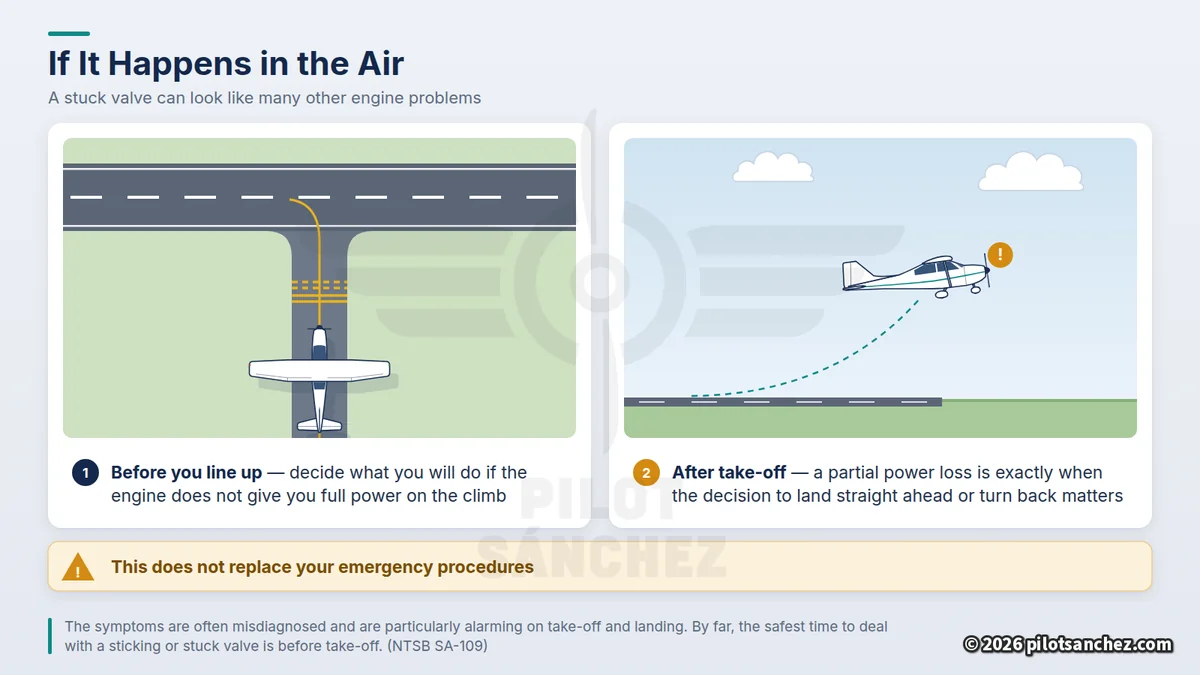
Nothing in the alert replaces your emergency procedures. What it does say is that a stuck valve can look like many other engine problems, and that the symptoms are often misdiagnosed and are particularly alarming on takeoff and landing. A partial power loss after takeoff is exactly the situation where the decision to land straight ahead or turn back matters; our post on the NTSB's Beverly Mooney report looks at one such case. Before you line up, decide what you will do if the engine does not give you full power on the climb.
A Note for Pilots in Europe
The 42 accidents are US cases from the NTSB's records. The engines it describes, reciprocating engines of the kind made by Lycoming and Continental, also power many light aircraft in Europe, and the causes of valve deposits do not change at the border. The practical advice is the same: follow your aircraft maintenance programme (AMP) and the engine manufacturer's instructions, and ask your maintenance organisation about the valve and guide inspection for your engine.
The takeaways are simple: do not ignore a rough cold engine, change the oil on time, lean by the book, avoid shock cooling, and fly the airplane regularly.
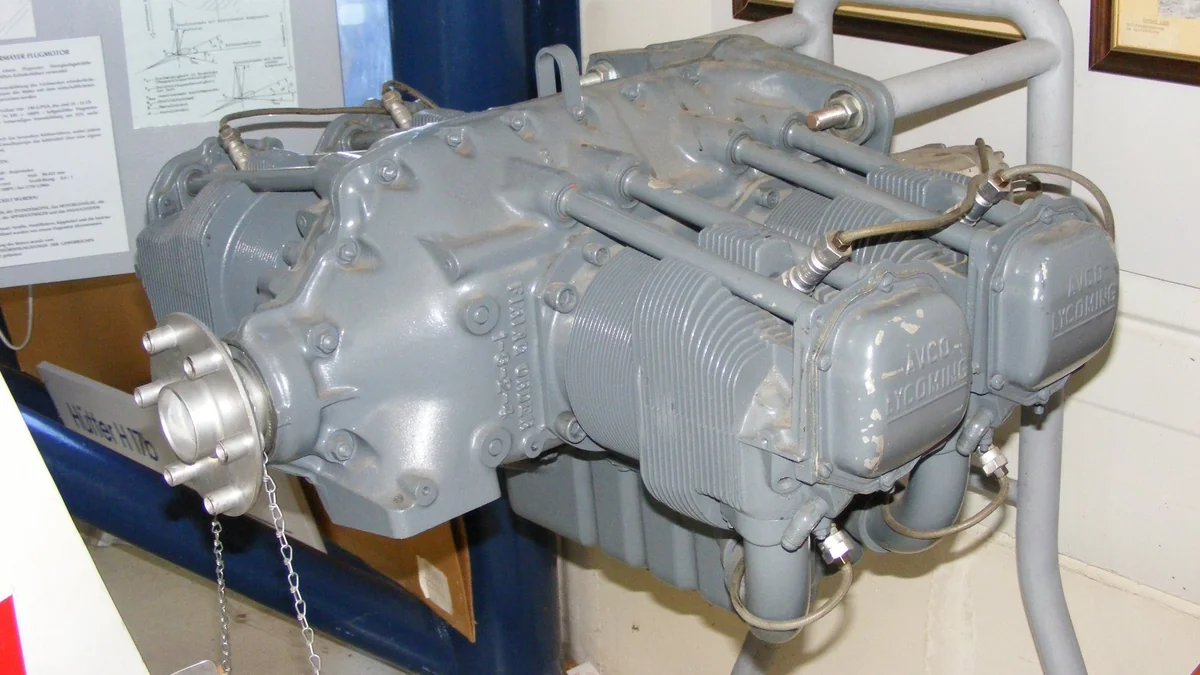
Cover: a Lycoming O-320 engine on display at the Aviaticum museum in Austria. Photo: Rottweiler, Wikimedia Commons, public domain, cropped.
Sources
- NTSB, Safety Alert SA-109, "Sticking Exhaust Valves", issued 29 October 2026
- AVweb, "NTSB Warns of Sticking Exhaust Valves in Piston Aircraft Engines", 4 November 2026
- Lycoming, Service Instruction 1425A, "Suggested Maintenance Procedures to Reduce the Possibility of Valve Sticking" (PDF, as attached to the NTSB docket)
- AOPA, Jeff Simon, "Aircraft Maintenance: Reaming, lapping, other valve tasks", 12 July 2022
- AOPA Air Safety Institute, "Maintaining Your Engine"
