Open the Spanish AIP entry for Granada and look at section AD 2.2. Elevation: 567 m, 1,860 ft. Just below it: reference temperature, 35°C.
That second number is the one most pilots skip. It shouldn't be. Put those two figures together on a standard pressure day and your aeroplane will perform as if Granada sat at about 4,500 ft. That's density altitude, and in a Spanish summer it's not an exotic mountain-flying topic. It's Tuesday afternoon.
What density altitude actually is
The FAA's density altitude pamphlet defines it as pressure altitude corrected for non-standard temperature. The useful way to think about it is simpler: it's the altitude your aeroplane thinks it's at.
Your POH performance figures are based on the standard atmosphere: 15°C and 1013 hPa at sea level, with the temperature falling about 2°C per 1,000 ft. When the air is hotter than standard, it's less dense. Less dense air means:
- Less engine power. A normally aspirated piston engine breathes less oxygen per stroke.
- Less propeller thrust. The prop has less air to bite.
- Less lift for a given true airspeed. The wing needs a higher true airspeed for the same indicated airspeed. So the ground speed at rotation is higher and the take-off roll is longer.
All three hit you at once, which is why the effect on take-off distance and climb is so large.
The Spanish numbers
The AIP gives a "reference temperature" for each aerodrome. Under ICAO Annex 14 it should be the monthly mean of the daily maximum temperatures for the hottest month of the year, averaged over several years. In plain words, it's a typical summer afternoon. Not a heatwave.
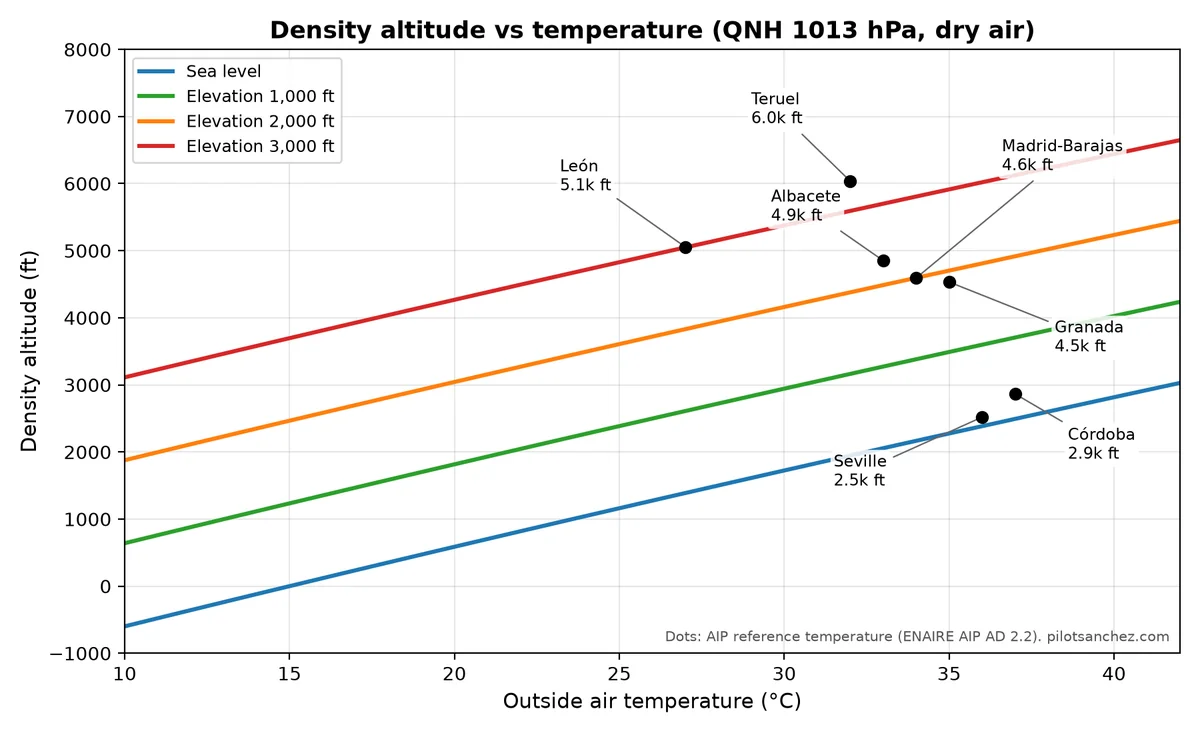
We took elevation and reference temperature from the ENAIRE AIP for a range of Spanish aerodromes and calculated the density altitude at standard pressure, dry air:
| Aerodrome | Elevation | AIP reference temp. | Density altitude (approx.) |
|---|---|---|---|
| Seville (LEZL) | 111 ft | 36°C | 2,500 ft |
| Córdoba (LEBA) | 307 ft | 37°C | 2,900 ft |
| Badajoz (LEBZ) | 608 ft | 35°C | 3,000 ft |
| Granada (LEGR) | 1,860 ft | 35°C | 4,500 ft |
| Madrid-Barajas (LEMD) | 1,998 ft | 34°C | 4,600 ft |
| Albacete (LEAB) | 2,301 ft | 33°C | 4,900 ft |
| Salamanca (LESA) | 2,595 ft | 30°C | 4,900 ft |
| León (LELN) | 3,006 ft | 27°C | 5,100 ft |
| Teruel (LETL) | 3,367 ft | 32°C | 6,000 ft |
Two things jump out. First, Córdoba and Seville sit almost at sea level, but on a normal summer afternoon they behave like a 2,500 to 3,000 ft aerodrome. Second, the whole Meseta is already at 2,000 to 3,000 ft before the sun does anything. Add a typical July afternoon and you're operating at 4,500 to 6,000 ft density altitude, from aerodromes that look like flat, friendly fields.
And remember these are average afternoons. On a 40°C day, Granada at standard pressure is above 5,000 ft. A low QNH pushes it higher still.
A rule of thumb you can do in your head
Density altitude ≈ pressure altitude + 120 ft for every °C above ISA temperature.
ISA temperature at your aerodrome is 15°C minus 2°C per 1,000 ft of elevation. For Granada: 15 minus about 4 = 11°C. At 35°C you're 24°C above ISA. 24 × 120 = 2,880 ft. Add the 1,860 ft elevation and you get about 4,700 ft. That's close to the precise figure (it slightly overestimates, which is the safe side). If the QNH is below 1013, add about 30 ft per hPa to get pressure altitude first.
What it does to take-off and climb
The only numbers that count are those in your POH, calculated for the actual conditions. But a couple of FAA rules of thumb show the size of the effect:
- Fixed-pitch propeller: add about 15% to the take-off distance for every 1,000 ft of density altitude, up to 8,000 ft. For a constant-speed prop, about 12% per 1,000 ft, up to 6,000 ft.
- Humidity: the FAA pamphlet notes that hot air can hold several times more water vapour than cold air (eight times as much at 96°F as at 42°F) and recommends adding 10% to your computed take-off distance in high humidity.
- The Koch chart example: at 100°F (38°C) and 6,000 ft pressure altitude, take-off distance rises by 230% and rate of climb drops by 76%. A 500 ft/min climb becomes 120 ft/min.
Try it on a typical trainer. If the POH gives a 250 m ground roll at sea level in standard conditions, the 15% rule at 4,500 ft density altitude suggests over 400 m. Then there's the climb, which matters more than the take-off roll at many aerodromes with trees, power lines or rising ground beyond the end.
Grass, a soft surface or an upslope make it worse. The FAA warns that long grass, sand or mud can double your take-off distance on their own.
Practical habits for a Spanish summer
1. Fly early
On a clear inland summer day, the morning can easily be more than 10°C cooler than mid-afternoon. Every 10°C is roughly 1,200 ft of density altitude, and you get smoother air thrown in.
2. Do the performance calculation every time
Use the POH charts with the actual temperature and pressure, not the numbers you remember from training in March. Add a safety margin; some pilots add 50% to take-off and landing calculations.
3. Weight is the lever you control
You can't change the temperature. You can leave a bag, carry less fuel when the trip allows it, or make two trips. Run the mass and balance properly before you go. Our pre-flight briefing tool is useful for exactly that.
4. Set an abort point
The FAA suggests picking a landmark at 50% of your calculated take-off distance. If you don't have about 70% of your rotation speed by then, abort. Decide that before you open the throttle, not halfway down the runway.
5. Lean as the POH says
Many piston engines need the mixture set for best power at high density altitude, even for take-off. The procedure differs by engine, so follow your POH or flight manual.
6. Expect a flatter climb and a faster approach
At a high density altitude, the same indicated airspeed means a higher true airspeed. Your approach will feel fast over the ground, and your landing roll will be longer. Your climb gradient over the trees at the end will be shallower than you're used to.
FAQ
What is density altitude in simple terms?
The altitude at which the aircraft performs, taking into account temperature and pressure. High density altitude means thin air, and that means less power, less thrust and longer take-off and landing distances.
How do I calculate density altitude quickly?
Take pressure altitude and add about 120 ft for every °C above the ISA temperature for that altitude (15°C at sea level, minus 2°C per 1,000 ft).
Does humidity affect density altitude?
Yes, a little. Humid air is slightly less dense and reduces engine power. The FAA suggests adding 10% to the computed take-off distance when humidity is high.
What is the AIP reference temperature?
Under ICAO Annex 14, the monthly mean of the daily maximum temperatures for the hottest month of the year at that aerodrome. It's listed in section AD 2.2 of the Spanish AIP.
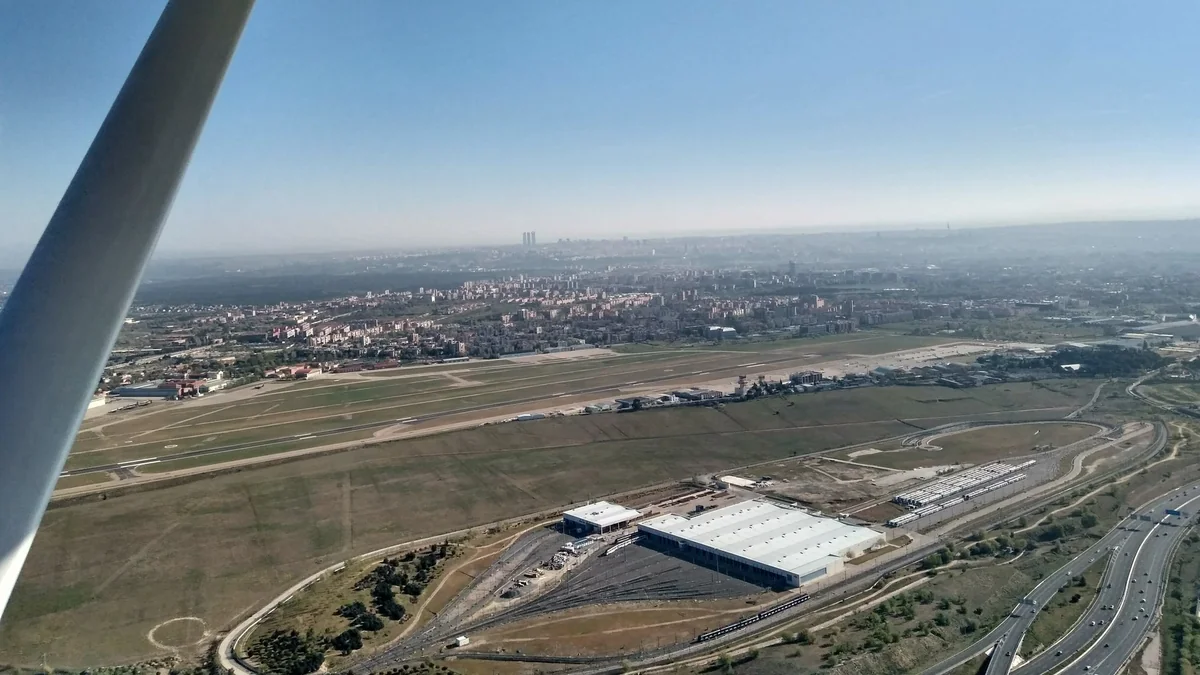
Cover: Madrid-Cuatro Vientos seen from the right downwind for runway 09. Photo: Marostegui, Wikimedia Commons, licensed CC BY-SA 4.0, cropped.
Sources
- ENAIRE, AIP España, AD 2 aerodrome data (elevation and reference temperature)
- FAA, FAA-P-8740-2 Density Altitude (PDF)
- FAA Safety Team, Aircraft Performance and Calculations fact sheet (PDF)
- ICAO Annex 14, Volume I, Aerodrome Design and Operations, section 2.4 (aerodrome reference temperature)
