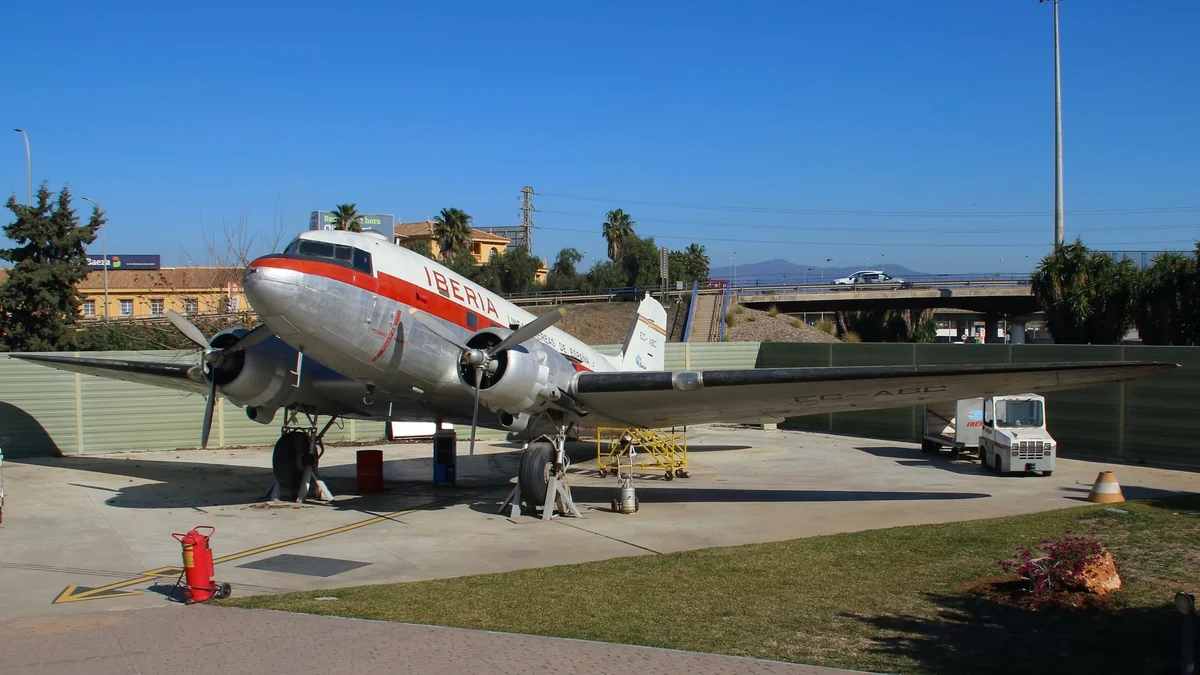
If the historic flying displays at Cuatro Vientos are where Spain's old aircraft still fly, Málaga is where you can walk through the cabins and stand in the terminal that saw the first holiday flights arrive. Tucked into the southern corner of Málaga-Costa del Sol Airport, the Museo de Aeropuertos, Navegación y Transporte Aéreo is free and quiet, and it's packed with the kind of detail pilots love. Nothing flies here. It's the static complement to Cuatro Vientos, and a very good one.
What and where it is
Officially it's the Museo de Aeropuertos, Navegación y Transporte Aéreo de Málaga, better known as the Museo Aeronáutico de Málaga or "Aeromuseo". It belongs to Aena, the Spanish airport operator. It opened over 20 years ago to look after historic airport heritage, and today it shows pieces from Aena airports all over Spain, from Melilla to Huesca.
A lot of the hands-on work is done by volunteers. The Asociación de Amigos del Museo was officially registered in 2005, after years of informal volunteering. It has more than 100 members, and its 30-plus restorers put in over 10,000 hours a year. You may have heard the museum is run by another non-profit with a different name. We couldn't confirm that. The sources we found name Aena as the owner and the Amigos del Museo as the volunteer association behind it.
The museum sits at Plaza Pierre Georges Latécoère, next to the airport's General Aviation building, away from the passenger terminals.
Opening hours and prices
| Day | Hours |
|---|---|
| Monday | Closed |
| Tuesday | 10:00–20:00 |
| Wednesday to Sunday | 10:00–14:00 |
| Public holidays | Open, except 1 and 6 January and 24, 25 and 31 December |
Entry is free, and so is parking. That's every day, not one free day a week. Individual visitors don't need to book. The visit is self-guided and the museum suggests allowing about 90 minutes, though an aviation enthusiast can easily spend longer. Schools and groups book through Aena.
The aircraft
The museum has ten aircraft. Three of the airliners have cabins you can walk into, but they're only opened on special days announced on the museum's social media, so check before you go if that's the main reason for your visit.
Douglas DC-3
The star of the apron is a 1945 Douglas DC-3, a C-47B Skytrain registered EC-CPO, in Iberia livery. The museum calls it "the legend", and fairly so: it was fast, cheap, reliable, easy to repair and short-field capable, and it was the first airliner to make money. Around 400 are still in use somewhere in the world. Its interior has just been restored, and you can see the fuselage fittings that let operators reconfigure the cabin to suit the job.
Convair 440 Metropolitan
This 1957 Convair 440 tells the story of Málaga's first air tourism route. In 1959 a group of Finnish tourists flew in and met a city that wasn't yet used to visitors. Every year the museum marks the anniversary, and the volunteers get the aircraft ready for the occasion. Inside, part of the cabin is opened up to show the structure and how the electrical wiring, hydraulic lines and control pulleys run under the floor. For a pilot, it's a rare look at the systems you normally only see in a diagram.
McDonnell Douglas DC-9
The DC-9 flew from 1974 and retired to the museum in 2002 after 52,000 hours. The museum calls it "the last one before the digital era". About 2,400 of the family were built. Climb aboard (on open days) to see the galleys, the first-class seats and a flight deck with not a single screen. It's a useful reminder of how much of the instrument scan used to be needles and how much workload sat with the crew.
Lighter aircraft
The other aircraft include a Beechcraft E-18S, a twin from the era of the first jet set, when owning a private aircraft really was a luxury; and a Bell 47, the bubble-canopy helicopter that in 1946 became the first helicopter certified for civil use. The aviation hall adds light aircraft, a powered hang glider, a hot-air balloon and a working replica of a 1920s flight simulator.
The 1948 terminal and control tower
For many visitors, the highlight isn't an aircraft at all. The original 1948 terminal, designed by architect Luis Gutiérrez Soto, was the start of Málaga's international airport and, as the museum says, where the Costa del Sol was born. The building and its aircraft stand where they stood over 70 years ago. You can sit on the hand-carved wooden bench used by 1948 passengers, flick through a pre-jet aviation magazine, walk through a customs hall from your grandparents' day and climb the old control tower that guided the first airliners into Málaga.
Technology, engines and the hands-on zone
The museum spreads over four buildings, two historic and two built since 2010, with about 3,000 m² indoors and more than 5,000 m² of exhibition in all. The technology building covers radar, communications, airfield lighting, meteorology and classic airport vehicles. The engine collection includes a Rolls-Royce Trent 900, one of the engines that served on the first Airbus A380 prototype.
There are more than 20 interactive exhibits. You can open a flight recorder and feel its weight, lift a landing-gear wheel by muscle power, send a message in Morse, move a propeller, and work out the weight and balance of an aircraft. That last one is a good test for any student pilot who thinks loading sheets are boring. A fourth building holds the airline room, with more than 300 scale models and a collection of uniforms from many airlines.
The simulators
The simulation room is run by the Amigos del Museo. At the time of writing it includes a Frasca analogue simulator, a virtual-reality setup running Microsoft Flight Simulator and, for fun, Soyuz and X-Wing cockpits. Cessna 172 and Boeing 737 simulators are being built. Simulator sessions are paid as contributions to the association, unlike museum entry. They depend on the volunteers being on site, so don't count on a session without checking first.
The viewpoint
Several viewing areas look out over today's airport, with the threshold of the runway on one side and the neighbouring Málaga military air base on the other. It's a great spot to watch arrivals, and a nice contrast: 1950s aviation behind you, a modern jet on short final in front.
Getting there
- By car: take the MA-21 to exit 3 and follow the signs for "Aviación General / Museo". Parking is free.
- By bus: take EMT line A (the airport express) to its last stop, then walk about 20 minutes.
- By train: take Cercanías line C1 to the Aeropuerto station, then walk about 20 minutes.
The museum is not inside the passenger terminals, so leave time for the walk if you're fitting it in around a flight. If you're arriving by air and the Levante or Poniente is blowing, the viewpoint is a good place to watch the crosswind landings.
Málaga and Cuatro Vientos: two halves of one trip
The two places work well together. At Cuatro Vientos, the Fundación Infante de Orleans flies its historic aircraft on the first Sunday of most months, but you see them from behind a fence. In Málaga nothing flies, but you can step into a DC-9 cabin, sit in a 1948 departure lounge and get close to the hardware. If you love old aircraft, see both: one shows you how they fly, the other how they were built and used.
FAQ
Is the Málaga aviation museum free?
Yes. Entry and parking are free every day it's open. Only the simulators are paid, as a contribution to the volunteer association.
When is it open?
Tuesday 10:00–20:00 and Wednesday to Sunday 10:00–14:00. It's closed on Mondays and on 1 and 6 January and 24, 25 and 31 December.
Can you go inside the aircraft?
The DC-3, Convair 440 and DC-9 have visitable cabins, but they're opened only on special days announced on the museum's social media.
Do I need to book?
Not for an individual visit. Schools and groups should book through Aena.
Can I visit while waiting for a flight?
Only if you have plenty of time. The museum is at the south end of the airport, about a 20-minute walk from the nearest public-transport stops, and it's outside the secure area.
Sources
- Museo Aeronáutico de Málaga (Aeromuseo): home page
- Aeromuseo: visitor information (hours, prices, getting there)
- Aeromuseo: permanent exhibition
- Aeromuseo: simulation room
- Aeromuseo: Asociación de Amigos del Museo
- Aeromuseo: activities
- Aena: Málaga-Costa del Sol cultural visits and the museum
Cover: the museum's Douglas C-47B (DC-3) EC-CPO in Iberia colours, 2 February 2024. Photo by Colin Cooke Photo, Wikimedia Commons, licensed CC BY-SA 2.0, cropped.
