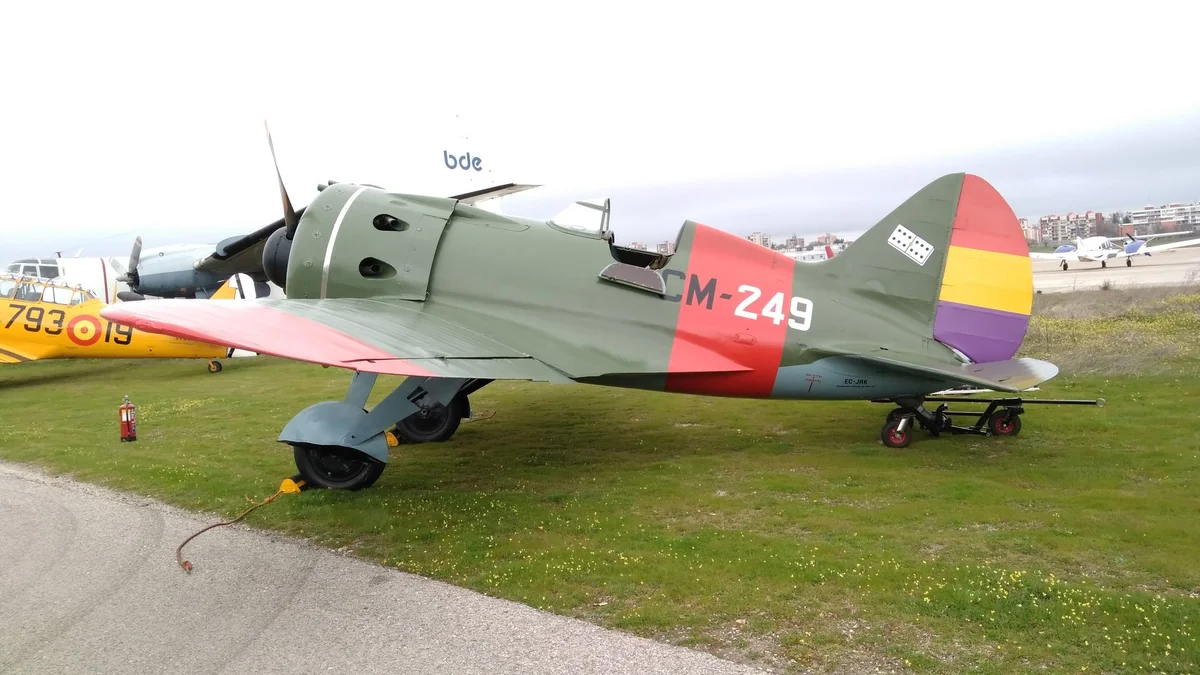
On the first Sunday of most months, just after one o'clock, a sound you won't hear anywhere else in Madrid rolls across the grass at Cuatro Vientos: a radial engine from the 1930s coughing into life, and, if you're lucky, a Polikarpov I-16 taxiing out towards the runway. Around two thousand people stop eating their sandwiches and look up.
That's the monthly flying display of the Fundación Infante de Orleans (FIO), a museum whose exhibits are expected to fly. If you're in Madrid on the right weekend, it's one of the best aviation mornings you can have in Europe for the price of a cinema ticket. Here's what we've been able to verify about how it works, what flies and how to combine it with the Museo del Aire next door.
When the displays happen
According to the FIO's own website, there's a flying display on the first Sunday of every month except January and August, the two months it considers to have the worst weather for this kind of flying. The next dates listed at the time of writing are 1 November and 6 December 2026, the latter confirmed by a Madrid listings site and consistent with the first-Sunday rule. Always check the official page before you travel.
The published programme for a display day:
- 10:30: ticket desks open
- 11:00: static display begins
- 11:15–12:30: guided tour of the aircraft on the ground
- 12:30–13:00: the public is moved back from the aircraft, engines start and the aircraft taxi out
- 13:00–14:00: flying display
There are also two children's workshops (ages 6 to 12, at 11:00 and 12:00, 12 places each), booked on the day at the tent by the entrance. No reservations.
When it doesn't fly
Old aeroplanes are fussy. The FIO is clear that what flies depends on the weather (most of the aircraft can't fly in rain or strong wind), on the aircraft themselves (a fault found on Saturday's practice flights keeps an aeroplane on the ground), on pilot availability and, for the oldest types, on the grass runway being usable. Its Polikarpov Po-2, de Havilland Moth and Comper Swift have a tailskid rather than a tailwheel and can only operate from grass.
The display counts as held if at least three of the planned aircraft fly. If it's cancelled, tickets bought online are refunded automatically; tickets bought at the desk can be used at any other display within a year.
Tickets and prices
The entry fee is formally a donation towards keeping the collection flying. Prices on the FIO site (valid since October 2025, same online and at the desk):
| Ticket | Price |
|---|---|
| General | €13 |
| Children 5–12 | €7 |
| Over 65 | €7 |
| People with a disability | €5 |
| Large family (adult) | €10 |
| Large family (child 5–12) | €5 |
| Under 5 | Free |
You can buy in advance online through entradas.com (linked from the FIO page) or at the desk on the day. The site capacity is capped at roughly 2,450 people by municipal rules, and the FIO's FAQ says it usually keeps about 400 tickets for sale on the day, which on busy days sell out before noon. Once capacity is reached, you can't get into the car park without a ticket. If you've travelled to Madrid for this, buy online.
Getting there
The displays take place at the Real Aero Club de España, Carretera de la Fortuna 14, 28054 Madrid, on the south side of Madrid-Cuatro Vientos airport. Parking is free. The FIO warns that cars without a Spanish environmental sticker risk a fine, because the airport is inside Madrid's low-emission area.
By public transport, the FIO suggests interurban buses 483 and 487 (Aluche–Leganés) and 486 (Oporto–Leganés), or Metro line 11 to La Peseta followed by a 20 to 25 minute walk. There is a single exit road, and the FIO itself admits that leaving on a busy day takes patience.
Bring something to sit on. There are no stands, the viewing area is natural ground, and food and drink are allowed. Pushchairs and wheelchairs are fine: there are no steps.
What you'll see
The FIO's collection page lists more than 40 aircraft, from a 1923 replica of Juan de la Cierva's C.4 autogiro (under restoration) to a 1970 HA-220 Super Saeta jet. The home page says 43 aircraft of 32 models; the English page says 42. Each aircraft is marked as flying, under maintenance or under restoration, so the line-up varies. Types listed as flying include:
- Polikarpov I-16, the stubby Soviet fighter known in Spain as the Mosca or Rata
- Polikarpov Po-2 biplane
- de Havilland DH.89 Dragon Rapide in early Iberia colours
- Bücker Jungmann (several) and Bücker Jungmeister
- North American T-6 Texan, Beechcraft T-34A Mentor and DHC-1 Chipmunk: the classic military trainers
- Boeing-Stearman Kaydet, Consolidated Fleet 2, Comper Swift and Miles Falcon Six
- Beechcraft C-45, Dornier Do 27, Piper L-4 and Stinson L-5
- Spanish-built types such as the AISA I-11B and the Hispano HA-220 Super Saeta
The FIO says around 20 of its aircraft typically fly at a display. Which ones you'll get on a given Sunday is impossible to promise, and that's part of the charm.
A short history of the FIO
The project began in 1984, when a group of aviation professionals set up a historic aircraft section in the José Luis Aresti Aero Club. The foundation itself was created in 1989, with the aim of building the widest possible collection of aircraft that shaped Spanish aviation, and keeping them airworthy.
It's named after Alfonso de Orleans y Borbón, cousin of King Alfonso XIII, who learned to fly at Mourmelon in France in 1910 and became the second Spaniard to hold an FAI licence. He flew as a military pilot for over two decades and kept flying as a civilian well into old age.
The aircraft are maintained in the FIO's own approved workshop, its Restoration and Maintenance Centre, by a mix of professional staff and volunteer mechanics who keep skills like fabric covering and woodwork alive. The display days themselves run largely on volunteers.
One thing to know if you're planning ahead: the FIO's FAQ says it will move to a new museum next to the Airbus factory at Getafe, expected in 2027. Until then, Cuatro Vientos is home, and it's fitting. The FIO calls it Spain's oldest operating airport, in use since 1911. It's also where Cierva's C.4 made its military demonstration in 1923, a story we told in our post on Juan de la Cierva and the autogiro.
Adding the Museo del Aire
The Museo de Aeronáutica y Astronáutica, usually just called the Museo del Aire, is on the other side of the same airfield. The Spanish Air and Space Force lists seven hangars and around 200 aircraft, including a Cierva C.19, a C.30 and a replica of the Plus Ultra flying boat. Entry is free (a voluntary donation is welcome) and no booking is needed for individuals.
The catch is the timing. The museum opens Tuesday to Sunday, 10:00 to 14:00, with last entry at 13:30, exactly when the FIO aircraft are flying. And the entrance is not next door to the FIO: it's off the A-5 motorway (km 10.7, direction Madrid), while the FIO is reached from Carretera de la Fortuna. Large bags and rucksacks (40 cm or more) are currently not allowed into the museum.
Realistically, you have two options. Do the museum on Saturday morning and the FIO on Sunday. Or do the museum from 10:00 on Sunday and head to the FIO for the flying, accepting the FIO's own warning that arriving late risks a full car park and no tickets left at the desk. If you go that way, buy your FIO ticket online first.
Tips for photographers
- Arrive for the static display. The guided tour from 11:15 is the best chance to photograph the aircraft up close. You can't climb into or touch them; only FIO pilots and mechanics can.
- Don't miss the start-up. From 12:30 the crowd is moved back and the engines start. Old radial engines starting up, with smoke and all, are often the best photos of the day.
- Bring a long lens. In the air, the aircraft are small. Something in the 300 to 400 mm range will help, and a slow shutter speed gives you a blurred propeller instead of a frozen one.
A note for visiting pilots
We couldn't find any official information on flying in to Cuatro Vientos (LECU) to watch a display, so don't assume it's possible. Check the Spanish AIP and NOTAMs for LECU, and if in doubt, ask the FIO or the aerodrome directly before you plan the flight. For pilots, the most interesting thing may be on the ground anyway: watching how a team handles a tailskid biplane on grass, or briefs a formation of 80-year-old trainers, is a lesson in its own right.
FAQ
When are the flying displays at Cuatro Vientos?
On the first Sunday of every month except January and August. The flying runs from 13:00 to 14:00; the gates and static display open in the morning.
How much does a ticket cost?
€13 general, €7 for children aged 5 to 12 and over-65s, €5 for people with a disability, and free for under-5s, with large-family discounts. Tickets are sold online and at the desk.
Is the Museo del Aire open on the same Sunday?
Yes, from 10:00 to 14:00 (last entry 13:30), with free entry. It overlaps with the flying display, so plan your day carefully.
What if the weather is bad?
The display goes ahead only if at least three of the planned aircraft can fly. Otherwise, online tickets are refunded and desk tickets stay valid for a year.
Sources
- Fundación Infante de Orleans: Exhibición de vuelo (programme, prices, cancellation policy)
- Fundación Infante de Orleans: Preguntas frecuentes (transport, parking, tailskid aircraft, move to Getafe)
- Fundación Infante de Orleans: La colección
- Fundación Infante de Orleans: The Infante de Orleans Foundation (history)
- Madrid Happy People: Exhibiciones de vuelo Cuatro Vientos (2026 dates)
- Ejército del Aire y del Espacio: Museo de Aeronáutica y Astronáutica, visits and opening hours
- Patrimonio Cultural de Defensa: Museo de Aeronáutica y Astronáutica
Cover: the FIO's Polikarpov I-16 on the grass at a display, with a yellow trainer behind. Photo by MArostegui, Wikimedia Commons, licensed CC BY-SA 4.0, cropped.
