For decades, the blue fuel in the bowser has been the one thing every piston pilot in Europe had in common. Avgas 100LL still carries tetraethyl lead, and replacing it has been "a few years away" for as long as most of us have been flying. This month that changed a little: a 100-octane unleaded fuel can now legally go into a large part of the European piston fleet.
On 8 October 2026, Swift Fuel GmbH, the Saarbrücken-based company that imports and sells Swift Fuels' avgas in Europe, announced that the European Union Aviation Safety Agency (EASA) has validated the FAA's expanded approvals for Swift 100R unleaded avgas. Here is what that means, what it doesn't mean yet, and what to check before you put it in an aeroplane.
What exactly was approved
The story starts in the United States. The FAA first approved 100R through a Supplemental Type Certificate (STC) in September 2024, initially for the Cessna 172R and 172S and their Lycoming IO-360-L2A engine. On 14 July 2026, Swift Fuels announced that the FAA had added more than 1,200 piston engine models and more than 1,600 airframe models to the STC's Approved Model List (AML).
According to Swift Fuels, the engine list includes around 395 Lycoming and 195 Continental models, and the airframe list covers roughly 118 Cessna, 98 Piper and 101 Beechcraft models, plus Grumman, Mooney, WACO, Fairchild, Stinson and others. The company says these aircraft burn up to 56% of the 100LL sold in the US.
The European news is that EASA has now validated those expanded approvals. Swift Fuel GmbH says they cover about 70% of FAA-approved aircraft types and now also apply to the corresponding EASA-certified aircraft and engines. The STCs for Europe can be ordered online, and the company's site says UK CAA approvals are also available or in progress.
What 100R is
100R is a 100 motor octane (MON) unleaded aviation gasoline, the same octane rating as 100LL but without lead. It is produced to ASTM International specification D8603. Swift describes it as a blend of hydrocarbons and ETBE with a proprietary additive, which it says helps keep engines clean and limits valve wear.
Swift Fuels also states that in an aircraft approved for 100R, it can be mixed with 100LL at any ratio. That matters in practice: you don't need to drain the tanks or wait for them to run dry before switching, and you can still fill up with 100LL at an airfield that doesn't sell 100R.
Where you can actually buy it
This is the catch for now. According to Swift Fuel GmbH, 100R is sold at eight airfields in Germany, Austria, the Netherlands and Belgium. The latest is a public pump at Hildesheim Airport in Germany, operating since late September 2026. Its distributor, Bollinger Aviation, says it is currently selling slightly cheaper than 100LL and aims to keep it that way.
Swift Fuels' July announcement also lists Canada, Germany, France, Austria, the UK, the Netherlands and Australia as countries with airfields approved to use 100R. So far there are no announced sales points in Spain or the rest of southern Europe.
What is not covered yet
The roughly 30% of types left out are mostly the harder cases: high-compression, high-performance engines. Swift Fuel GmbH says further approvals for those engines and the aircraft that use them, Cirrus models among them, are expected next year. In the US, Swift Fuels has said it aims to finish its 100R engine certification work by the end of 2027 or early 2028.
If your aircraft or engine is not on the list, 100R is not approved for it, full stop. Being "similar" to an approved model doesn't count.
What owners and renters should check
An STC is a modification to the aircraft's type design, so 100R doesn't become legal in an aeroplane just because the pump sells it. Before anyone fuels with it:
- Check both the airframe and the engine. Swift's European site asks owners to check both in its online approval search, and to confirm applicability against the official approval documents before ordering.
- Buy the STC for that aircraft. According to Swift Fuel GmbH, the paperwork is supplied electronically and the required decals and engine tags are sent by post. The company also publishes Service Instructions SI-1 and SI-2.
- Involve whoever manages your continuing airworthiness. Your maintenance organisation or CAMO will want the STC on the aircraft's records before the first unleaded fill.
- If you rent or fly a club aircraft, look for the decals. No decal by the filler and no STC paperwork for that aircraft means 100LL, even if 100R is right next to it on the apron.
And the old rule still applies with any fuel: check what went into the tanks, and sump it before the first flight of the day. We covered why in our post on a Cessna 421 that was filled with 145 gallons of Jet A.
The bigger picture
In the US, the push to get rid of lead has a deadline. The 2024 FAA Reauthorization Act requires the FAA to work with industry, through the EAGLE initiative (Eliminate Aviation Gasoline Lead Emissions), to move the piston fleet to unleaded fuel by the end of 2030 (2032 in Alaska). The FAA published its Transition Plan for Unleaded Aviation Gasoline on 30 July 2026, and it is testing three different fuels at its William J. Hughes Technical Center.
100R isn't the only candidate. GAMI's G100UL is approved by FAA STC for nearly all type-certificated aircraft and all spark-ignition piston engines in the FAA database, and LyondellBasell/VP Racing's UL100 is being evaluated for fleet-wide authorisation under the FAA's Piston Aviation Fuels Initiative (PAFI). Meanwhile, the FAA says it will use federal grant obligations to make sure US airports keep offering 100LL until safe unleaded alternatives are widely available.
Europe has no equivalent date in the announcements we reviewed. What it now has is a 100-octane unleaded option that is legal for a large share of the common training and touring fleet, if you can find it. For a flight school running Cessna 172s out of a field that sells it, that could become routine quite quickly. For most of us, it means asking the fuel supplier at our home field a simple question: when?
FAQ
Can I use Swift 100R in my aircraft in Europe?
Only if both the airframe and the engine are on the approved lists and the aircraft has the applicable STC. According to Swift Fuel GmbH, the EASA validation covers about 70% of FAA-approved aircraft types. Check both in Swift's online approval search before ordering.
Can I mix 100R with 100LL?
Swift Fuels says yes: in an aircraft approved for 100R, the two can be mixed at any ratio.
Is 100R approved for Cirrus aircraft?
Not yet. Swift Fuel GmbH expects approvals for high-compression engines and the aircraft that use them, Cirrus models among them, next year.
Where can I buy 100R in Europe?
At the time of writing, Swift Fuel GmbH lists eight airfields in Germany, Austria, the Netherlands and Belgium, including a public pump at Hildesheim. Swift publishes a map of locations on its website.
Is 100R the same as UL91?
No. UL91 is a lower-octane unleaded avgas that is already sold at some European airfields for engines approved to use it. 100R has the same 100 motor octane rating as 100LL, which is why it can be approved for many more engines.
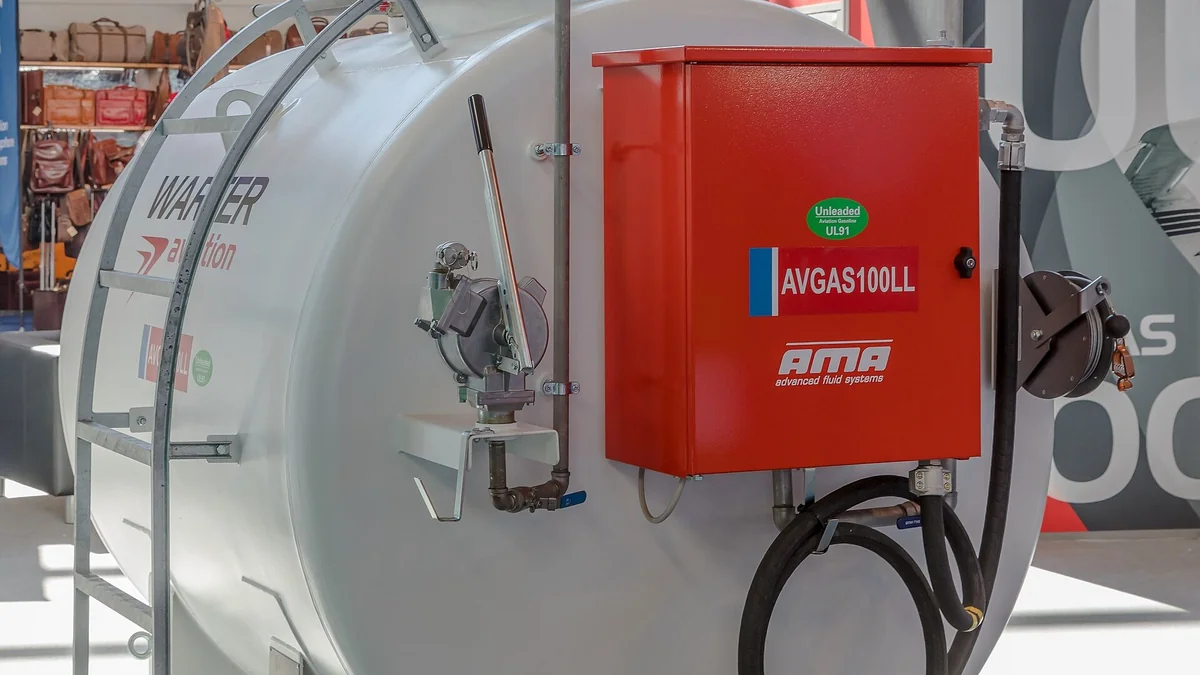
Cover: an avgas tank on display at AERO Friedrichshafen 2018, with both an AVGAS 100LL label and a green "Unleaded UL91" sticker. Photo: Matti Blume, Wikimedia Commons, licensed CC BY-SA 4.0, cropped.
Sources
- Swift Fuel GmbH, press release "EASA validiert erweiterte FAA-Zulassungen für Swift 100R", 8 October 2026 (PDF, in German, via AOPA Germany)
- Swift Fuel GmbH, Swift 100R STC: European and UK STCs
- Swift Fuels, press release on the FAA expansion of the 100R Approved Model List, 14 July 2026 (PDF)
- Swift Fuels, Frequently Asked Questions
- FAA, "FAA Releases Plan for Transitioning General Aviation Aircraft to Unleaded Gas", 30 July 2026
- FAA, Transition Plan to Unleaded Aviation Gasoline (PDF)
- AVweb, "EASA Expands Swift 100R Approvals in Europe", 15 October 2026
