Summer, 1919, Cuatro Vientos. A huge three-engined biplane, about five tonnes at maximum weight and one of the largest aircraft of its day, is on only its second flight. Its pilot, Captain Julio Ríos, is an experienced military pilot and a hero of the war in Morocco, but he has never flown anything this big. The first flight went beautifully. So on the second he tries something bolder: tight, steeply banked turns close to the ground.
The wing stalls. The aeroplane is destroyed. Ríos climbs out of the wreckage with cuts and bruises, which is more than most people expected.
The designer of that aeroplane was a 23-year-old civil engineering student called Juan de la Cierva y Codorníu, and the bomber was his final-year project. Most people would have walked away from aviation after watching their life's work broken on the grass at Cuatro Vientos. Cierva did something stranger. He set out to build an aircraft that could not stall the way his bomber had.
Four years later he had one. He called it the autogiro.
A boy, a bar counter and a crab
Cierva was born in Murcia on 21 September 1895 into a wealthy, political family, and was building things that flew long before he had any qualification to do so. As a teenager, with his friends José Barcala and Pablo Díaz, he built a biplane known as the BCD-1, nicknamed El Cangrejo ("the crab"), which flew at Cuatro Vientos in 1912 and is remembered as one of the first Spanish-built aeroplanes to fly regularly. A 1937 obituary in an Australian newspaper even claimed that the propeller of one of their early machines was carved from the wood of a bar counter, which is too good a detail not to repeat, with a pinch of salt.
There was no aeronautical engineering degree in Spain at the time, so he studied civil engineering. Remember that, because the key to the whole story turned out to be structural engineering, not aerodynamics.
Why the stall haunted him
If you fly fixed-wing aircraft, the 1919 accident should feel uncomfortably familiar. Steep turns at low level are a classic stall trap. In a level turn the load factor is 1 divided by the cosine of the bank angle, and the stall speed rises with the square root of that load factor. At 60° of bank the load factor is 2, so the stall speed goes up by about 41%. Pull a little harder near the ground, with a big, unfamiliar aeroplane and an impressed audience, and the margin disappears.
Cierva's reasoning was simple. Aeroplanes were most dangerous when slow and close to the ground. A fixed wing needs airspeed to produce lift. What if the "wing" kept moving even when the aircraft didn't?
His answer was a rotor that nobody drives. A conventional engine and propeller pull the aircraft forward; the airflow through the rotor keeps it spinning by itself (autorotation), and the spinning blades provide the lift. Slow down, and the rotor keeps turning. Lose the engine, and the machine comes down under a turning rotor rather than falling out of the sky. He filed the patent for the autogiro on 27 August 1920.
Three failures and a night at the opera
The idea was elegant. The first three machines, the C.1, C.2 and C.3, were not: each one tried to roll over during the take-off run.
The problem was dissymmetry of lift. When a rotor moves forward through the air, the blade advancing into the airflow meets the air faster than the blade retreating from it. More speed means more lift, so one side of the rotor lifts harder than the other and the aircraft rolls. Every helicopter student today learns this in the first few lessons. In 1921 nobody had solved it.
Cierva noticed something odd. His small models flew perfectly. Their rotors were made of bamboo, which bent freely, while the full-size blades were rigid. According to the standard account, the insight came to him while he was at the opera: the flexible blades were rising and falling as they went round, and that freedom was cancelling the rolling moment at the hub. His civil engineering training supplied the rest. A cantilever that is hinged at its root cannot transmit a bending moment to its support. So he hinged the blades.
The flapping hinge lets the advancing blade rise, losing some lift, and the retreating blade fall, gaining some, which evens things out across the disc. It sounds modest. It's the reason rotary-wing flight works.
Getafe, January 1923
The C.4 used a fuselage from a Sommer monoplane, a four-blade rotor and the new hinged hub. Testing started in June 1922 at Getafe and did not go smoothly; it took months of modifications. Then, in January 1923, Lieutenant Alejandro Gómez Spencer (Cierva's brother-in-law) flew it about 180 metres across the field. Sources disagree on whether it was the 9th or the 17th of the month, which is the sort of historical untidiness you get when the event that changes everything is a short hop on a winter morning.
What happened next is the part pilots should remember. On 20 January the engine quit in flight, and the C.4 came down safely in autorotation. The machine had been designed to survive exactly that, and it did. On 31 January, at a military demonstration at Cuatro Vientos, the C.4 flew a closed circuit of about 4 km in three and a half minutes at more than 25 metres. Rotary-wing flight was no longer an idea.
From Farnborough to the deck of the Dédalo
Spain had the inventor; Britain had the industrial backing. In 1925 Cierva took his C.6, built around an Avro 504K fuselage, to Farnborough and demonstrated it to the Air Ministry. The following year, with the support of Scottish industrialist James G. Weir, he set up the Cierva Autogiro Company. In 1928 a C.8L flew from London to Paris and became the first rotating-wing aircraft to cross the English Channel.
The engineering kept moving: drag hinges, dampers, better ways to spin the rotor up before take-off (early machines used a rope wound round the blades). Then came direct control. On the C.30, the pilot tilted the rotor hub itself to control pitch and roll, so the aircraft no longer needed aeroplane-style ailerons or an elevator.
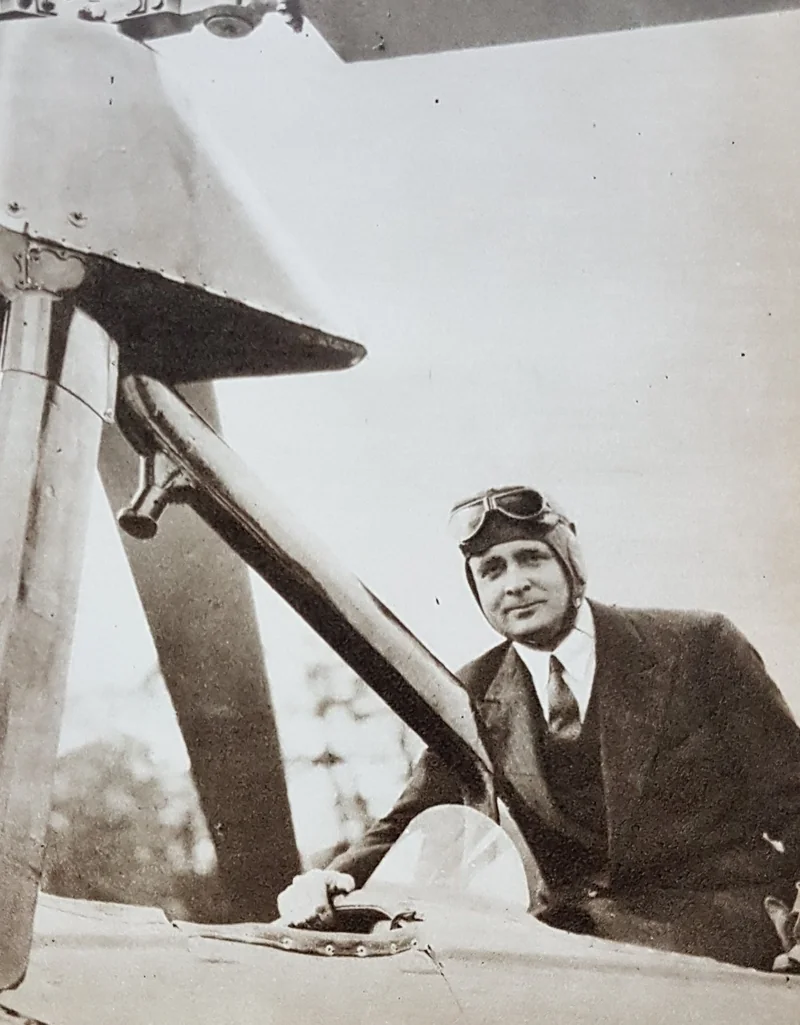
On 7 March 1934, Cierva flew a C.30 registered G-ACIO from Manises out over the harbour of Valencia and landed it on a marked area on the deck of the Spanish Navy's seaplane carrier Dédalo. Half an hour later he took off again after a run of about 24 metres. It was the first time a rotary-wing aircraft had landed on and taken off from a ship. Spain would not see a helicopter land on one of its warships until 1955.
The C.30 became the most successful autogiro of all, built under licence in Britain, France and Germany.
Croydon, 9 December 1936
Cierva's last months were tangled up in the Spanish Civil War, during which he used his contacts in Britain to help the Nationalist side obtain aircraft and supplies. On the morning of 9 December 1936 he boarded a KLM DC-2 at Croydon bound for Amsterdam. After a fog delay, the airliner took off at about 10:30, drifted off course and flew into a house on rising ground south of the airfield. Fifteen people died, Cierva among them. He was 41.
The irony is hard to miss: the man who spent his life making low-speed flight safer died as a passenger in a fixed-wing airliner, in fog, just after take-off.
What he left behind
Near the end of his life Cierva had accepted that the future belonged to the helicopter. The helicopter that eventually arrived was built on his work. Focke-Achgelis, a Cierva licensee, flew the experimental Fw 61 helicopter in 1936 using technology developed for the autogiro. The articulated rotor, with blades free to flap, became standard rotorcraft engineering. If you have ever flown in a helicopter with a fully articulated rotor head, you have flown on a Spanish civil engineer's hinge.
And the autogiro never went away. Every gyroplane you see turning its rotor lazily on a Spanish taxiway works on the principle Cierva sketched after watching his bomber fall out of a turn.
Where to see Cierva's machines in Spain
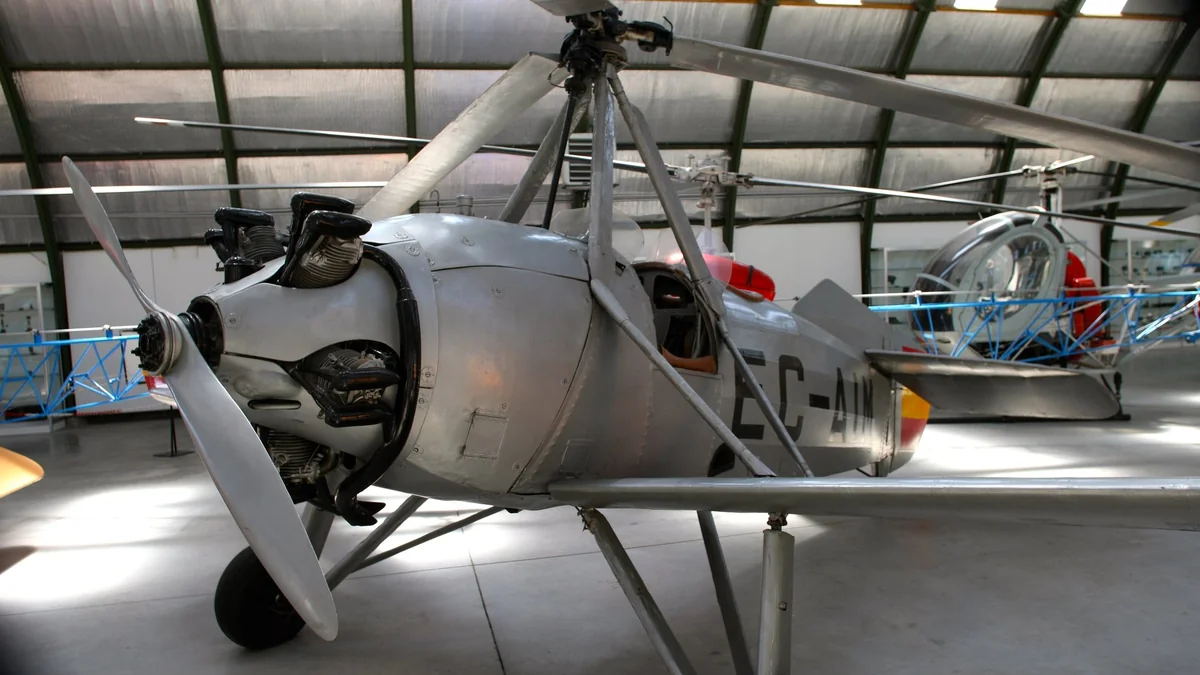
Go to the Museo de Aeronáutica y Astronáutica at Cuatro Vientos, Madrid, the field where the BCD-1 flew, the 1919 bomber crashed and the C.4 gave its military demonstration. Hangar 4 is dedicated to rotary-wing aircraft and lists a Cierva C-6, a C-19 Mk IV-P and a C-30. Stand next to the C-19, look up at those hinged blades, and the whole story makes sense in about ten seconds.
The best lesson from Cierva isn't about rotors. It's about how he responded to an accident: not by blaming the pilot and moving on, but by asking what kind of machine would make that mistake survivable.
FAQ
Who invented the autogiro?
The Spanish engineer Juan de la Cierva (1895–1936). He patented the autogiro in 1920, and his C.4 made the first successful flight of a stable rotary-wing aircraft at Getafe, Madrid, in January 1923.
What is the difference between an autogiro and a helicopter?
In a helicopter, the engine drives the main rotor. In an autogiro (gyroplane), the rotor is not powered in flight: it turns by itself in the airflow (autorotation), while a separate propeller provides thrust. That is why an autogiro cannot hover in still air.
What was Cierva's key invention?
The flapping hinge, which lets each blade rise and fall as it goes round. It cured the dissymmetry of lift that rolled his first three autogiros over, and the principle was later adopted for helicopter rotors.
Sources
- ACAMI: 7 de marzo de 1934, aterrizaje del autogiro en el Dédalo
- Revista Ejército: "Autogiro" (biography, the 1919 bomber accident and the Dédalo trials)
- Biblioteca Virtual de Defensa: Aeródromo de Manises, 1934 (Cierva's visit and the Dédalo landing)
- Rutas Alter Matrice: Juan de la Cierva y Codorníu (the BCD-1 "Cangrejo" and the 1919 trimotor)
- Wikipedia: Cierva C.4 (citing Leishman, Principles of Helicopter Aerodynamics, and Jane's Encyclopedia of Aviation)
- Wikipedia: Juan de la Cierva (Farnborough, the Cierva Autogiro Company, the Croydon accident)
- Wikipedia (ES): Cierva C.30
- Museo de Aeronáutica y Astronáutica: Hangar 4 (rotary-wing collection)
Cover: Cierva C.19 at the Museo de Aeronáutica y Astronáutica (Cuatro Vientos, Madrid). Photo by Agustin Ruzafa, Wikimedia Commons, licensed CC BY-SA 3.0, cropped.
