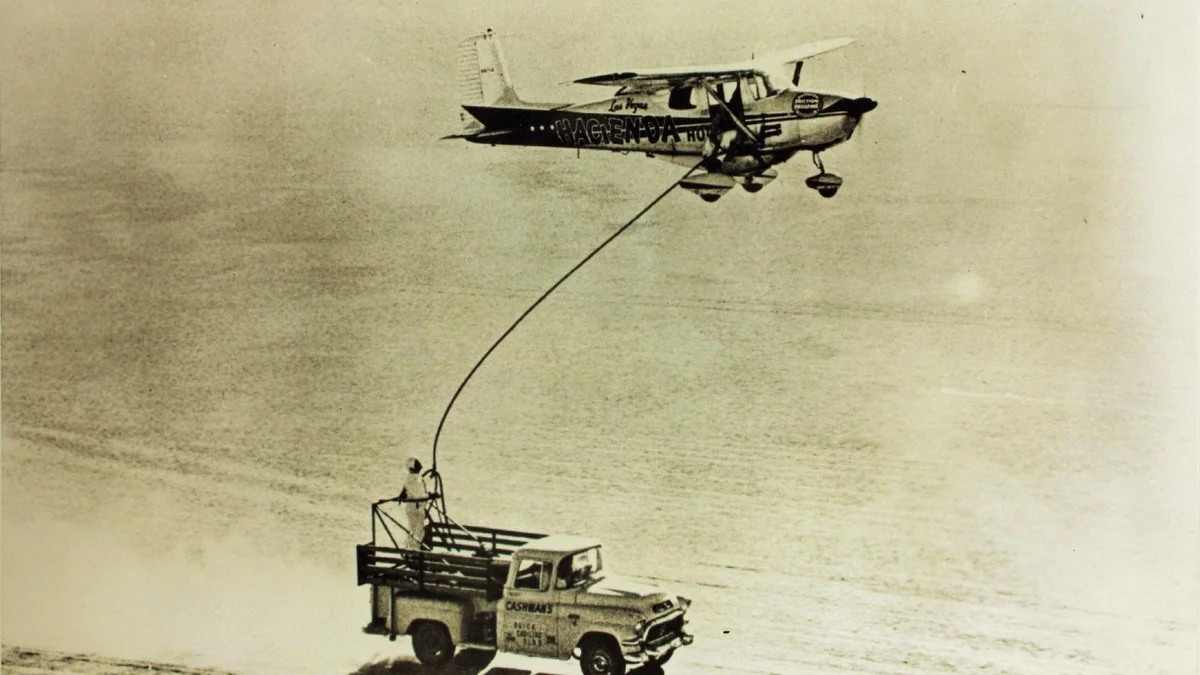
Picture the scene. A straight desert road near Blythe, California, closed to traffic. A Ford truck accelerates with a fuel tank and a pump in the back. About 20 feet above it, matching its speed, flies a Cessna 172 with "Hacienda" painted on the side. A hook comes down on a winch, picks up the hose, and one of the pilots, standing on a little platform outside the door, plugs it into a belly tank. Three minutes later the hose drops back and the Cessna climbs away.
They did that more than 128 times. Between 4 December 1958 and 7 February 1959, Robert Timm and John Cook kept that Cessna in the air for 64 days, 22 hours, 19 minutes and 5 seconds. It's still the Cessna 172 endurance record, and the record for any crewed, refuelled flight of its kind. And it happened in the same type you probably did your PPL on.
Why on earth would anyone do this?
Publicity. The Hacienda was a family-oriented hotel and casino at the southern end of the Las Vegas Strip. Bob Timm worked there as a slot machine mechanic. He'd also flown bombers in the Second World War. He pitched an endurance flight to the owner, Warren "Doc" Bailey, as advertising. Bailey put up $100,000, according to AOPA's detailed 2008 account of the flight.
Endurance flying had been a craze since the 1920s. In 1935 the Key brothers had stayed up for over 27 days in a Curtiss Robin. In September 1958 Jim Heth and Bill Burkhart had just flown their Cessna 172, The Old Scotchman, for 1,200 hours over Dallas: just over 50 days. That was the number to beat.
The aeroplane: a stock 172, mostly
The aircraft was a 1958 Cessna 172, N9172B, with about 1,500 hours on the airframe. Mechanic Irv Kuenzi spent nearly a year modifying it:
A 95 US gallon belly tank, with an electric pump to transfer fuel to the wing tanks. Total capacity was 142 gallons.
Plumbing through the firewall so the engine oil and filters could be changed with the engine running.
The interior stripped out, the right seat removed and a 4 ft by 4 ft foam mattress fitted in its place.
A folding door on the co-pilot side and a small platform that could be lowered outside for refuelling.
A small stainless steel sink, for washing and shaving.
A Narco Omnigator Mk II and a Mitchell wing-leveller autopilot, which would matter later.
The FAA granted a waiver to operate 350 to 400 lb above maximum take-off weight. Hold that thought: an overweight 145 hp Cessna over hot desert terrain is not a performance machine.
The engine story nobody told the pilot
Timm wanted an alcohol injection system to stop carbon building up in the cylinders. Kuenzi thought it was a bad idea but fitted it. The first attempts ended early, and on the third the "special" new engine supplied by Continental burned its exhaust valves. Kuenzi refitted the original engine, which had about 450 hours since new. Then, without telling Timm, he quietly disconnected the alcohol line and routed it to dump overboard through the bottom of the cowling.
That engine ran for 1,559 hours continuously during the record flight. As AOPA tells it, the sales manager at Continental had dealt with the "special engine" request by asking an office employee to walk down to the production line and pick the one she liked best.
Life in a Cessna for two months
Timm and Cook swapped flying duty every four hours. The Hacienda's chefs cooked proper meals, then chopped them up small enough to fit into thermos jugs to be winched aboard. Water for washing came up every other day, a quart at a time. To pass the hours they read comics, did exercises and played games like guessing how many cars they'd pass in the next hour.
Some moments were funnier on the ground than in the air. On 12 January 1959, after refuelling, Timm stepped out onto the platform naked for a sponge bath. Cook noticed the aircraft wasn't going to clear a ridge with the platform down and yelled at him to pull it in. They cleared it. After that, they kept personal hygiene for flat terrain.
The hour nobody was flying
This is the part every pilot should read twice. On the 36th day, 9 January, Timm fell asleep over Blythe at 02:55 in the morning, minutes before he was due to wake Cook. He woke at about 04:00, halfway to Yuma, in a canyon, heading south. The wing-leveller autopilot had kept the aeroplane upright for more than an hour. He later told a reporter he flew for two hours before he recognised any lights, and he vowed never to tell Cook.
Two experienced pilots, a carefully planned operation, a support crew on the ground. Fatigue still got through. Sleep in a vibrating, noisy cabin is poor sleep, and after weeks of it the body simply takes what it needs.
Things break
The generator failed on day 39. From then on, fuel had to be moved from the belly tank to the wings with a hand pump. A wind-driven generator was fitted to the strut, with limited output. Soon after came the refuelling they had dreaded most: a moonless night in mid-January. Cook taped a torch to the hook and lowered it, while Timm held the Cessna a few feet above the truck. The ground crew had sent a second "pathfinder" truck about 300 feet ahead to give him something to see. Cook's journal called it "as black a night as I have ever seen".
They broke the existing record on 23 January and decided to keep going, to make the new one hard to beat. By the end, Cook listed what was gone: generator, tachometer, autopilot, cabin heater, landing and taxi lights, belly tank fuel gauge, electric fuel pump and winch. Carbon was building up in the cylinders and plugs, and climbing with a full load was getting hard.
One take-off, one landing
On 7 February 1959 they landed back at McCarran Field, Las Vegas. Before the start, officials had painted white stripes on the tyres from a speeding Ford Thunderbird as Timm flew low over it. That way nobody could secretly land and take off again without it showing. Timm and Cook had to be helped out of the aeroplane. Cook's verdict: "there sure seemed to be a lot of fuss over a flight with one takeoff and one landing."
The aircraft later went to Canada. Timm's son Steve found it on a farm in Saskatchewan and brought it back to Las Vegas in 1988. According to AOPA, it was restored and hung in the baggage claim area of the airport, today Harry Reid International.
What a stunt can teach a weekend pilot
Fatigue doesn't ask permission
Timm didn't decide to sleep. Most of us will never fly for 64 days, but we will fly after a short night, a long working week or a hot afternoon. Treat tiredness like weather: assess it before the flight, and have a plan if it builds up during the flight.
Automation buys time, not safety
A simple wing leveller saved that flight. It didn't find the way, avoid terrain or wake anybody up. Use the autopilot as a tool to lower your workload, not as a second pilot.
Weight and terrain go together
Cook's journal records being "stalled out, overloaded" while turning on an uphill slope with a full belly tank. It's a reminder that a heavy aircraft and rising ground need room, a sensible airspeed and an escape route planned before you need it. The same applies in a summer valley in the Pyrenees. Your next flight won't last 64 days, but the same discipline applies. If you fly a 172, check the numbers before you go: our Briefing tool works out weight and balance and performance from the POH, and our Cessna 172 weight and balance guide walks you through it by hand.
Know what "normal" sounds like
The crew tracked every failure and every loss of performance. Noticing small changes early is still the best engine monitoring system most of us have.
FAQ
What is the longest flight ever in a Cessna 172?
64 days, 22 hours, 19 minutes and 5 seconds, flown by Robert Timm and John Cook from 4 December 1958 to 7 February 1959, starting and ending at McCarran Field, Las Vegas.
How did they refuel the Cessna 172 in flight?
From a Ford truck driving along a straight, closed desert road. The Cessna flew just above it, winched up the fuel hose and filled a 95-gallon belly tank in about three minutes, usually twice a day.
How far did they fly?
The distance is usually given as about 150,000 miles (around 240,000 km), roughly six times around the Equator.
Has the record been broken?
No. It still stands as the endurance record for a refuelled, crewed propeller aircraft of this kind.
Cover: N9172B takes on fuel from the Ford chase truck during the 1958-59 endurance flight. Photo: San Diego Air and Space Museum Archives, via Wikimedia Commons, no known copyright restrictions, cropped.
