At 05:15 on 17 July 1938, a scruffy nine-year-old Curtiss Robin took off from runway 06 at Floyd Bennett Field, Brooklyn. The pilot had filed to fly home to Long Beach, California. The airfield manager had told him he could use any runway he liked, as long as he didn't take off to the west, towards the administration building.
He didn't. He took off east and kept going east for the next 28 hours and 13 minutes. Then he landed at Baldonnel, near Dublin, climbed out and, so the story goes, announced that he must have flown the wrong way.
That's Wrong Way Corrigan, one of aviation's best jokes. He never admitted it was a joke. And there's a serious lesson hidden inside it.
Who was Douglas Corrigan?
Born Clyde Groce Corrigan in Galveston, Texas, in 1907, he took his first ride in a Curtiss Jenny in 1925 for $2.50 and soloed in March 1926. Then he went to work at Ryan Aeronautical in San Diego. There, according to his Wikipedia biography, he assembled the wing and installed the fuel tanks and instrument panel of a rather famous aircraft: Charles Lindbergh's Spirit of St. Louis. He pulled the chocks when Lindbergh left San Diego for New York.
After Lindbergh's flight in May 1927, Corrigan wanted to do the same thing. His destination of choice was Ireland, the land of his ancestors.
The aeroplane nobody would approve
In 1933 he bought a used 1929 Curtiss Robin for $310. He fitted it with an engine built from two old Wright Whirlwind J6-5 engines, giving 165 hp instead of the original 90. He added extra fuel tanks, so many that he could only see out of the sides. There was no radio. His compass was 20 years old.
In 1935 he applied to the Bureau of Air Commerce for permission to fly nonstop from New York to Ireland. Refused: the aircraft wasn't considered sound enough. He modified and reapplied for two years. By 1937 the licence wasn't even renewed, because the aeroplane was considered too unstable. In July 1938 he got an experimental licence and permission for a transcontinental flight, with conditional approval for the return.
He flew from California to New York in 27 hours, cruising at 85 mph to save fuel. A fuel leak developed on the way, filling the cockpit with fumes. In New York, he decided there was no time to fix it.
28 hours and a screwdriver
He took off with 320 US gallons of fuel and 16 of oil. After about 10 hours, his feet got cold: fuel from the leaking tank was sloshing on the cockpit floor. He took a screwdriver and punched a hole through the floor so the fuel would drain away on the side opposite the hot exhaust.
Corrigan later claimed he only noticed his "error" after about 26 hours of flying. That doesn't sit well with the fuel on the floor at hour 10, or with the fact that he said he increased engine speed by almost 20% to shorten the flight. His provisions for the trip were two chocolate bars, two boxes of fig bars and a quart of water.
The journalist H. R. Knickerbocker, who saw the aircraft in Dublin, wrote that the nose of the engine cowling was "a mass of patches" and the door was held together with baling wire. He called it "the most wretched-looking jalopy".
The punishment, and the parade
The authorities sent a 600-word telegram listing the regulations he'd broken, at a time when telegrams were charged by the word. His certificate was suspended for 14 days. He and the Robin came home on the liner Manhattan, arriving on 4 August, the last day of his suspension. New York gave him a ticker-tape parade on Broadway. Hollywood made a film, The Flying Irishman, with Corrigan playing himself. He endorsed a wristwatch that ran backwards. To the end of his life, he stuck to his story.
The lesson: 180-degree errors are real
Corrigan's "mistake" was almost certainly deliberate. The mistake he claimed is not a joke at all. Reciprocal and gross heading errors have caught out real crews, and the typical ingredients haven't changed since 1938: a misread number, an instrument nobody cross-checked, and a pilot who believes the plan more than the evidence.
Varig 254: the decimal point
On 3 September 1989, a Varig Boeing 737 left Marabá, Brazil, for Belém. The flight plan heading read "0270". It was meant as 027.0°. The captain read it as 270° and set due west. The first officer, instead of checking his own flight plan, copied the captain's setting. The aircraft flew deep into the Amazon. Later, the crew tuned a beacon that shared a frequency with a station hundreds of miles away and didn't catch that its Morse identifier was wrong. The 737 ran out of fuel and made a forced landing in the jungle. Twelve people died.
Every link in that chain has a light-aircraft version.
How 180-degree errors happen in a light aircraft
Direction indicator not set, or drifted. Set it to the compass in straight and level flight, and check it every 10 to 15 minutes.
Reciprocal track on the chart. You measured 075° and wrote 255°, or read the wrong side of the protractor.
VOR TO/FROM confusion. Flying a radial with the wrong TO/FROM flag gives you reverse sensing, and the needle "corrects" you further off course.
GPS direct-to the wrong waypoint. Similar names or codes, picked from a list in a hurry.
Unidentified navaids. Varig's crew trusted a beacon they hadn't identified.
Gross error checks that cost nothing
Does the heading make sense? Before take-off, say it out loud: "Destination is north-east, heading 040, roughly towards the mountains." If the DI says 220, something is wrong.
Use the sun. Around solar noon (in mainland Spain, between about 13:00 and 14:45 local time, depending on the season and how far west you are) the sun is due south. If you're "flying north" with the sun in your face, stop and think.
Know your first checkpoint and when it should appear. If it doesn't show up within a few minutes of the planned time, don't press on hoping. Check your heading against the compass and the map.
Cross-check two independent sources. Compass and DI, GPS and the chart, the ground and the plan.
Always identify navaids. Listen to the Morse ident. Every time.
Distrust a smooth, confident plan. The more certain you feel, the more worth it is spending 30 seconds checking.
FAQ
Why is Douglas Corrigan called "Wrong Way"?
Because in July 1938 he took off from New York with a flight plan for California and landed in Ireland, claiming he had made a navigation error.
Did Wrong Way Corrigan really get lost?
Almost certainly not. He had been refused permission to fly the Atlantic and had prepared his aircraft for it, but he never publicly admitted the flight was deliberate.
What aircraft did Corrigan fly?
A 1929 Curtiss Robin monoplane he rebuilt himself, with a 165 hp engine assembled from two old Wright Whirlwind J6-5s and extra fuel tanks.
How long did Corrigan's flight to Ireland take?
28 hours and 13 minutes, from Floyd Bennett Field in Brooklyn to Baldonnel Aerodrome, near Dublin, on 17 and 18 July 1938.
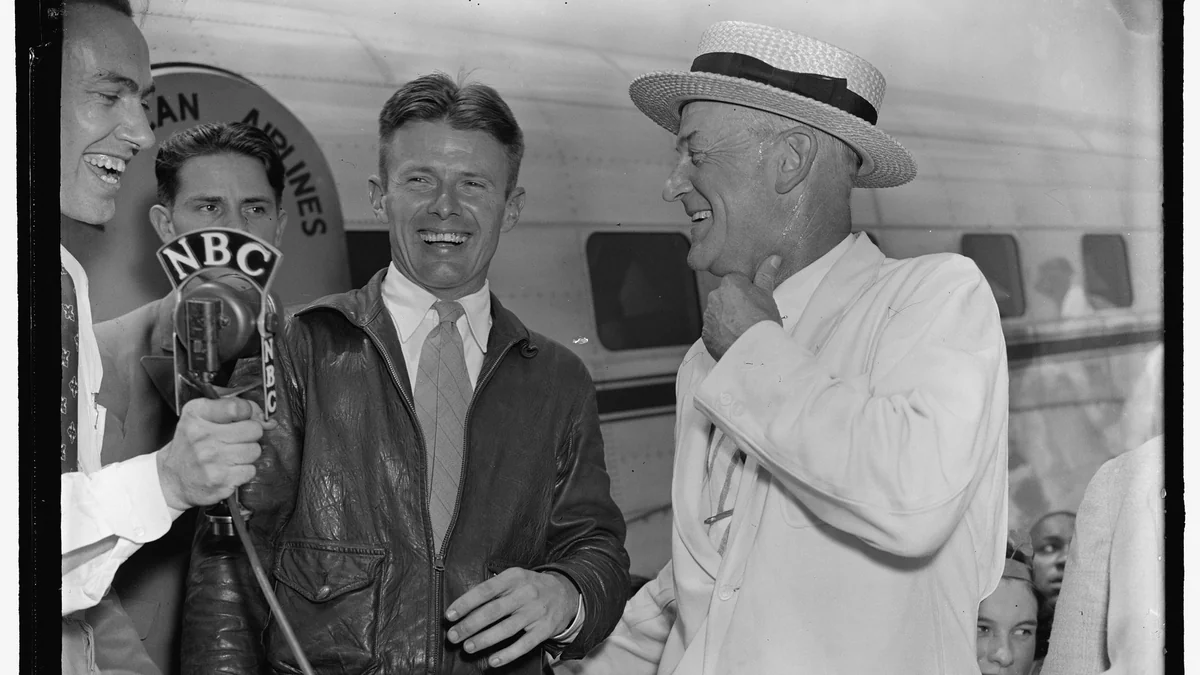
Cover: Douglas "Wrong Way" Corrigan at an airport in 1938, with an American Airlines DC-2 behind. Photo: Harris & Ewing, Library of Congress, via Wikimedia Commons, public domain, cropped.
Sources
Douglas Corrigan, That's My Story, E. P. Dutton, 1938
