Listen to any busy frequency for five minutes and you'll hear grown professionals talking like pirates. "Climb flight level one-tree-zero." "QNH one-zero-one-fife." "Squawk four-five-two-niner."
Nobody is being cute. Those pronunciations are written into the ICAO standard, and the words around them (Alfa, Bravo, Charlie...) are the survivors of a surprisingly serious piece of research involving a linguistics professor in Montreal, a psycho-acoustics lab at Harvard and comprehension tests with speakers from 31 nations. The alphabet you learned for your radio licence was not invented in an afternoon. It was argued over for the best part of a decade.
Before Alfa, there was Able
Spelling alphabets started on bad telephone lines, long before aircraft had radios. The first internationally recognised one for non-military use was adopted by the CCIR, a forerunner of today's ITU, in 1927. After changes in 1932 it was taken up by the International Commission for Air Navigation (ICAO's predecessor) and used in civil aviation until the Second World War.
The war scrambled everything. The United States adopted the Joint Army/Navy alphabet in 1941, known as "Able Baker" after its first two words, and the RAF used something similar. In 1943 the US and UK combined their systems so their forces could talk to each other. Along the way the US military asked Harvard's Psycho-Acoustic Laboratory to work out which words survived best on "military interphones in the intense noise encountered in modern warfare". Many of the military words turned out to be poor; some commercial ones did better.
After the war, ICAO adopted Able Baker for international aviation in 1946. There was an obvious problem: it was built around English sounds. Latin America was using its own alphabet, known as "Ana Brazil". A pilot from Madrid or Buenos Aires had every right to ask why spelling a callsign should require pronouncing English like a native.
The linguist's rules
In 1947 IATA proposed a draft with sounds common to English, French, Spanish and Portuguese. Between 1948 and 1949, Jean-Paul Vinay, a linguistics professor at the Université de Montréal, worked with ICAO on a new alphabet. ICAO's criteria for each word were strict. It had to:
- be a live word in each of the three working languages (English, French and Spanish);
- be easily pronounced and recognised by airmen of all languages;
- have good radio transmission and readability characteristics;
- have a similar spelling in at least English, French and Spanish, with the right initial letter;
- be free from any association with objectionable meanings.
The result was adopted on 1 November 1951 and came into force for civil aviation on 1 April 1952. It did not survive contact with real radios for long.
Coca, Metro, Nectar, Union, Extra
Users soon found that some of the new words were easy to confuse: Delta and Extra, Nectar and Victor. Some operators were unhappy enough to go back to Able Baker. ICAO reopened the work in 1952, and tests were run with speakers from 31 nations, mainly by the UK and US governments. One of the more useful findings was that noise doesn't create new confusions so much as amplify the ones already built into the word list.
The final fix was surprisingly small. Only five words were replaced, those for C, M, N, U and X: Coca became Charlie, Metro became Mike, Nectar became November, Union became Uniform and Extra became X-ray. ICAO sent a recording of the new alphabet to its member states in November 1955, and the version we use today took effect on 1 March 1956. NATO, which had been working in parallel, adopted it the same day.
A 1955 NATO memo explains why nobody has tinkered with it since: changing one word means reconsidering the whole alphabet, because a fix for one pair of letters can easily create a new confusion somewhere else. Since 1956 the code words have stayed the same.
Why "Alfa" and "Juliett" look misspelt
If you have ever been corrected for writing "Alpha", here is the reason. The official spelling is Alfa because speakers of some languages would not know that "ph" is pronounced as "f". And it's Juliett with two Ts because French speakers might treat a single final T as silent and say "Julie". Both quirks are there for exactly the kind of non-native speaker the alphabet was designed for, which, in Spain, includes most of us on the frequency.
So why "niner"?
The ICAO standard gives a modified pronunciation for a handful of numbers:
| Digit | ICAO pronunciation |
|---|---|
| 3 | TREE |
| 4 | FOW-er |
| 5 | FIFE |
| 9 | NIN-er |
| 1000 | TOU-SAND |
The usual explanations are practical. "Tree" avoids three being mangled into something like "sri" by speakers who struggle with the "th" (the same logic gives us "tousand"). The long "fower" keeps four apart from "for". "Fife" swaps the V in five for an F, because "five" can sound like "fire", which is the last word you want misheard in a military context.
Niner is the famous one, and the explanation you will hear in every crew room is that "nine" sounds like the German nein ("no"). That idea does appear in the literature, but we couldn't find it stated as the official rationale in the ICAO material we checked, so treat it as plausible rather than proven. There is also a simpler practical argument: on a scratchy radio, "five" and "nine" share the same long vowel and can blur together. Adding a syllable to nine and changing the consonant in five pulls them apart.
Whatever the origin, it works. "Two-five" and "two-niner" are very hard to confuse even in a noisy cockpit, and on a QNH or a squawk code that's exactly the point.
A word you already know: Mayday
The distress call is older than the alphabet. In the early 1920s Frederick Stanley Mockford, the officer in charge of radio at Croydon Airport, was asked for a distress word that every pilot and ground station would understand. Much of the traffic was between Croydon and Le Bourget in Paris, so he chose "Mayday", from the French m'aider ("help me"). It was introduced on cross-Channel flights in February 1923, because "SOS" didn't work well by voice: the letter S is hard to make out over a telephone. The 1927 International Radiotelegraph Convention in Washington then adopted it as the radiotelephone distress call.
How to use it well in the cockpit
- Say the full callsign first. Under ICAO rules, an aircraft registered EC-ABC can only shorten its callsign to "Echo Bravo Charlie" (first character plus at least the last two) after the ground station has used the abbreviated form first.
- Digits, one at a time. Squawks, frequencies and runways are read digit by digit: "squawk seven-zero-zero-zero", "runway one-three".
- Don't improvise. "B as in Barcelona" might feel friendly, but the whole value of the alphabet is that every controller in the world expects the same 26 words.
- Know the local variations. They exist. In 2013 it was reported that some controllers at Atlanta avoided "Delta" because it is also the callsign of Delta Air Lines. In Indonesia, "Lima" is sometimes replaced because lima means five in Malay. If you hear something unexpected abroad, ask.
And if you're preparing for a trip, a clean flight plan and a written frequency list make the radio side much easier. Our VFR planner helps with the route and reporting points; the alphabet you'll have to practise yourself.
FAQ
Why do pilots say "niner" instead of "nine"?
Because the ICAO radiotelephony standard specifies "NIN-er" to keep nine distinct from other numbers, especially five, on poor-quality radio. The popular explanation that it avoids confusion with the German "nein" is widely repeated but hard to trace to an official ICAO rationale.
Is it "Alpha" or "Alfa"?
The official ICAO spelling is Alfa, so speakers who don't read "ph" as "f" pronounce it correctly. Likewise it is Juliett, not Juliet.
When was the current phonetic alphabet adopted?
ICAO's current version took effect on 1 March 1956, after a 1951 version was found to have confusable words. The 26 code words have not changed since.
Who designed the aviation phonetic alphabet?
No single person, but the Montreal linguist Jean-Paul Vinay did key work with ICAO in 1948 and 1949, building on wartime research including tests at Harvard, and the final changes came from comprehension tests with speakers of 31 nationalities.
Sources
- Wikipedia: NATO phonetic alphabet (history, citing ICAO, NATO archives and L.J. Rose, ICAO Bulletin, 1956)
- NATO: The NATO phonetic alphabet, Alfa, Bravo, Charlie...
- NATO archives: SGM-675-55, Phonetic Alphabet for NATO Use (1955)
- Wikipedia: Spelling alphabet (comparison tables, including the 1949 ICAO and 1951 IATA word lists)
- Wikipedia: Mayday (citing The Times, 2 February 1923, and the 1927 Washington Radiotelegraph Convention)
- SKYbrary: Aircraft Call Sign (ICAO Annex 10, Vol II, Chapter 5 rules on abbreviation)
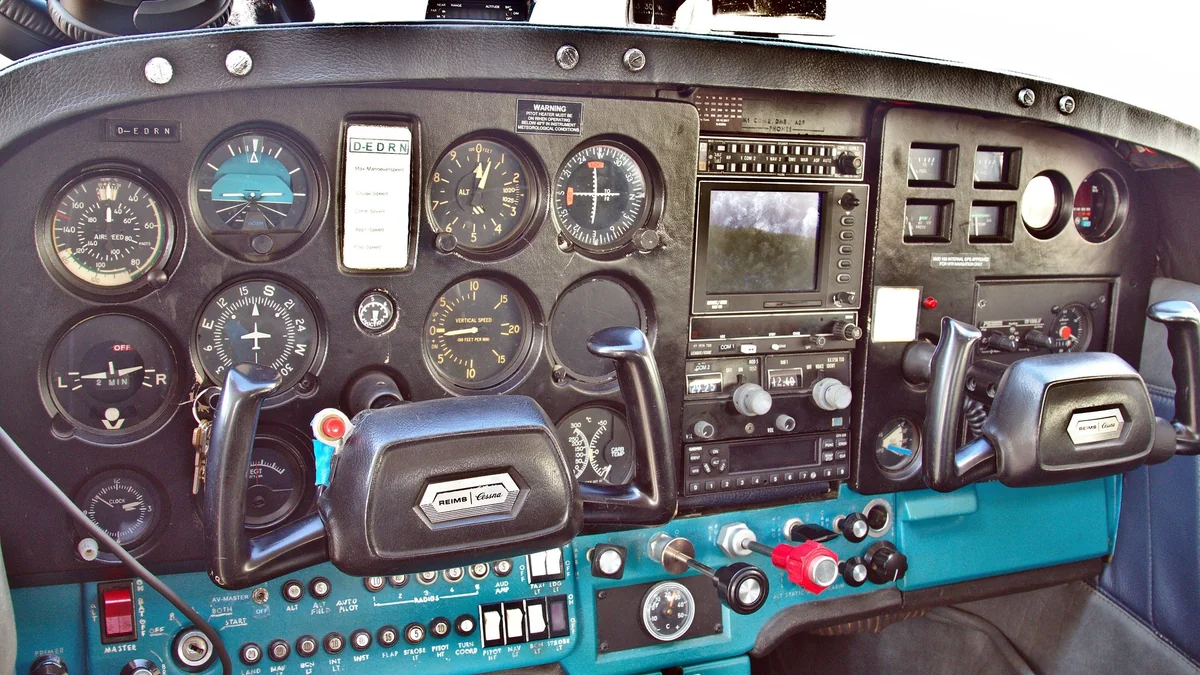
Cover: Cessna 172 cockpit. Photo by Jacek Rużyczka, Wikimedia Commons, licensed CC BY-SA 4.0, cropped.
