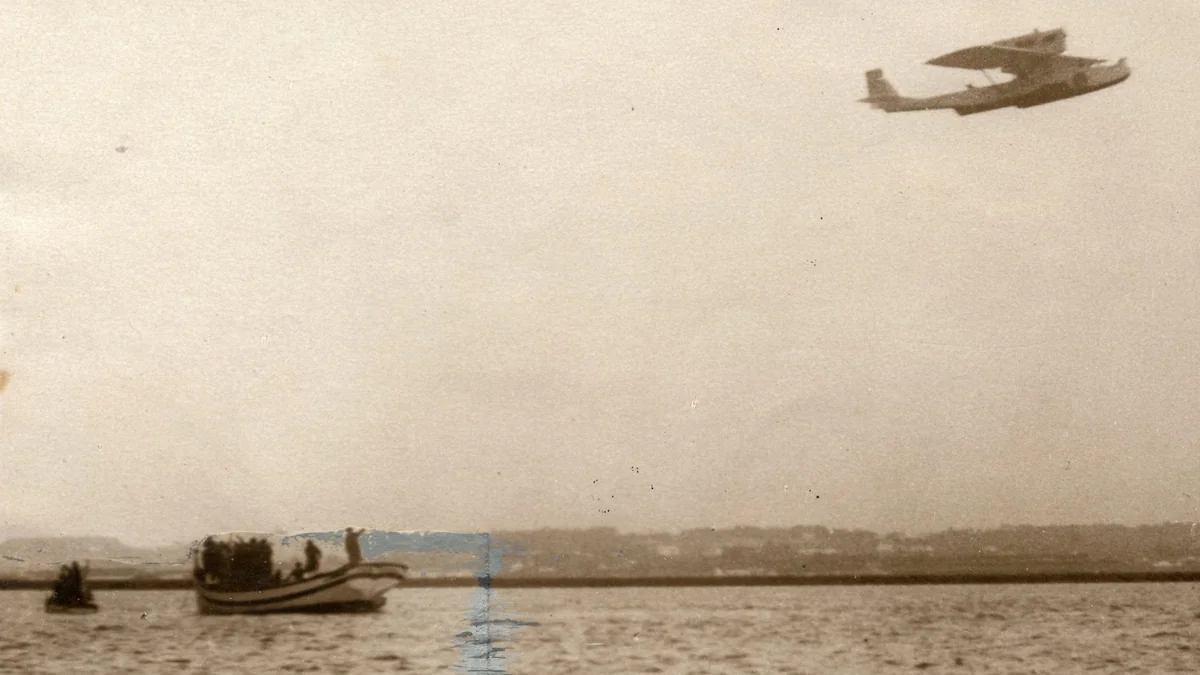
Somewhere south of the Canary Islands, in January 1926, Ramón Franco was looking for an island he could not see. The air was full of fine dust blown off the Sahara. Years later every Canary Islands pilot would call it calima. In his own account, quoted by the Spanish government magazine Carta de España, he wrote that they did not see the island of Sal, in Cape Verde, until they were directly over it. What gave it away was the white line of surf breaking on the rocks.
No GPS, no VOR, no ATC. Just a compass, a clock, charts, a radio direction finder that was new and not entirely trusted, and an open cockpit. That was the Plus Ultra flight: Spain to Buenos Aires in a German flying boat, 10,270 km in seven legs, and one of the great navigation stories of the 1920s.
The aircraft: a "whale" with two engines in line
The Plus Ultra was a Dornier Do J Wal (Wal means whale), registered M-MWAL and carrying the military serial W-12. Its two Napier Lion engines of 450 hp sat in tandem above the wing: one pulling, one pushing. The pilots sat side by side in the open, with the radio behind them. Its broad metal hull carried stubby sponsons instead of wing-tip floats, which made it stable on the water.
The Spanish-language Wikipedia article lists a 22.5 m span, 4,000 litres of fuel and a maximum take-off weight of 5,700 kg. Keep those numbers in mind. For the longest leg of the trip, weight became the whole story.
The crew
Comandante Ramón Franco, pilot and leader of the expedition, an experienced seaplane pilot from the war in Morocco.
Capitán Julio Ruiz de Alda, second in command.
Teniente de navío Juan Manuel Durán, the Navy's man on board.
Pablo Rada, the mechanic from Navarre, who would end up repairing a propeller over the ocean.
Ramón Franco was the younger brother of Francisco Franco, and his later political life was turbulent. This article is about the flight.
Seven legs, from Palos to the River Plate
They took off on 22 January 1926 from the Muelle de la Calzadilla at Palos de la Frontera, in Huelva, lifting off the water in front of La Rábida at the mouth of the Río Tinto. That's the same stretch of coast Columbus sailed from in 1492, and nobody involved missed the symbolism. The press called the aircraft "the fourth caravel".
| Leg | Distance | What happened |
|---|---|---|
| Palos de la Frontera to Las Palmas | 1,300 km | About 8 hours; landfall in haze, landed in the Puerto de la Luz at dusk |
| Gando (Gran Canaria) to Porto Praia (Cape Verde) | 1,745 km | 9 h 50 min on 26 January; Sal only seen when overhead |
| Porto Praia to Fernando de Noronha | 2,305 km | The ocean crossing; aircraft stripped of weight; landed with little fuel left |
| Fernando de Noronha to Pernambuco (Recife) | 540 km | 31 January; the rear propeller failed short of the coast |
| Pernambuco to Rio de Janeiro | 2,100 km | 12 h 15 min, arriving on 4 February |
| Rio de Janeiro to Montevideo | about 2,000 km | Arrived 9 February |
| Montevideo to Buenos Aires | 220 km | Landed on the River Plate on 10 February |
Total flying time was a little under 60 hours: sources give 59 h 30 min or 59 h 39 min. Average speed works out at roughly 172 km/h. The route roughly followed the one taken in 1922 by the Portuguese naval aviators Sacadura Cabral and Gago Coutinho, who needed three different aircraft to finish their South Atlantic crossing. The Spaniards did it in one.
Weight is range: the leg that changed the crew
The third leg, 2,305 km of open ocean from Cape Verde to the Brazilian islands, was the one everybody worried about. The only way to carry enough fuel was to take everything else out.
Accounts of the expedition describe what went. Personal luggage, spares, and finally a crew member. Durán, the naval officer, was left at Porto Praia and travelled on the destroyer Alsedo, which was escorting the flight together with the cruiser Blas de Lezo. A Navarrese newspaper's centenary article goes further: charts, signalling gear and even the almanac, cut down to the pages for January and February. Whether every detail is literal or not, the logic is the logic of any long overwater flight. A kilo of anything is a kilo less fuel.
They departed at 06:11 on 30 January. The plan was Pernambuco. They didn't get there that day. According to the Spanish-language Wikipedia account, strong headwinds pushed them off the plan and they put down at Fernando de Noronha, where they found the tanks almost empty. Franco wrote that they landed "without any help from outside" in a bay where nobody seemed to be expecting them. The Alsedo turned up later with tools, spares and Durán, who rejoined for the hop to the mainland.
Every modern pilot knows this situation in miniature: the destination is still possible on paper, the wind is not what the forecast said, and the fuel gauge is starting to argue with the plan.
They chose the island. That's the decision that kept the flight alive.
A propeller over the ocean
The 540 km from Noronha to Pernambuco should have been the easy one. It wasn't. More than 100 km from the coast the rear propeller broke. Accounts based on Franco's own book say that spares, luggage and part of the fuel went over the side as the aircraft lost height. They also say Rada worked on the damaged propeller in flight, and the leg took more than an hour longer than planned. In Pernambuco they rested, repaired the aircraft and fitted a new propeller.
From there it became a victory lap. Franco described the welcome in Rio as "brutal": hundreds of thousands of people, speeches, fireworks, and the crew carried along without their feet touching the ground. Ruiz de Alda called the 12-hour leg a "sport" trip. In Buenos Aires the crowds were so dense that, according to one account, the Argentine Navy minister lost a sleeve of his uniform in the crush.
What a 1926 flying boat can teach a 2026 PPL
1. Landfall is the hard part
Dead reckoning over water gets you to the right area. Finding the actual island, coast or airfield in poor visibility is a separate skill. Franco's problem in Cape Verde was haze, not cloud. It was legal, flyable air that simply hid the target until the last moment. If you fly to the Canaries, along the Andalusian coast in summer or anywhere calima shows up, plan your arrival with that in mind. Use the ground features that stand out in haze: coastlines, surf lines, big roads. Have a time at which you expect to see them, and a plan for when you don't.
2. Diversion is a plan, not a failure
Fernando de Noronha wasn't on the plan for the day. It became the plan when the wind changed the maths. Pick your options before departure, update them in flight, and make the call while you still have the fuel to make it calmly.
3. Know your weight, item by item
The Plus Ultra crew treated weight as fuel, because it was. In a four-seat trainer it's the same trade, only smaller: full tanks or full seats, rarely both. Do the mass and balance properly, not from memory.
4. Mechanical sympathy
Rada wasn't a passenger. A good chunk of the expedition's success came down to a mechanic who knew the engines intimately. Most of us won't be fixing propellers in flight, thankfully. But knowing your aircraft's systems well enough to recognise "not normal" early is the modern version of the same thing.
Where is the Plus Ultra today?
King Alfonso XIII gave the aircraft to Argentina, and it flew mail for the Argentine Navy before being retired. In the 1980s it was shipped back to Spain with the idea of restoring it to fly and repeating the flight. Its condition made that impossible, so it was restored for static display and returned. Today the original is at the Complejo Museográfico Provincial Enrique Udaondo in Luján, near Buenos Aires.
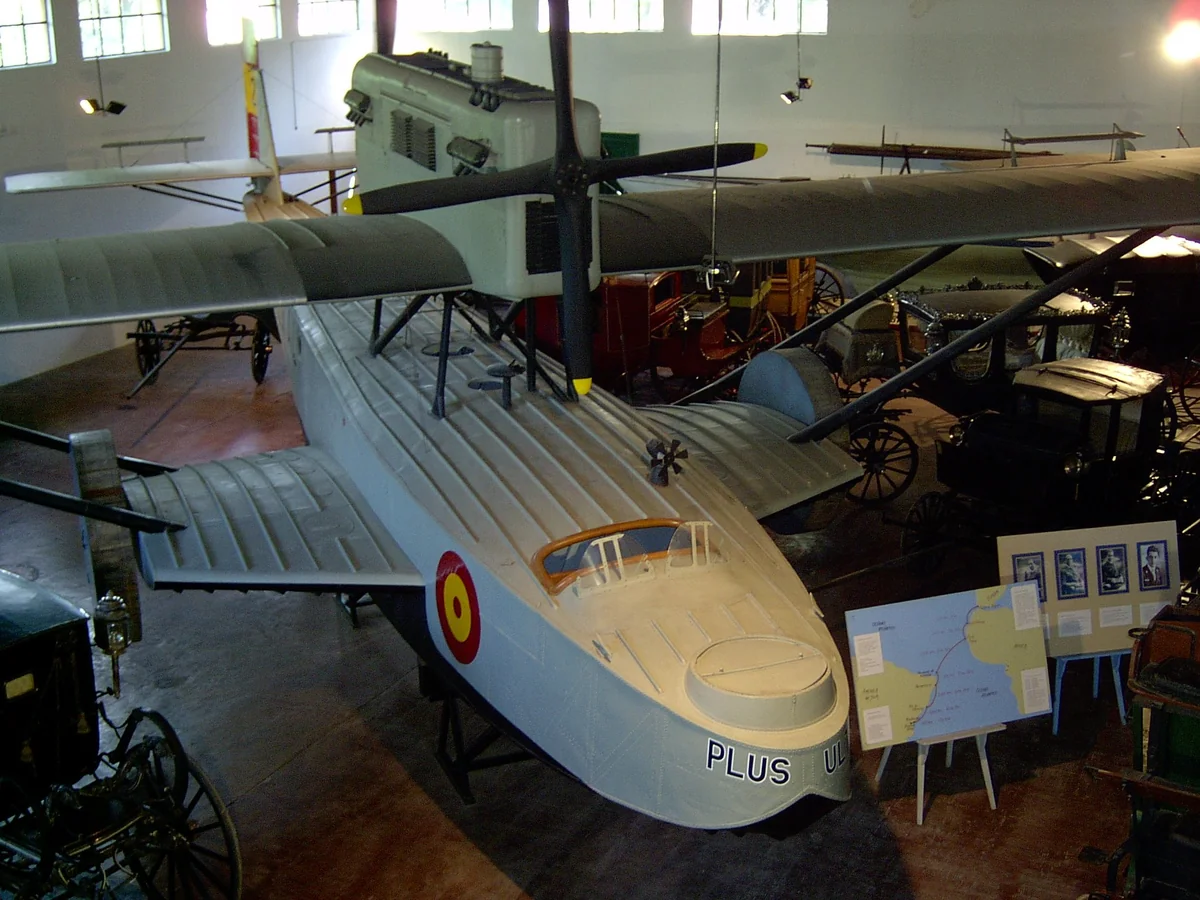
The original Plus Ultra at the Complejo Museográfico Enrique Udaondo in Luján, Argentina. Photo: Jesús Manuel Cuartero (uploaded by Fer31416), Wikimedia Commons, CC BY-SA 3.0.
If you can't get to Argentina, a replica built in 1992 is on display at the Museo de Aeronáutica y Astronáutica at Cuatro Vientos, Madrid. In Huelva, the monument at La Rábida, a gift from Argentina by sculptor Agustín Riganelli, marks the departure point. The flight even got a tango: Carlos Gardel recorded "La gloria del águila" in Barcelona in January 1928.
FAQ
What was the Plus Ultra flight?
The first flight between Spain and South America, made in January and February 1926 by a Dornier Wal flying boat from Palos de la Frontera (Huelva) to Buenos Aires, covering 10,270 km in seven stages.
Who flew the Plus Ultra?
Ramón Franco (pilot), Julio Ruiz de Alda, Juan Manuel Durán and mechanic Pablo Rada. Durán skipped the Cape Verde to Fernando de Noronha leg to save weight.
How long did the Plus Ultra flight take?
It left on 22 January 1926 and arrived in Buenos Aires on 10 February, with a little under 60 hours of actual flying time.
Can you see the Plus Ultra today?
The original is in Luján, Argentina. A replica is at the Museo de Aeronáutica y Astronáutica at Cuatro Vientos, Madrid.
Cover: the Dornier Wal Plus Ultra in 1926. Photo: unknown author, Spaarnestad Photo (SFA022812397), via Wikimedia Commons, public domain, cropped.
