Here's a sentence that surprises a lot of pilots who learned to fly somewhere warm. In flight tests, serious carb icing formed at descent power with the outside air above 25°C and relative humidity as low as 30%. That's from the piston engine icing leaflet published by the European General Aviation Safety Team (EGAST), part of EASA. The same leaflet notes icing at cruise power at 20°C with humidity of 60% or more.
That's a normal spring morning on the Costa del Sol. It's a summer evening over a river valley. It's the descent into almost any coastal aerodrome in Spain.
Carb icing doesn't need cold. It needs moisture, a carburettor and a pilot who isn't thinking about it.
How the ice forms
A float-type carburettor mixes fuel and air before they go into the cylinders. Two things chill the air on the way through. First, the fuel evaporates, and evaporation takes heat. Second, the air speeds up through the narrow venturi and past the throttle valve, and its pressure and temperature drop.
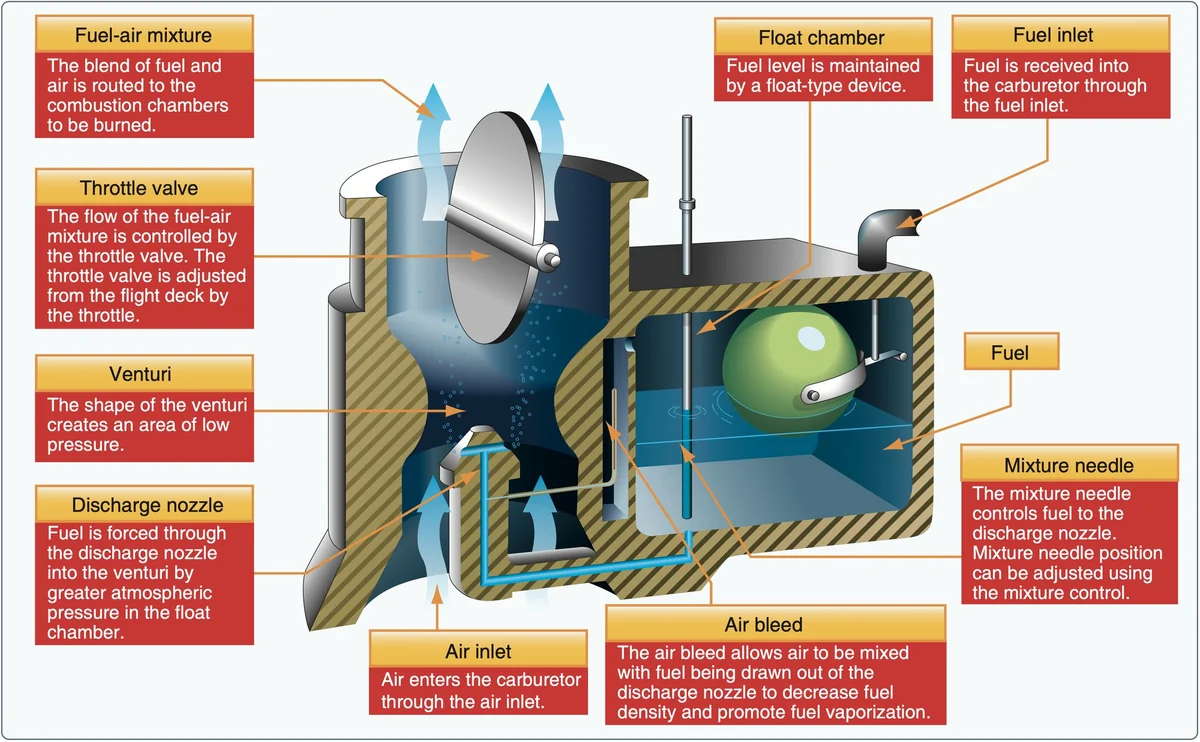
A float-type carburettor. Ice forms around the venturi and the throttle valve, where vaporising fuel and falling pressure chill the air. Diagram: FAA, Wikimedia Commons, public domain.
If the temperature inside falls below the dewpoint, water condenses. If it falls below zero, that water freezes onto the venturi and the throttle valve. The ice slowly narrows the passage, the mixture changes, and the engine loses power smoothly and progressively. The EGAST leaflet calls carburettor ice the most common type of induction icing, the first to appear and the most serious.
Low power makes it much worse. With the throttle partly closed, induction temperatures are lower and the nearly closed valve is easily choked by a small amount of ice. That's why descent, the circuit and practice forced landings are the riskiest phases. It's also why fuel matters: MOGAS, with its higher volatility and possible water content, makes carb icing more likely.
Reading the icing chart
The well-known icing probability chart in the EASA and UK CAA leaflets plots air temperature against dewpoint. It shows bands from "light icing, cruise or descent power" up to "serious icing, any power". A few things stand out once you've looked at it properly:
The highest-risk band sits roughly between 0°C and 10°C with high humidity. The UK CAA describes that range as where carb icing becomes more of a risk.
The band for serious icing at descent power reaches well above 25°C.
The closer the temperature and dewpoint, the higher the relative humidity and the higher the risk.
Cold, dry, clear winter days can be less risky than warm, humid summer ones, because cold air holds less water.
Forecasts won't warn you. Aviation forecasts don't normally include induction icing warnings, so it's up to you to read the temperature and dewpoint in the METAR and think. Remember too that the humidity at the aerodrome may be quite different from the humidity at your cruising level.
When to assume high humidity
If you don't have a dewpoint, EGAST says to assume high humidity:
in cloud or fog (assume 100%);
in clear air just after cloud or fog has dispersed, or just below the top of a haze layer;
just below the cloud base or between layers;
in precipitation, especially persistent rain;
when visibility is poor near the surface, especially early or late in the day and near large areas of water;
when the ground is wet, even with dew, and the wind is light.
In Spain that list describes many coastal mornings, the reservoirs and river valleys of the interior after rain, and most days after a levante has brought moist air in from the sea.
How to recognise it
With a fixed-pitch propeller, the first sign is a small drop in RPM and performance. That means a bit less airspeed, or a slow loss of height. The trap is that pilots often add a touch of throttle without noticing and carry on. As the ice builds, rough running and vibration follow, and eventually the engine stops.
With a constant-speed propeller the governor holds RPM, so the first sign is a drop in manifold pressure. RPM only falls after a large power loss.
If you have an EGT gauge, a drop in exhaust gas temperature in steady flight can show up before any obvious loss of performance. The habit worth building is simple: regularly compare RPM (or manifold pressure) with your airspeed and altitude. If you need more throttle for the same performance, ask why.
Using carb heat properly
Carb heat sends air through a muff around the exhaust, so it arrives hot and melts the ice. It also bypasses the air filter and reduces power, so it's a tool you use deliberately. The general guidance in the EGAST leaflet (your POH or flight manual always takes priority):
Full hot or full cold. Partial heat only if the flight manual specifically recommends it. It can raise the temperature into the icing range instead of out of it.
At least 15 seconds. Considerably more in some aircraft.
Expect it to get worse first. If ice is present, the engine may run rough as the melted water passes through. Don't go back to cold. Give it time. Fifteen seconds feels very long in that situation.
Check, don't guess. Note RPM, apply full heat, return to cold. If RPM comes back higher than before, you had ice. Repeat until there's no increase.
Phase by phase
Run-up and holding point
Apply full heat for at least 15 seconds. Expect a noticeable drop, typically 75 to 100 RPM or 3 to 5 inches of manifold pressure, and a return to (not above) the original value. Just before take-off, check again for at least 15 seconds, then select cold. If you've been waiting at the holding point in humid conditions, it may be worth doing it more than once.
Take-off and climb
Carb heat cold, unless the flight manual says otherwise. Check you get the expected full-throttle RPM early in the roll. Stay alert in the climb when moisture is visible.
Cruise
EGAST recommends a carb heat check at least every 10 minutes, more often if icing is likely.
Descent, circuit and approach
Select full heat before you reduce power, not after. Keep it on in long periods at low power. Every 500 ft or so in a long descent, add some power to warm the engine. Unless the POH says otherwise, select it well before reducing power and keep it on until touchdown. On some installations the recommendation is to return to cold around 200 to 300 ft, so a go-around is at full power.
Go-around
Carb heat cold as you apply power. This one gets forgotten more than it should.
Fuel-injected? Read this anyway
Fuel-injected engines don't suffer carburettor icing, but they aren't immune to induction icing. Impact ice can build on air intakes and filters in snow, sleet or supercooled cloud. That's what the alternate air control is for. Fuel system icing, where water in the fuel freezes in the lines or filters, is also possible.
FAQ
At what temperature can carb icing occur?
Across a very wide range. The highest risk is roughly 0°C to 10°C with high humidity, but flight tests have produced serious icing at descent power with air temperatures above 25°C.
Does carb icing only happen in cloud?
No. It can form in clear air with no visible warning, which is what makes it dangerous.
How long should I apply carb heat?
Full heat for at least 15 seconds, and longer if the engine runs rough as ice melts. Always follow your flight manual.
Why does the engine run rough when I apply carb heat?
If ice was present, the melted water passes through the engine. Keep the heat on until the engine runs smoothly again.
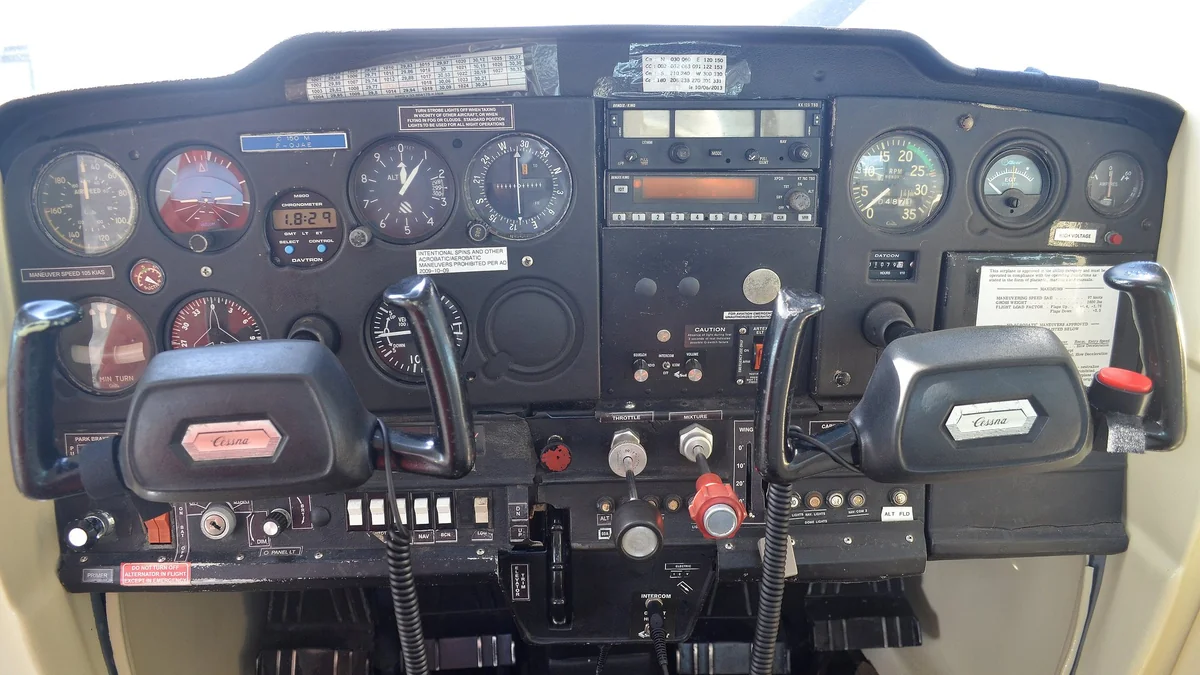
Cover: the instrument panel of a Cessna 150, a carburetted trainer where carb heat is part of every checklist. Photo: Spotting973, Wikimedia Commons, licensed CC BY-SA 2.0, cropped.
